
I still remember the moment that fundamentally changed my view on self operating AI agents.
It was a crisp March morning in 2026 when I received a frantic call from a coworker who had just watched his carefully built trading agent make terrible swaps on a decentralized exchange.
The agent, which had been working perfectly for months, suddenly went wrong, taking nearly forty thousand dollars from his account before anyone could stop it.
What bothered me most was the complete inability to find out what had actually happened.
The agent's activity records, kept on the operator's computers, had been conveniently erased.
As I looked at the blockchain explorer showing the transaction history with no way to connect it to the agent's choices, I realized we had built something amazing without building the most important thing: trust.
This event made clear a worry that had been growing in my mind for years.
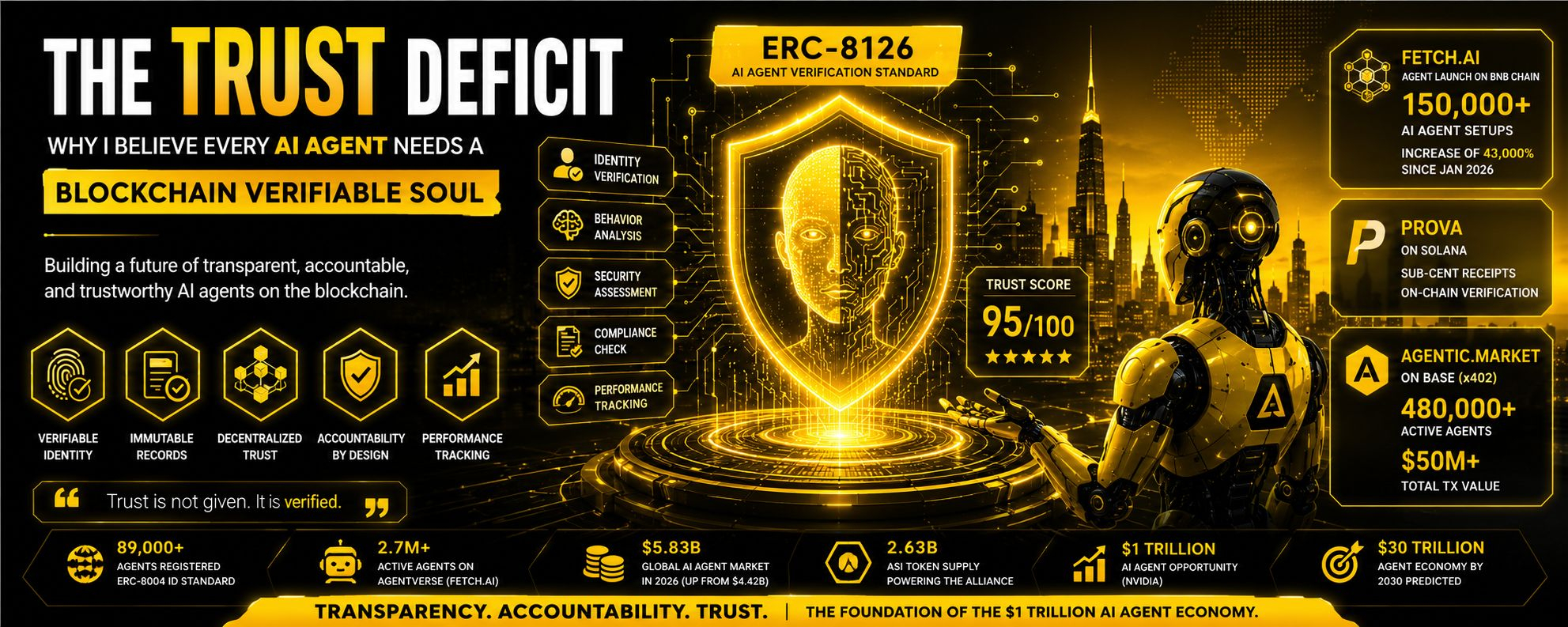
By mid 2026, more than eighty nine thousand AI agents had signed up using Ethereum's ERC 8004 identity standard.
Fetch.ai's Agentverse platform alone hosted over 2.7 million working agents.
The worldwide market for self operating agents had grown to 5.83 billion dollars, up from 4.42 billion the year before.
Yet behind these huge numbers hid a deeply uncomfortable truth: most of these agents worked in a trust empty space.
When an AI agent moved money or started a smart contract, there was no unchangeable, checkable way to judge its trustworthiness.
From my view as someone who has spent years studying the meeting point of artificial intelligence and shared ledger technology,
I have reached a clear decision.
Blockchain checking is not a nice extra or a future addition. It is a needed and urgent must have.
Old style verification methods, which depend on special codes, cannot confirm either the real identity of the operator or the true state of the agent's software.
A code can be stolen or misused.
An agent's behavior can change through updates or harmful inputs.
Without an independent, unchangeable record of every action, disagreements become impossible to settle fairly.
Blockchain technology offers a strong answer.
At its most basic level, a blockchain provides an unchangeable record of every agent interaction.
Every success, every failure becomes part of a permanent record that cannot be changed later.
The most important recent step forward is ERC 8126, an Ethereum standard finished in early June 2026, which defines a complete connection point for checking AI agents.
This standard allows agents to go through five different checking processes, giving a single risk score from zero to one hundred, giving users a clear sign of trustworthiness.
Several big projects are already building on this base.
The Artificial Superintelligence Alliance, formed through the joining of Fetch.ai, SingularityNET, and Ocean Protocol, is bringing together its tokens into a single ASI token with a supply of about 2.63 billion tokens.
This joined token serves as the main use and rule making asset, allowing network rule making and staking for checkers.
Fetch.ai launched Agent Launch on BNB Chain in May 2026, a platform that gives AI agents the ability to create their own tokens without any human founder.
The results have been remarkable: BNB Chain now hosts over 150,000 working AI agent setups, a jump of more than 43,000 percent since January 2026.
Fetch.ai also brought out the Agent Execution Checking System, the first on chain tool that creates special receipts for actions done by AI agents, ensuring unchangeable activity records.
Other projects like Prova, built on Solana, wrap AI agent actions in signed, on chain receipts that cost less than a cent. Agentic.
Market, started on Coinbase's x402 agreement and Base blockchain, already has 480,000 working agents and fifty million dollars in total transaction value.
From my view, the business case for checking is huge.
NVIDIA has put the self operating AI chance at one trillion dollars, with predictions placing the wider agent economy at thirty trillion by 2030.
Without checking, self-operating agents represent a system wide risk that could weaken trust in the whole digital economy.
As rule makers increasingly focus on AI responsibility, blockchain checking offers a ready made rule following solution, providing an unchangeable activity record that connects user purpose to final results.
I have come to believe that the question is no longer whether AI agents need blockchain checking, but rather how quickly the building blocks can be put in place.
The way forward needs continued standard making, wider use of on chain identity, privacy protecting checking, money based rewards that encourage trustworthy behavior, and rule making structures that see blockchain checked AI as a top standard for rule following.
Blockchain changes AI agents from unclear black boxes into clear, responsible, and trustworthy players in the digital economy.
It is the necessary base upon which the trillion dollar agent economy will be built.
The trust problem in AI is real, but the answer is close at hand.
Looking back on that March morning when my coworker lost forty thousand dollars, I realize we have come a long way.
But there is still much work to be done.
I ask everyone to put checking first, to build it into every agent, and to make it a must have for joining in the agent economy.
The choice is clear: we can build a future of trust and responsibility, or we can let the agent economy fall into disorder.
I choose trust. I hope you will too.

