
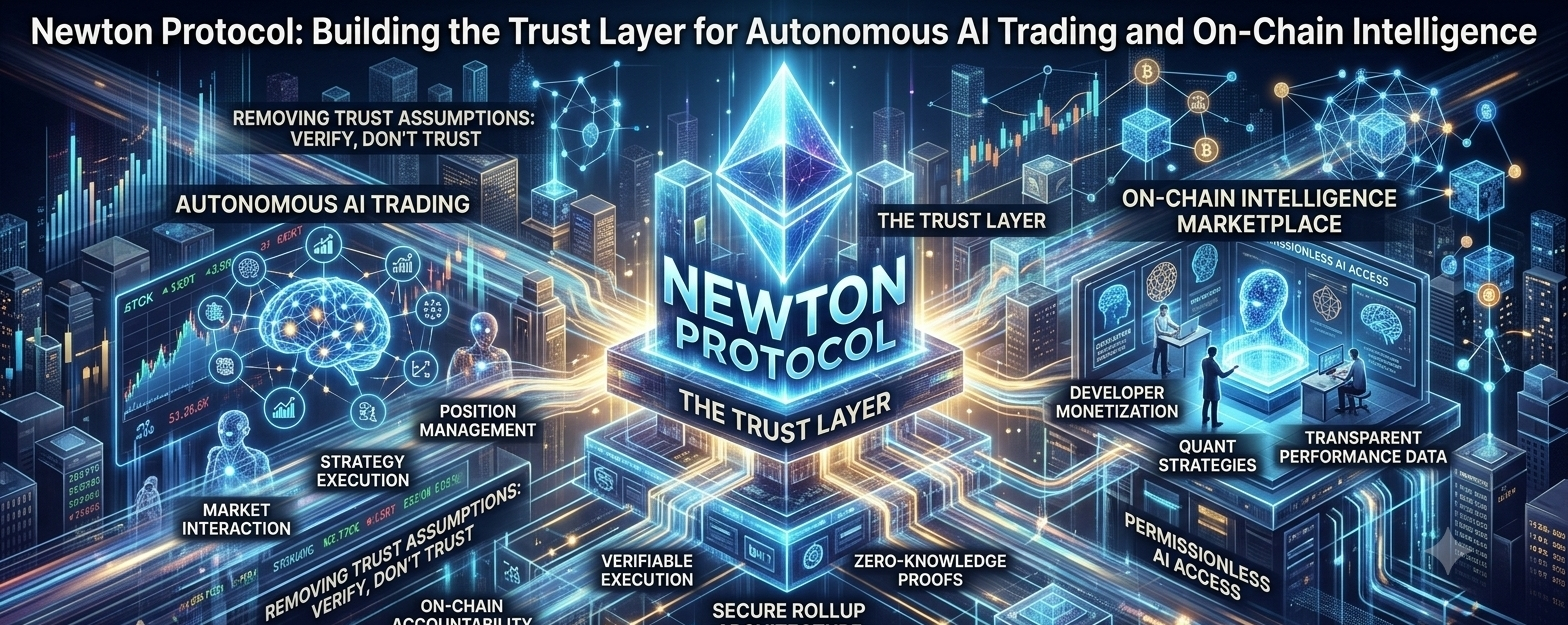

What caught my attention about Newton Protocol ($NEWT) isn't just another "AI + blockchain" headline. We've seen enough of those already. The interesting part, at least from my perspective, is that they're trying to build infrastructure around autonomous agents that actually execute strategies, manage positions, and interact with markets in a verifiable way.
That's a much tougher problem than simply launching an AI chatbot with a token attached to it.
I've spent enough time around crypto to know that automation sounds great until you start asking practical questions. Who controls the strategy? Can users verify what an AI agent is doing? How do you prevent hidden changes in execution logic? And perhaps most importantly, how do you create trust when the decision-maker is software instead of a human trader?
Newton Protocol seems to be approaching this through a secure rollup architecture designed specifically for AI-driven activity. That makes sense to me because AI agents generate decisions continuously, and having an environment optimized for high-frequency interactions could become pretty valuable if adoption grows.
The automated trading angle is also interesting. Most trading bots today operate in isolated environments. Users deposit funds, trust the operator, and hope the strategy performs as advertised. There's usually very little transparency behind the scenes.
A secure execution layer changes that dynamic.
Imagine AI strategies operating with verifiable records, transparent execution history, and on-chain accountability. Suddenly the conversation shifts from "trust my algorithm" to "verify what happened." In crypto, that's a meaningful distinction.
Another aspect I keep thinking about is the marketplace for AI developers. If Newton succeeds in creating a place where developers can publish, monetize, and distribute AI models or trading strategies, that could open up an entirely new ecosystem.
Right now talented quant developers often work behind closed doors or build proprietary systems for hedge funds and private firms. A permissionless marketplace introduces a different incentive structure. Developers gain exposure, users gain access to specialized tools, and performance data becomes part of the product itself.
Of course, there are challenges.
Building reliable autonomous agents is hard enough. Building a decentralized infrastructure where those agents can securely interact with financial markets adds another layer of complexity. Latency matters. Security matters. Economic incentives matter. One weak point can undermine the entire experience.
Still, I think Newton Protocol is attempting to solve a problem that feels increasingly relevant rather than purely speculative.
AI is already influencing market analysis, portfolio management, and execution strategies. The next phase probably isn't just better models. It's creating systems where those models can operate securely, transparently, and at scale.
Whether Newton becomes a dominant player remains to be seen, but I do think the thesis is compelling. Crypto has always been about reducing trust assumptions. Applying that principle to autonomous AI systems feels like a natural evolution.
Maybe that's where things get really interesting — not replacing traders entirely, but building environments where humans and AI can collaborate with clearer rules, better transparency, and stronger guarantees around execution.
