

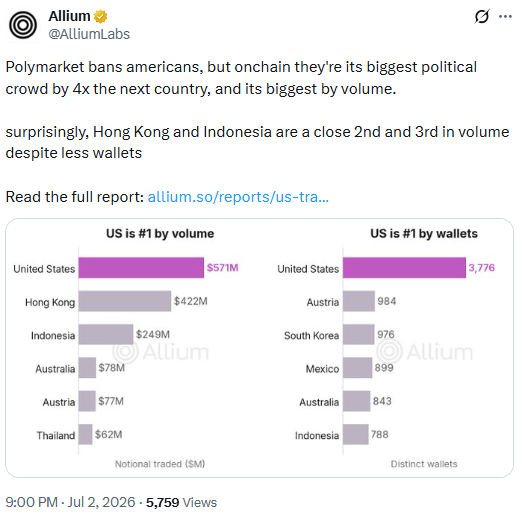
Although Polymarket officially blocks users from the United States, a new analysis suggests the restriction may be far less effective than regulators intended. According to fresh blockchain data, traders linked to the U.S. continue to represent one of the platform's largest and most active user groups.
A report published by blockchain analytics firm Allium indicates that while geo-blocking may have changed how users access the platform, it has done little to reduce overall demand.
U.S. Demand Hasn't Disappeared
In its report released on July 3, Allium analyzed cryptocurrency wallets that could be associated with specific countries. Although the dataset covered only a portion of tagged wallets, the company said the results reveal a clear trend.
Wallets linked to the United States accounted for the largest share of activity on political prediction markets, despite Polymarket officially listing the U.S. as a restricted jurisdiction.
According to the researchers, the restrictions have not eliminated participation—they have simply pushed much of the activity outside the direct reach of U.S. regulators.
Geo-Blocking Faces New Questions
Polymarket's terms of service explicitly prohibit access from the United States and dozens of other restricted jurisdictions. The platform also states that users are not allowed to bypass these restrictions by using VPNs or similar tools.
These policies date back to 2022, when the Commodity Futures Trading Commission (CFTC) ordered Polymarket to pay a $1.4 million civil penalty and shut down markets that failed to comply with U.S. regulations.
Since then, the company has operated a separate product for the U.S. market while continuing to restrict American users from its primary global platform.
Geopolitical Markets Dominate U.S. Interest
The report also highlights notable differences in trading behavior.
Wallets associated with the United States showed a significantly stronger interest in prediction markets related to international conflicts than the broader Polymarket user base. Markets focused on geopolitical tensions involving the United States, Israel, and Iran ranked among the most actively traded, while election-related markets attracted comparatively less attention.
These findings align with earlier independent research conducted by Harry Crane, a statistician at Rutgers University, who estimated that U.S.-based users could account for roughly 30% of Polymarket's total trading volume.
Regulatory Pressure Could Intensify
The report comes as prediction markets face increasing regulatory scrutiny.
The CFTC is currently considering new rules governing event-based prediction markets that could affect both Polymarket and competing platforms. At the same time, several European countries have begun restricting similar services over licensing and regulatory concerns.
If future data continues to show substantial trading activity originating from jurisdictions where the platform is officially blocked, regulators may place even greater pressure on Polymarket in the months ahead.
The findings also raise a broader question: can geographic restrictions truly be enforced in decentralized digital markets, or have they become little more than symbolic barriers in an increasingly borderless financial ecosystem?
#Polymarket , #crypto , #cryptotrading , #blockchain , #Web3
Stay one step ahead – follow our profile and stay informed about everything important in the world of cryptocurrencies.
Disclaimer:
The information and opinions presented in this article are for informational and educational purposes only and should not be considered financial or investment advice. Nothing on this page constitutes a recommendation to buy or sell any assets. Cryptocurrency investments are inherently risky and may result in financial loss. Always do your own research before making any investment decisions.