
I’ve been looking at Newton Protocol a bit differently lately.
At first, it sounds like another AI crypto project. AI-driven strategies, automated trading, a marketplace for developers, secure rollup infrastructure — all the usual words are there. But when you sit with it for a minute, the real idea feels deeper than just “AI trading.”
Because the uncomfortable truth is simple.
If AI agents are going to touch real money, they need rules.
A normal trading bot is already risky enough. You connect a wallet, give it permission, and hope the strategy does what it says. Sometimes it works. Sometimes it does something stupid. Sometimes the user does not even understand what permission they gave until something goes wrong.
Now imagine that problem with smarter AI agents moving across Web3, reading signals, managing strategies, routing trades, rebalancing positions, and reacting faster than humans can think.
That future is exciting, but also a little scary.
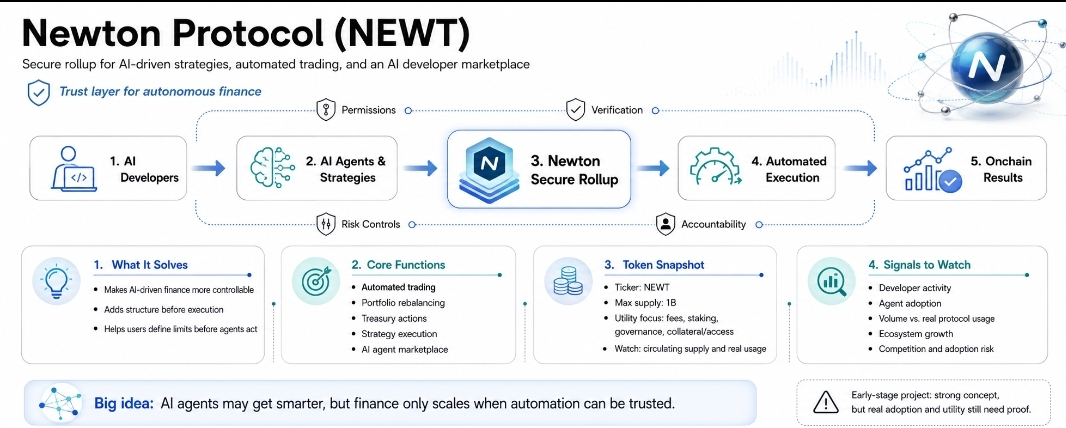
This is where Newton Protocol starts to feel interesting to me. It is not only trying to make AI agents faster or more useful. It is trying to build a safer structure around them. More like a control room than just an engine. The agent can act, but the action should happen inside clear limits, with permission, verification, and accountability.
That difference matters.
In crypto, people love speed. Faster trades, faster execution, faster automation. But speed without control can become expensive very quickly. One wrong condition, one bad route, one weak permission setup, and the whole strategy can turn into a lesson.
Newton’s bigger idea is that automated finance needs trust before it needs more speed.
That is why I do not see NEWT as just another AI narrative token. The stronger angle is infrastructure. If Newton can help developers build agents that users actually trust, then the marketplace side becomes important. Useful agents could bring users. More users could bring activity. More activity could make the token utility more meaningful.
But that is the key word: useful.
A marketplace only matters if developers build agents that solve real problems. Automated trading, risk management, portfolio adjustments, treasury actions, strategy execution — these are not small things. If Newton becomes a place where serious automation tools are built, then the project has a real path. If it only attracts shallow AI tools with nice branding, then the narrative can fade fast.
There are some important signals worth watching. NEWT has a maximum supply of 1 billion tokens, so supply is not unlimited. But circulating supply matters more in the short term because float expansion can pressure the chart. Trading volume can show attention, but attention is not the same as adoption. Token utility also needs to become visible through things like fees, staking, governance, collateral, access, or real usage inside the ecosystem. Developer activity matters too, because without builders, the whole marketplace idea becomes weak.
For me, the clean cause-and-effect is this: if developers build practical AI agents, users may start testing them. If users trust them, capital may start flowing through the system. If real activity grows, NEWT has a stronger reason to matter beyond speculation. But if price moves only because AI is a hot narrative, then traders should stay careful.
That is the balance.
Newton Protocol has a strong idea, but strong ideas still need proof. Adoption is not automatic. AI automation is still new. Users may not easily trust agents with funds. Competition will be heavy. Supply growth can affect price. And the market will eventually ask for real usage, not just big promises.
Still, the problem Newton is trying to solve feels real.
As AI gets closer to money, the biggest question will not be which agent is the smartest. It will be which system can prove the agent acted safely, correctly, and within limits.
That is why Newton Protocol is worth watching.
Not because AI trading sounds cool.
Because if autonomous finance grows, trust may become the most valuable layer of all.#Newt @NewtonProtocol
