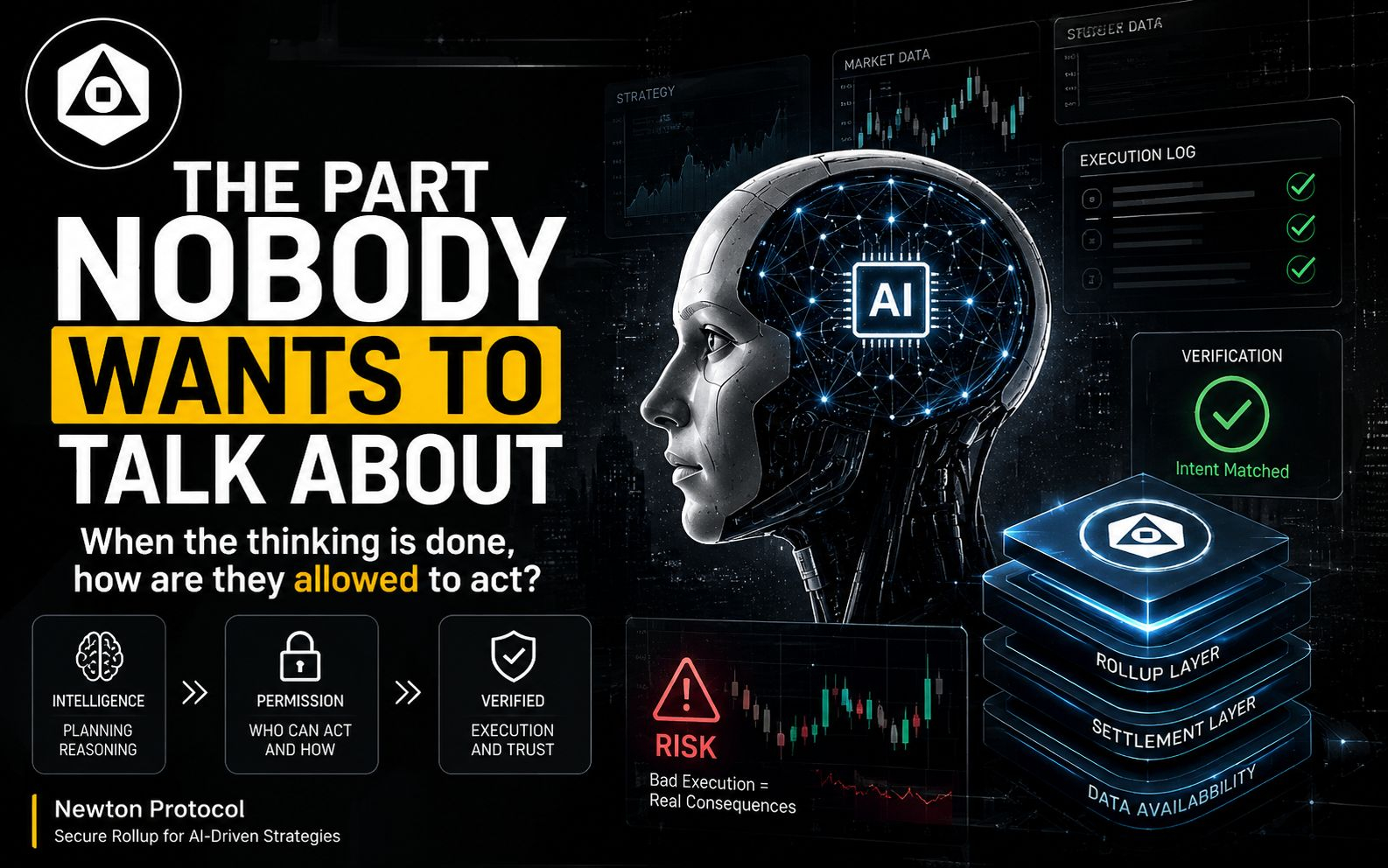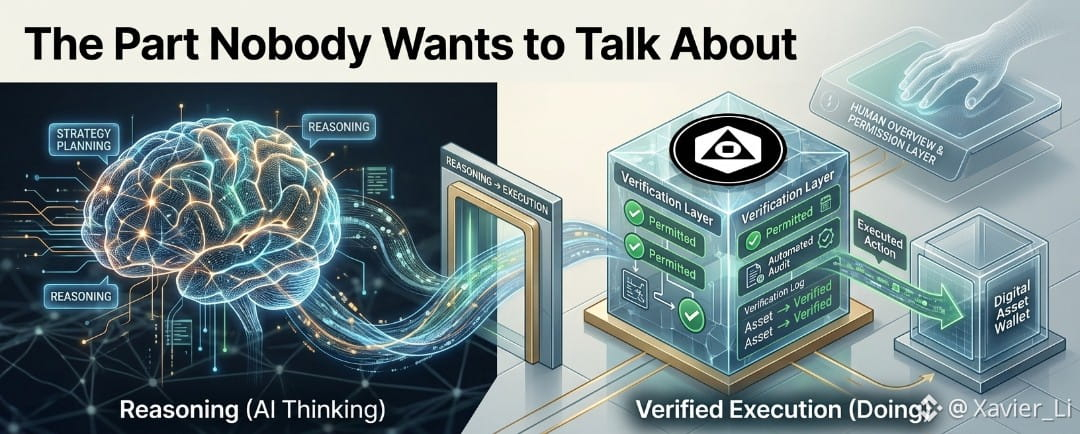
I've been thinking about execution lately. Not the exciting kind. The boring kind. The kind that happens after the smart part is over.
Here's what I keep coming back to. We spent the last two years watching models get better at thinking. They can write, reason, plan, argue with themselves, and break a problem into steps. Every few weeks something comes out that makes the previous thing look slow. And somewhere in all that noise, a quieter question got buried, and it's the one I can't shake.
What happens when the thinking is done and the thing actually has to do something?
Because that's a different problem. That's always been a different problem.
I remember the early days of trading bots. Not the AI ones. The dumb ones. Simple rules, if-this-then-that, nothing intelligent about them. And even those failed in ways nobody predicted. Not because the logic was wrong, but because the moment the logic met the market, everything got messy. Slippage. Latency. A price that moved between the decision and the action. A bot that kept buying because it never got told to stop. The intelligence was fine. The execution was where things broke.
So now we have agents. Actual agents. Things that can reason about a strategy, adapt, respond to conditions. And the conversation is almost entirely about how smart they are. How good the reasoning is. How well they can plan.
Almost nobody is asking the other thing. How are they *allowed* to act?
That word keeps sticking. Allowed. Because an AI that generates a brilliant strategy and an AI that is trusted to move actual money are two completely different animals, and we keep pretending they're the same.
I've watched both these worlds for a long time. AI on one side, doing its thing, mostly in labs and demos and papers. Crypto on the other, promising to rebuild finance and mostly rebuilding the same mistakes with new words. For years they didn't really touch. And now they're colliding, and I'm watching it with the same feeling I get every time two hype cycles decide to merge. A little tired. A little curious. Mostly waiting to see what actually holds.
Because here's the thing about autonomous systems moving value. The trust problem isn't the same as regular software. When a normal program has a bug, it crashes, and you fix it. When an agent with permissions makes a bad call, the money is already gone. There's no undo. The decision and the consequence happen in the same breath.
This is where I find myself thinking about the infrastructure underneath. The part nobody puts on a slide. Where does the agent actually run? Who checks what it did? Can anyone verify the execution matched the intention, or do we just trust that it did?
Newton Protocol is one of the projects poking at this. A rollup built specifically for AI-driven strategies, automated trading, a place where developers can deploy and share and monetize agents. And when I first read that, my reaction was the reaction I've trained myself to have. Another marketplace. Another layer. We've seen the marketplace idea a hundred times.
But then I sat with the actual problem it's aiming at, and I got a little less dismissive. Because the framing isn't "look how smart our agents are." The framing is closer to "here's a place where execution can be verified." And that's a strange thing to build a pitch around when everyone else is selling intelligence. It's almost unglamorous. Which, honestly, is why I paid attention a little longer than I meant to.
Whether it works is another question. A marketplace of agents raises its own mess. Who's responsible when a strategy someone deployed loses someone else's money? What are the incentives to publish something safe versus something that just looks good in backtests? Verification sounds clean until you ask who's doing the verifying and what they get out of it. These aren't problems you solve with architecture alone. They're human problems wearing a technical costume.
And infrastructure never shows its real face in calm markets. It shows up when things break. When volatility hits and every agent is trying to act at once and the execution layer is suddenly the only thing standing between order and disaster. That's the test. Not the demo. The bad day.
So I don't know. Maybe the interesting shift isn't smarter agents at all. Maybe it's the quieter question of how they're permitted to act, who's watching, and what part of the stack still holds when the systems making decisions are the ones we understand least.
I keep circling back to it and I keep not landing anywhere. Which probably means it's the right thing to be thinking about.