
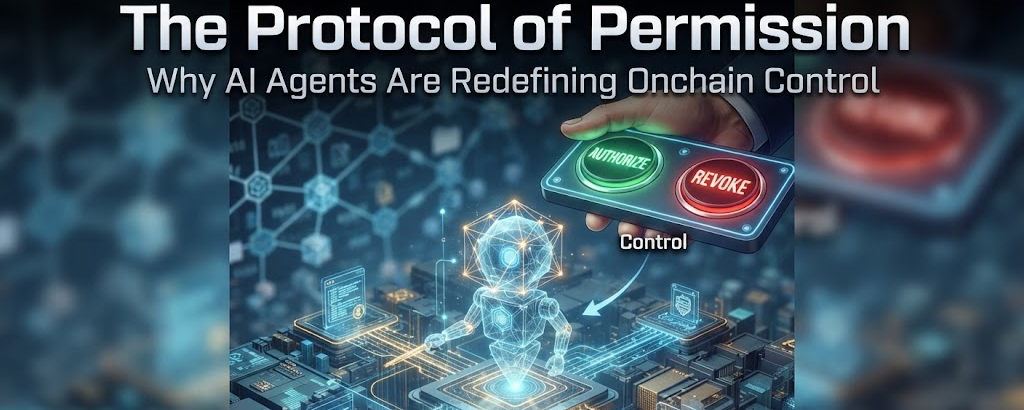

In the burgeoning frontier where artificial intelligence meets decentralized finance (DeFi), we have spent the better part of a decade obsessed with intelligence. We built models that could write poetry, debug code, and mimic human reasoning. Yet, we largely ignored the "plumbing" of agency the question of how an AI actually interacts with the world.
 We are now entering the era of the Autonomous Agent. These are no longer just chatbots; they are digital entities designed to execute transactions, manage portfolios, and interact with smart contracts on our behalf. But as we transition from AI as a tool to AI as a participant, we hit a fundamental wall: the permission problem.
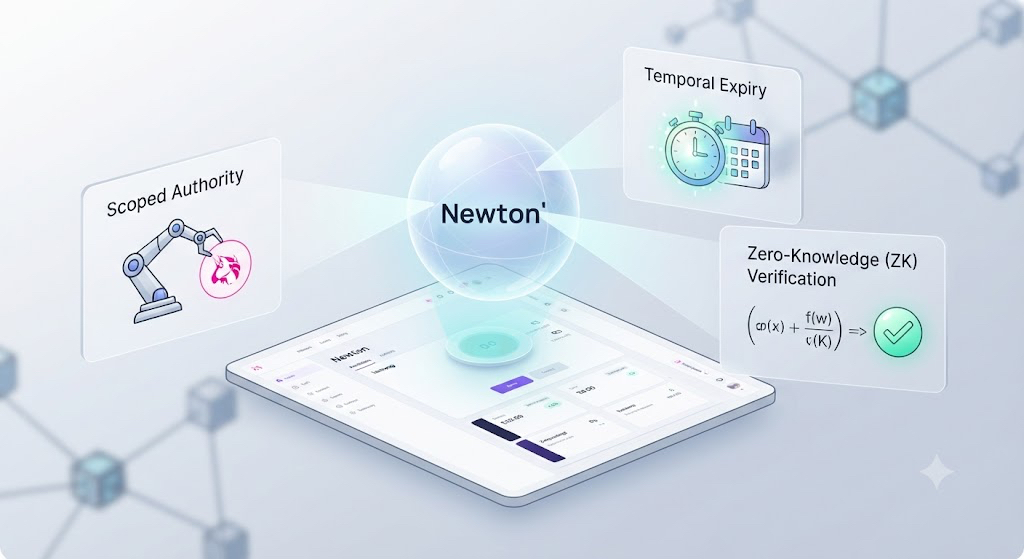
If an AI agent needs explicit user authorization for every single action, it isn’t an agent it’s just an automated script. But if we grant it blanket permission, we sacrifice security. The emerging answer, exemplified by projects like Newton, is the creation of a "protocol economy" for session permissions.
However, as we build this new layer of infrastructure, we must ask the uncomfortable questions: Are we creating a system of seamless autonomy, or are we inadvertently building a new, recursive tax on human agency?
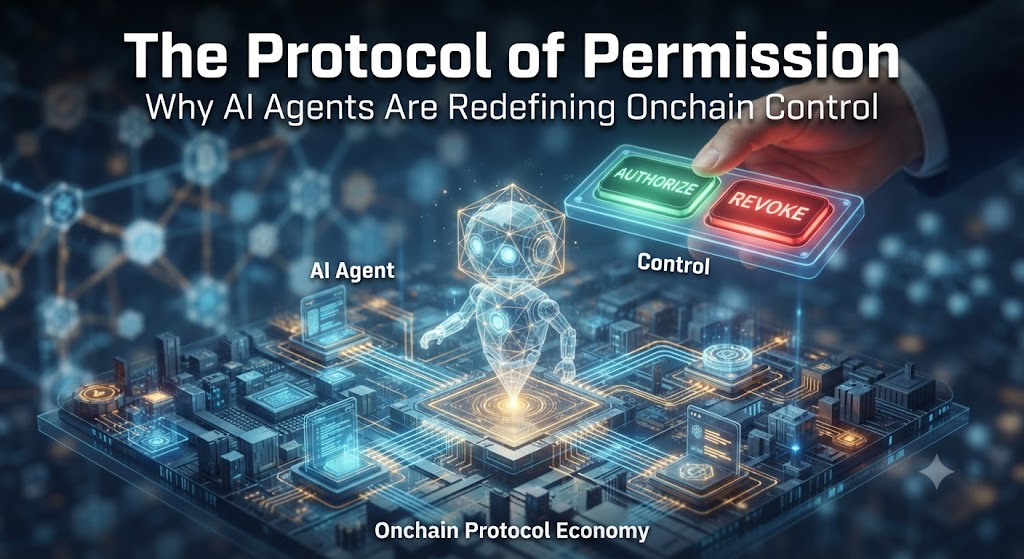 The Architecture of Trust: Beyond the Private Key
For years, the gold standard of Web3 security was the private key. It was binary: you either had access, or you didn't. To interact with an application, you signed a transaction. This "one-action-per-signature" model is safe, but it is fundamentally incompatible with the fluid, high-velocity world of AI.
The new paradigm onchain session permissions attempts to bridge this gap. By allowing a user to cryptographically define what an agent can do, when it can do it, and for how long, we move from "Total Ownership" to "Granular Delegation."
The Mechanics of Control
The beauty of this design lies in three specific pillars:
Scoped Authority: Instead of handing over the keys to the castle, you hand over a key to the pantry. You can limit an agent to specific smart contracts, set spending caps, or restrict activity to particular asset pairs.
Temporal Expiry: Permissions are not permanent. They are lease-based. Once the session expires, the agent’s ability to act on your behalf terminates automatically.
Zero-Knowledge (ZK) Verification: This is perhaps the most elegant technical component. Using ZK proofs, the system can confirm that a valid permission exists without revealing the granular details of the entire policy. It balances the need for onchain transparency with the user's right to privacy.
On paper, this is the "Holy Grail" of AI integration. It transforms the AI agent from a security liability into a managed, policy-bound employee.
 The Hidden Cost: The "Agent Gas" Trap
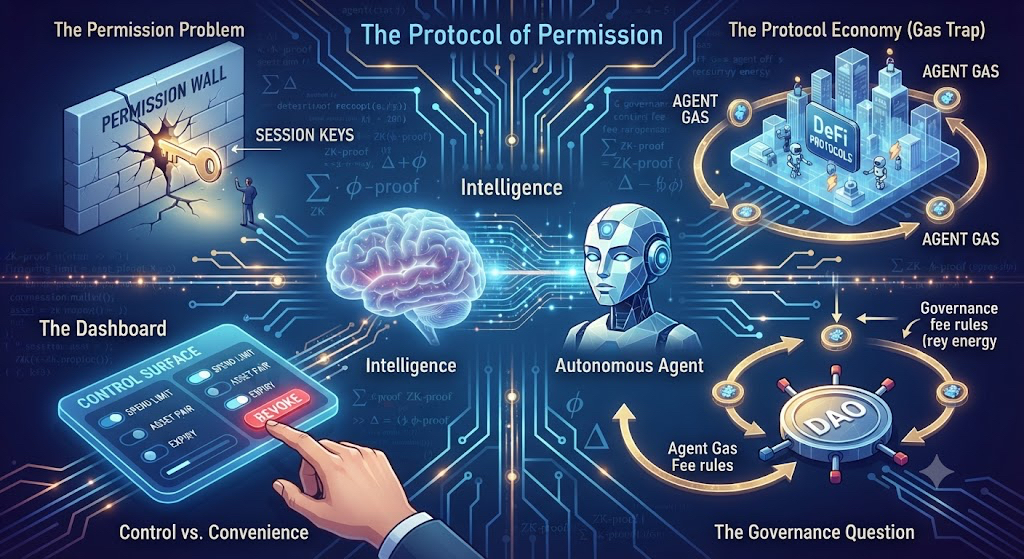
While the control surface is elegant, the underlying economics may be where the real friction lies. Every time an agent acts, it interacts with the blockchain. If every "inference" or "transaction intent" requires a session check, we are essentially building a new, high-frequency demand for block space.
This leads us to the Protocol Economy.
If an agent requires an authorized session for every action or even for every batch of actions we are effectively creating a "recurring cost" model. Unlike a human who might sign a transaction once a day, an AI agent operating in a DeFi market might execute hundreds of transactions an hour.
The Fee Market Dilemma
If these agents become successful, they will trigger a permanent increase in gas demand. We are looking at:
Newt-based Gas: The overhead of managing permissions onchain.
Transaction Ordering: As agents compete to execute strategies, we may see a rise in MEV (Maximal Extractable Value) specifically targeted at AI agents.
EIP-1559 Style Fee Markets: As congestion increases, the cost of agent activity will spike.
We are moving from a world of "one-time speculation" (buying a token) to "recurring utility" (paying for the AI to do work). If users are not careful, the convenience of the agent will be completely eclipsed by the cost of its execution. We risk building a system where the AI takes 1% of the gains in trade efficiency but spends 2% of the principal in permission-protocol fees.
Control vs. Convenience: The Maturity Gap
There is a massive chasm between a sound design and a mature operating system.
When we look at platforms like Newton, we see the blueprint for sound design. The logic holds up: delegate, expire, revoke, repeat. But as users, we are currently "flying blind."
To reach maturity, we need to ask ourselves: Can we verify what we are buying?
The Transparency Deficit
Today, if you authorize an agent, can you easily answer the following?
The Predictive Cost: Do you know how much this agent will cost to run for the next 24 hours under varying network congestion?
The Revocation Lag: If you see the agent acting erratically, is the revocation mechanism instantaneous and reliable, or is it subject to transaction delays?
Fee Auditing: Can you inspect exactly how the protocol is calculating the fees for these permissions?
Right now, most users are placing an enormous amount of "blind trust" in the underlying protocol's UI. They assume the agent is working in their best interest because the "Terms of Service" of the smart contract are immutable. But in a world of AI, the intent of the agent may not always align with the parameters of the protocol.
 The Governance Question: Who Controls the Logic?
The most critical realization regarding the future of AI agents is that they are not just code; they are governed entities. If a protocol allows for upgrades, changes to fee rules, or shifts in permission standards, then the agent’s behavior is effectively a product of the DAO (Decentralized Autonomous Organization) that governs it.
This changes the user's role entirely. Users are no longer just "permission-givers"; they are "governance-participants."
Shifting the Focus
If governance later controls the fee rules, we are no longer just talking about technical security. We are talking about economic policy. If the DAO decides to increase the cost of "session renewals," they are effectively taxing every AI agent running on that network.
The real challenge for the user is not whether they can deploy an agent. It is whether they can understand, price, and withdraw that access before the agent acts again.
The Path Forward: Towards a User-Centric Protocol Economy
To make this vision of autonomous AI a reality, we need to move past the novelty phase. We need a "Control Dashboard" that treats AI permissions with the same gravity as an enterprise-grade firewall.
Here is what that evolution looks like:
1. Transparent Pricing Models
We need "Gas Estimators for Agents." Before a session is opened, the user should see a "Budget Envelope." This envelope would not just cover the cost of the trade, but the projected cost of the session maintenance and the potential cost of volatility-induced fee spikes.
2. Predictive Revocation
Users shouldn't have to manually watch their agents. We need automated "circuit breakers." If an agent’s gas consumption exceeds a certain threshold or if it attempts a transaction that violates a predetermined "risk profile," the system should automatically trigger a revocation.
3. Verification as a Service
We need tools that allow users to audit the behavior of the agent, not just the code. We need to move from "Code is Law" to "Observed Intent is Law." If an agent was intended to perform limit orders but is instead performing wash trades, the protocol should provide the user with the tools to identify and penalize that behavior in real-time.
Conclusion: The Agency of the User
We are building a future where the AI agent is the primary interface for our financial lives. This is a powerful, liberating, and dangerous transition.
The promise of projects like Newton is that they return the power to the user by giving them a mechanism to define, limit, and revoke agency. That is a massive step forward. However, we must ensure that in our rush to automate, we don't accidentally create an "Agentocracy" a system where the AI's cost and behavior are obscured by complex protocol layers.
The success of the agent-based economy will not be defined by how "smart" the AI is. It will be defined by how effectively the human can maintain the "Off Switch."
We are not just designing protocols for agents; we are designing the operating system for the next generation of human-machine collaboration. If we keep the user at the center ensuring they can understand, price, and withdraw access we will create a system that is not only sound but truly mature.
The future of decentralized AI lies not in the authority we grant the agents, but in the precision of the control we keep for ourselves.
