
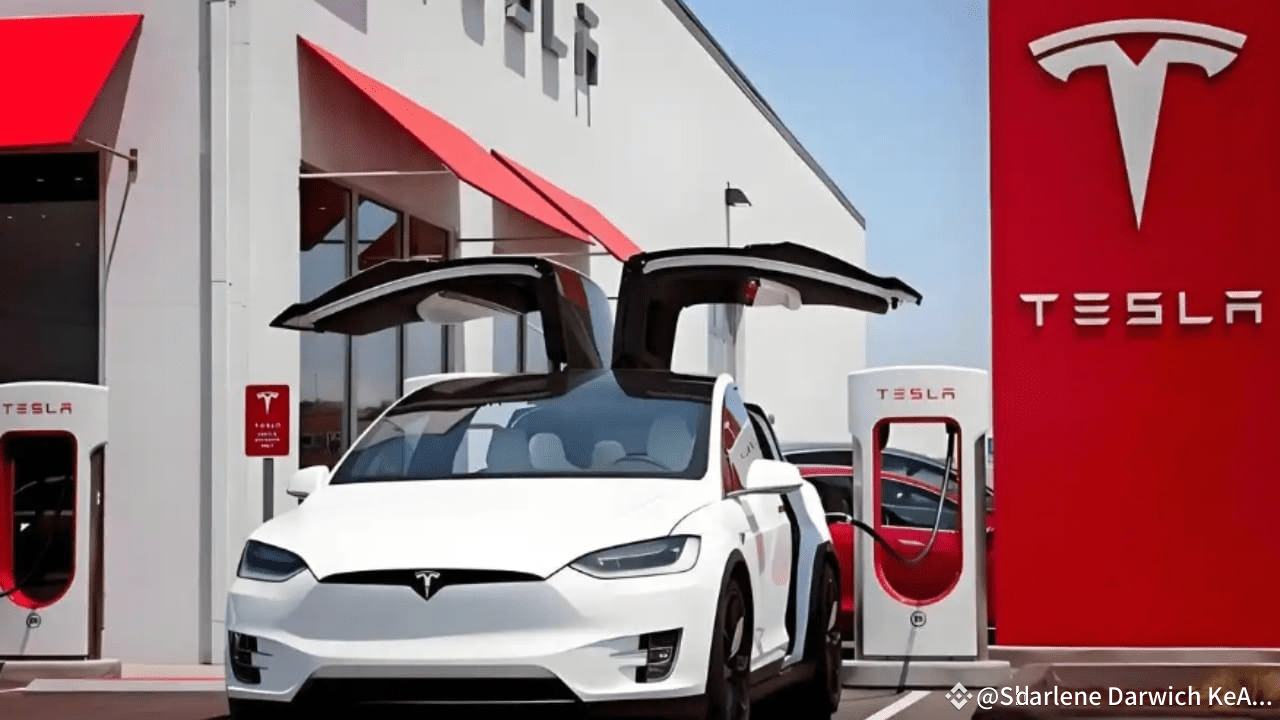
Against the backdrop of a 20% year-on-year plunge in automotive revenue, total revenue falling short of expectations, and a substantial reduction in net profit, Tesla still did not tap into its cryptocurrency asset reserves — as of March 31, 2024, Tesla still held 11,509 Bitcoins, with a total value of approximately $951 million.
This financial report not only reflects the operational pressures and policy challenges faced by Tesla but unexpectedly brings the presence of 'Bitcoin' on the company's balance sheet back into the spotlight.
At a time when the market is concerned about the company's revenue pressure, Tesla has not liquidated or reduced this digital asset but chose to continue to 'hold on,' reflecting perhaps not only an optimistic attitude towards Bitcoin's future but also a redefinition of its strategic financial role.
1. Revenue and profit are under comprehensive pressure, and Tesla is caught in a 'dimensionality reduction period.'
According to the latest financial report, Tesla's total revenue for Q1 2024 was $19.3 billion, a 9% year-on-year decline, far below the market expectation of $21.3 billion.
The automotive sector is particularly prominent:
Revenue fell by 20% year-on-year, sliding from $17.4 billion a year ago to $14 billion this quarter;
Net profit plummeted from $1.39 billion to $409 million, with a year-on-year decline of over 70%.
This is not a simple cyclical trough. The intensifying competition in the global electric vehicle market, rising cost pressures, and U.S. tariff policies targeting Chinese components are all posing systemic challenges to Tesla.
What worries the market even more is that Tesla did not provide an annual growth guidance in this financial report but postponed the task of 'reassessing the 2025 outlook' to the next quarter. This indicates that the company's top management has a clear understanding of macro uncertainties.
2. In the midst of a comprehensive downturn, is holding on to Bitcoin a matter of faith? Or a strategic consideration?
Despite being under pressure fundamentally, Tesla did not sell a single Bitcoin. According to data from on-chain analysis platform Arkham, it has never reduced its holdings of 11,509 BTC since establishing its position in early 2021.
As of the Q1 financial report release date, the book value of this portion of Bitcoin was $951 million, although lower than December's $1.076 billion, the decline entirely stemmed from Bitcoin price fluctuations rather than trading actions.
The key point is: at a time when cash flow is under pressure, Tesla remains unwilling to touch this asset. This 'silence' actually conveys a clear attitude:
Bitcoin is not only an 'investment' on the balance sheet but also part of the company's liquidity and long-term reserve strategy.
In Mlion.ai's on-chain data tracking system, Tesla's corresponding BTC address has shown almost no trading activity in the past 90 days, with a model classification rating of 'deep long-term holding account.'
3. Changes in FASB rules make Bitcoin holdings 'more tactically valuable.'
In the past, due to the restrictions of U.S. Financial Accounting Standards Board (FASB), companies holding Bitcoin had to account for it at the 'minimum market value' within each quarter in their financial statements, greatly reducing its performance on the asset side and making it difficult for companies to 'release potential value' during price rebounds.
However, at the beginning of 2024, FASB officially implemented new regulations: Bitcoin and other digital assets must be revalued at the market price at the end of the quarter. This means that companies can finally objectively reflect the fluctuating income of their holdings, rather than continuously lowering the book value.
For Tesla, this change should not be underestimated:
During financial tightening, Bitcoin has become the only potential 'activatable value' in the financial statements;
When confidence in the capital market recovers, BTC holdings will become a 'credit compensation item' for corporate valuation recovery.
Mlion.ai's asset structure optimization model analysis points out that under the new FASB accounting regulations, Bitcoin will become a key variable in the diversified reserve structure of enterprises alongside gold and U.S. dollar cash.
4. Macro and policy intertwine: Musk's other gamble.
Tesla's revenue pressure is not merely a market issue but a reflection of global policy risks. Musk has recently appeared frequently in Washington, participating in the White House's 'Government Efficiency Department' initiative, and communicating with the Trump administration on how to cut federal spending.
At the same time, however, the White House's tariff expansion plan directly threatens Tesla's supply chain stability: key components such as battery materials, circuit boards, and specialty glass mostly rely on imports from China, and once tariffs increase, profit margins will be further compressed.
This uncertainty in the external environment has further strengthened Bitcoin's role as a 'sovereignty-free, regulation-free' strategic reserve.
Mlion.ai's 'policy hedging factor' has continuously raised the weight of BTC against corporate resistance to macro uncertainties over the past two quarters. Tesla's behavior has been labeled in the model as a 'long-term value reserve strengthening operation.'
5. Conclusion: Beneath Tesla's financial report lies the paradigm shift of Bitcoin's enterprise-level applications.
Bitcoin is no longer an 'Easter egg' or 'corner information' in Tesla's financial report, but rather a core extension of the company's financial robustness, strategic flexibility, and even the CEO's investment preferences.
In an environment characterized by economic downturns, frequent policy changes, and capital market valuation contractions, whether Bitcoin assets can be used as a 'stabilizer' is becoming a 'new dimension' for assessing a company's ability to respond to cycles.
Perhaps Musk did not say it outright, but he expressed an attitude of 'these assets must be valued' through his 'doing nothing' approach.
In the future, how enterprises use, value, report, and utilize cryptocurrency assets will become the eye of the storm in a new round of capital market transformation. Mlion.ai is continuously tracking this quiet structural evolution through on-chain analysis, accounting logic modeling, and policy trend interpretation.
Disclaimer: The above content is for informational sharing only and does not constitute any investment advice. Cryptocurrency assets are highly volatile, and corporate investment behavior has specific contexts; please refer to it rationally.