
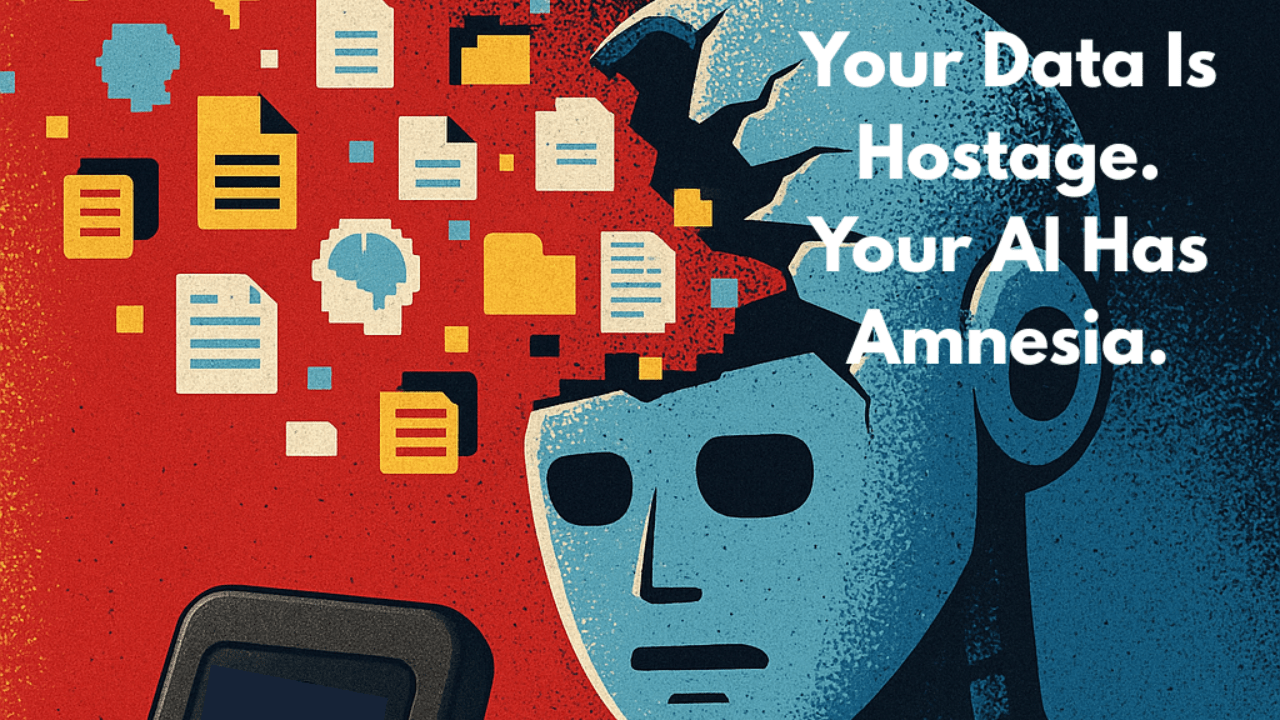


Your Spotify knows your soul, Gmail hides your secrets, your browser history records all your late-night secrets, but what about your AI?
It initiates every conversation as if it just met you, while tech giants store your data separately in different vaults. Each company guards your data like a digital dragon, which is why your AI feels like a genius with amnesia—powerful yet completely unaware of your true identity.
We built Kinic to solve both problems at once: a tamper-proof bridge that allows AI to access your distributed digital life while giving you control over everything. Think of Plaid, but for the AI revolution. Your data, your AI, your rules—finally here.
Date Night
Imagine this: you are planning a date night and want something special. You spend hours browsing hidden food lists in your city, food blogs recommended by friends, reading reviews of newly opened cocktail bars, posts about rooftop restaurants on Instagram, and posts about romantic restaurants at a certain price point on social media. After browsing thirty tags, your brain is exhausted, and you've forgotten half of what you've read.
Right now, you turn to a LLM chatbot for help, but here’s the catch: this LLM bot knows nothing about your research. It cannot see that underground bar you bookmarked, the dietary restrictions mentioned in that blog post, or the three different sources warning that trendy bar has a one-hour wait. Therefore, its suggestions are as generic as anyone else’s, completely overlooking the context from the thirty sites you just collected.
You end up copying and pasting a few snippets into the chat, trying to recreate your research, saying, 'There’s a place called...,' 'Where did I read about...,' 'Can you compare these three options I found...,' and it’s exhausting. You are doing the work of connecting information for AI, while AI just responds to snippets.
This is completely the opposite; you should be able to browse these sites, absorb all the information into your personal memory bank, and then ask, 'Based on context, what is the best date spot tonight?' Your AI should already know which places have craft cocktail underground bars, which spots offer city views, and which locations meet your noise level and price requirements.
But what’s really interesting is: what if your AI could understand your partner's preferences too? Perhaps they have recently been browsing vegetarian restaurants, or mentioned their excitement about a newly opened jazz club in a group chat. Traditional AI tools cannot do this—each user operates separately, with no intersection between their contexts.
Traditional SaaS solutions will only create another centralized data silo, requiring both parties to upload data to another company’s server. The breakthrough is that data storage is owned by the user and encrypted for protection, allowing for selective sharing. Your research on date locations, the other person’s dietary preferences, and your schedules—everything can be accessed by AI while still being personally controlled by you.
This is not a distant future—this is what Kinic is building, browsing, absorbing, querying, sharing context in an encrypted manner. Your research will instantly become AI memory, and you can precisely control what is shared and with whom.
Modern AI lacks context, and it's not its fault—it is battling digital amnesia, forced to start every conversation from scratch, while your actual research and context are trapped in browser tabs and bookmarks.
This is exactly the core problem Kinic solves. Just as Plaid revolutionized fintech by building a secure bridge between banks and applications, Kinic is building the infrastructure layer connecting AI and distributed digital lives. It is not just an AI tool; it is a pipeline for achieving truly personalized AI.
This difference is profound. What you receive is not a generic response but an AI that understands your thought patterns. You do not have to start from scratch; instead, you can gain continuity across conversations, projects, and platforms. You do not have to hand over your data to companies but can open the door to the AI future people have long awaited while retaining ownership.
This is not just about providing stronger autocomplete features or smarter recommendations. When AI can access all the contextual information you provide—from your communication style in emails to your aesthetic preferences in bookmarks to your work patterns in calendar data—it is no longer a calculator, but a cognitive amplifier.
The infrastructure is in place, the technology is working, and for the first time in history, you can have the key to your own AI memory.
The technology to achieve this goal.
The hallmark of revolutionary infrastructure is that it seems impossible before it is built, then suddenly it becomes obvious. We have spent a year building the tech stack that makes user-controlled AI memory truly effective—this is not a theoretical white paper; it is code you can download today.
Your personal vector database, everywhere.
Its foundation is our WASM-based vector database, which runs entirely on the ICP blockchain. Imagine: no need to trust any central server, no worries about third-party databases being compromised. Your memories will last forever, protected by WebAuthn biometric technology—your fingerprint will unlock your AI's understanding of you.
When you visit any website or check your email, magic happens. Our Chrome extension absorbs the content, localizes it in your browser through vectorization, and stores it in your personal data repository. Do you have bookmarks from 2019 that sparked your current startup idea? Your AI will remember the email leads where you brainstormed management ideas? Indexed and searchable.
Portable vector formats mean this context can follow you across all AI models—GPT, Claude, Gemini—they can all be intelligently tailored to your specific situation without holding your data hostage.
Zero-knowledge machine learning.
But this is where things start to get crazy. We use advanced encryption technology to allow trustless interactions between data stores. A16Z research has released a special technology called JOLT, a virtual machine that allows us to perform verifiable computations on any program at lightning speed. It uses a special technique called lookup—this is particularly well-suited for non-linear functions that arise in AI.
We modified the JOLT prover to enable scalable zero-knowledge machine learning. Then we combined it with the memory-efficient folding scheme pioneered by Microsoft Research and other great institutions, finding and verifying protocols—well-suited for ML workloads—now part of our Nova-based prover network. This is a significant technology in many ways, but requires deeper discussion.
This means in practice: your AI can verify programs using your data without revealing the specific details of that data. Imagine, AI agents can verify whether they understand your preferences through encryption, enabling trustless collaboration between different AI systems, while protecting your actual information privacy. This is essential for personal dating scenarios and equally important for business-to-business interactions.
Privacy-first architecture.
Our WASM zkVM employs a folding scheme based on the latest privacy protection research and supports proof combinations. Unlike other zkVMs that consider privacy after the fact, we have designed our scheme for privacy from the start. Multi-folding support means we can efficiently aggregate proofs.
Here’s how the full stack works: browser-based vector databases capture context → memory-efficient ZKP proves understanding → rapid zkML supports AI reasoning → on-chain verification ensures tamper-proof operations → you control everything with an encryption key.
This is infrastructure at the Plaid level, but aimed at the AI revolution. Unlike current AI memory solutions that require trust in centralized providers, it actually follows the original intent of the internet: distributed, user-controlled, and verifiably encrypted.
We have released the Chrome extension, come try it out! Early users have already started building applications and using it for unexpected functionalities!
The dragon has come! This requires blockchain.
Traditional tech people need to hear an unsettling truth: you cannot build an 'AI memory version of Plaid' with the centralized architecture that Plaid once successfully used. Its basic economic principles simply do not work.
Trust issues are a matter of survival. When Plaid connects your bank account to Mint, the worst-case scenario is financial fraud—serious, but manageable. However, when an AI memory platform connects your browser history, emails, location data, and private conversations from every app you use, a data breach could jeopardize not only your financial safety but also your entire digital identity. No matter how many security audits you conduct, users will not trust a centralized company to provide such private data access.
The competitive moat issue: traditional SaaS companies build moats through data network effects—the more users, the better the service for everyone. However, AI memory is inherently personalized; your browsing patterns do not make my AI assistant better but make yours better. Centralized AI memory companies have no defensible moats because their value does not compound growth among users—it compounds growth internally among users over time.
Platform risk issues: any centralized AI memory solution poses a survival threat to major platforms. Google, Apple, Meta—they all profit by controlling user data and context; they will never integrate with solutions that can commoditize their core competitive advantages. Centralized 'AI grids' will be cut off from their data sources or replicated and crushed by large tech companies.
Regulatory impossibility: GDPR, CCPA, and the impending wave of AI regulations demand that users have ownership and portability of personal data. A centralized company collecting private behavioral data across platforms is undoubtedly a compliance nightmare waiting to happen. Smart contracts give users encrypted control over their own data. Not only is this technically superior, but it is also the only architecture that can withstand regulatory scrutiny.
Why are smart contracts so important? User-controlled smart contracts can simultaneously address all these issues. Users trust the system because they hold the keys; there is no central server to hack or subpoena. Platforms cannot kill what they cannot control, and its technical architecture aligns with the direction of regulatory development, rather than the past.
This is not an encrypted ideology; it's a market reality.
The memory revolution starts now.
This is not about building another AI tool, but about building a foundational layer that allows every AI tool to genuinely provide intelligence. Companies that understand this shift—that AI memory must be user-controlled to be truly valuable—will possess the infrastructure layer of the next generation of computing platforms.
Your data will never be hijacked, your AI will never forget. We are at a unique technological crossroads where multiple transformations converge: AI models are advancing but are plagued by digital amnesia; personal data is surging but remains isolated; privacy regulations demand user ownership despite a lack of necessary infrastructure.
Kinic is not just addressing current challenges; we are building the infrastructure for the upcoming AI-native world. In the future, every application will have an AI assistant, every interaction will generate context, and every decision will be enhanced by machine intelligence. Control over the memory layer will be crucial.
Early signs are emerging. Our recently released development API and Chrome extension have shown surprising adoption patterns. Users are not just saving bookmarks; they are developing research workflows, creating shared knowledge bases, and conducting due diligence, which used to take weeks now takes only hours. The rapid emergence of use cases indicates that the need for such infrastructure has long existed.
A competitive advantage is forming. Every piece of absorbed data, every stored context vector, and every generated encrypted proof enhances the network's value to individual users. This goes beyond traditional network effects; it is a more powerful dynamic—personalized AI based on your behavior over months that competitors cannot replicate from scratch tomorrow.
The window of opportunity is narrow. While big tech companies are aware of this impending shift, their existing platforms will be architecturally constrained. They will ultimately connect to Kinic's decentralized memory storage.
Your data should not be captured, your AI should not forget, and your date plans should not be disrupted.
Download Kinic, own your memories:
kinic.io
For more information, please read:
JOLTx achieves SOTA in zero-knowledge machine learning (zkML).
Your best new friend for data in a decentralized AI world.

The IC content you care about.
Technical progress | Project information | Global events

Follow IC on Binance channel.
Stay updated.