
I’ll be honest. Whenever a blockchain says it’s built for “real-world adoption,” my guard goes up. I’ve heard that line too many times, and it usually means faster blocks, cheaper fees, and the same old assumption that users will somehow adapt to crypto’s weirdness.
What pulled me toward Vanar wasn’t a bold promise. It was a quieter feeling — like someone on the team has actually watched normal people struggle with Web3, get confused, get annoyed, or just give up… and decided that the system should change instead of blaming the user.
Vanar doesn’t feel like it’s trying to educate people into crypto. It feels like it’s trying to remove crypto from their way.
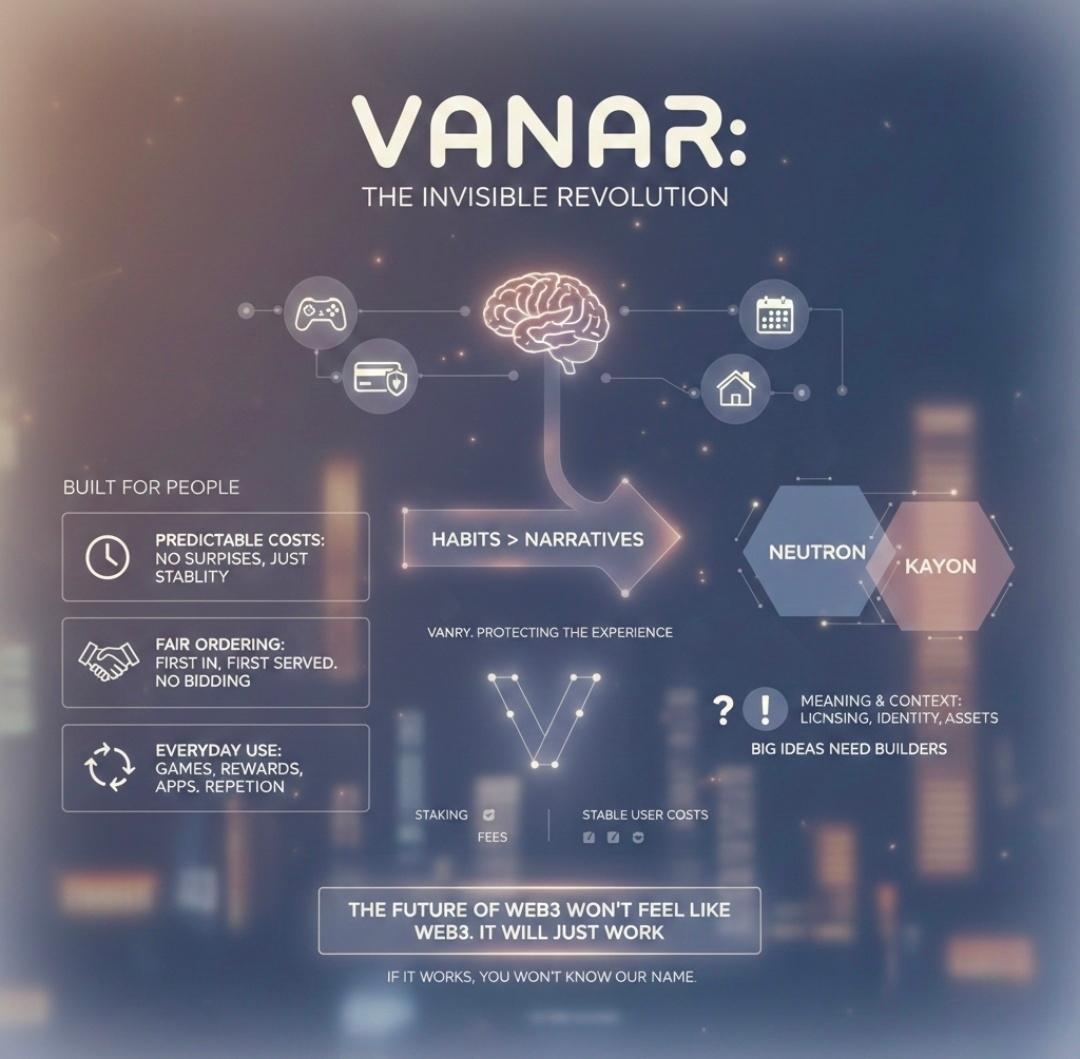
Predictability sounds boring — until you need it
In most blockchains, fees feel like a gamble. Sometimes they’re cheap. Sometimes they explode. And users are expected to understand why, or at least accept it.
That might be fine if you’re a trader clicking buttons all day. But imagine running a game, a loyalty app, or a brand campaign. Imagine telling your team, “It should be cheap… unless the network gets busy… then who knows.”
Vanar goes the other way. The goal isn’t to be the cheapest chain on a good day. The goal is to be predictable every day. A fixed, tiny, USD-equivalent cost that doesn’t suddenly surprise you.
That doesn’t sound exciting. But predictable systems are what real products are built on. When costs are stable, teams can plan. When teams can plan, they ship. And when things ship, users actually show up.
Fairness matters more than theory
There’s a lot of debate in crypto about transaction ordering. Paying more to jump the queue is often framed as “market efficiency.”
But in real life, that just feels unfair.
Vanar leans toward a simple idea: if you act first, you go first. No bidding wars. No quiet advantage for bigger wallets. Just a normal line.
It’s such a small thing — and that’s exactly why it works. Most users don’t want to think about blockspace or priority fees. They just want to know that when they click, the system respects them.
Trust is built from moments like that.
Built for everyday use, not occasional drama
Some chains are designed for big, rare moments. Huge transactions. Short bursts of activity. Long periods of quiet.
Vanar feels designed for repetition. Lots of small actions. Over and over. The kind of activity you get from games, collectibles, rewards, and consumer apps.
That tells you something about intent.
This isn’t a chain optimized to look impressive once in a while. It’s built to be used constantly, without flinching. Not glamorous — but useful.

People follow their assets, not whitepapers
One of the strongest signals in Web3 is where users’ assets actually live.
If your NFTs, game items, or digital identity move somewhere, you move with them. Not because you made a conscious choice — but because that’s where your stuff is.
That’s why the Virtua shift matters. When assets migrate onto Vanar and get upgraded there, Vanar becomes the default environment for those users. No tutorials required. No explanations needed.
Habits form quietly. And habits are stronger than narratives.
VANRY isn’t just “gas”
At a glance, VANRY looks simple: pay fees, stake, support the network.
But when the chain itself is designed around stable user costs, the token plays a deeper role. It becomes part of the system that protects the experience from market chaos.
That’s a subtle but important difference. The token isn’t just there to make the chain run. It helps keep the promise that things will feel normal for users.
And the fact that VANRY still connects to familiar ecosystems shows something practical: Vanar isn’t trying to isolate itself. It understands where liquidity, tools, and developers already live.
Reliability first, with a real question for the future
Vanar’s validator and staking model clearly prioritizes stability. And for mainstream users, that makes sense. Most people don’t want to participate in an experiment. They want things to work.
But there’s an honest question that matters long-term:
Do early guardrails slowly open… or do they stay forever?
That evolution will say a lot about where Vanar is headed. Early structure can be healthy — as long as it doesn’t turn into permanent control.
Neutron and Kayon: the big, risky idea
Most blockchains are good at answering one question: “Who owns this?”
They’re not very good at answering:
What is this?
Why does it exist?
What rules apply to it?
What rights come with it?
Neutron and Kayon are trying to move blockchain beyond raw data and into meaning. Memory. Context. Reasoning.
If this works the way it’s described, it could matter for things like licensing, compliance, identity, and real-world assets — places where meaning is as important as ownership.
This is also where caution is healthy. Big ideas are easy to describe and hard to ship well. The real test won’t be words. It will be whether builders actually use these tools because they make life easier.
Why Vanar matters
Because the version of Web3 that actually wins won’t feel like Web3.
It will feel like:
a game that doesn’t break
an app that doesn’t surprise users
a system that doesn’t require explanations
something that just… works
Vanar feels like it’s aiming for that outcome by making choices that put normal users first, even when those choices aren’t popular in crypto culture.
It’s not trying to be loud.
It’s trying to be dependable.
And in a space full of noise, quiet reliability might be the most radical thing you can build.
Final thought:
If Vanar succeeds, most users won’t even know its name and that might be the clearest sign that it worked.