

Have you ever opened a Web3 app, got excited for two seconds, and then immediately felt that “ugh… what is this?” moment?
You didn’t come there to study gas fees, mempools, confirmations, or anything technical. You came to do something simple. Buy a game item. Claim a collectible. Move an asset inside a metaverse. Normal digital life stuff.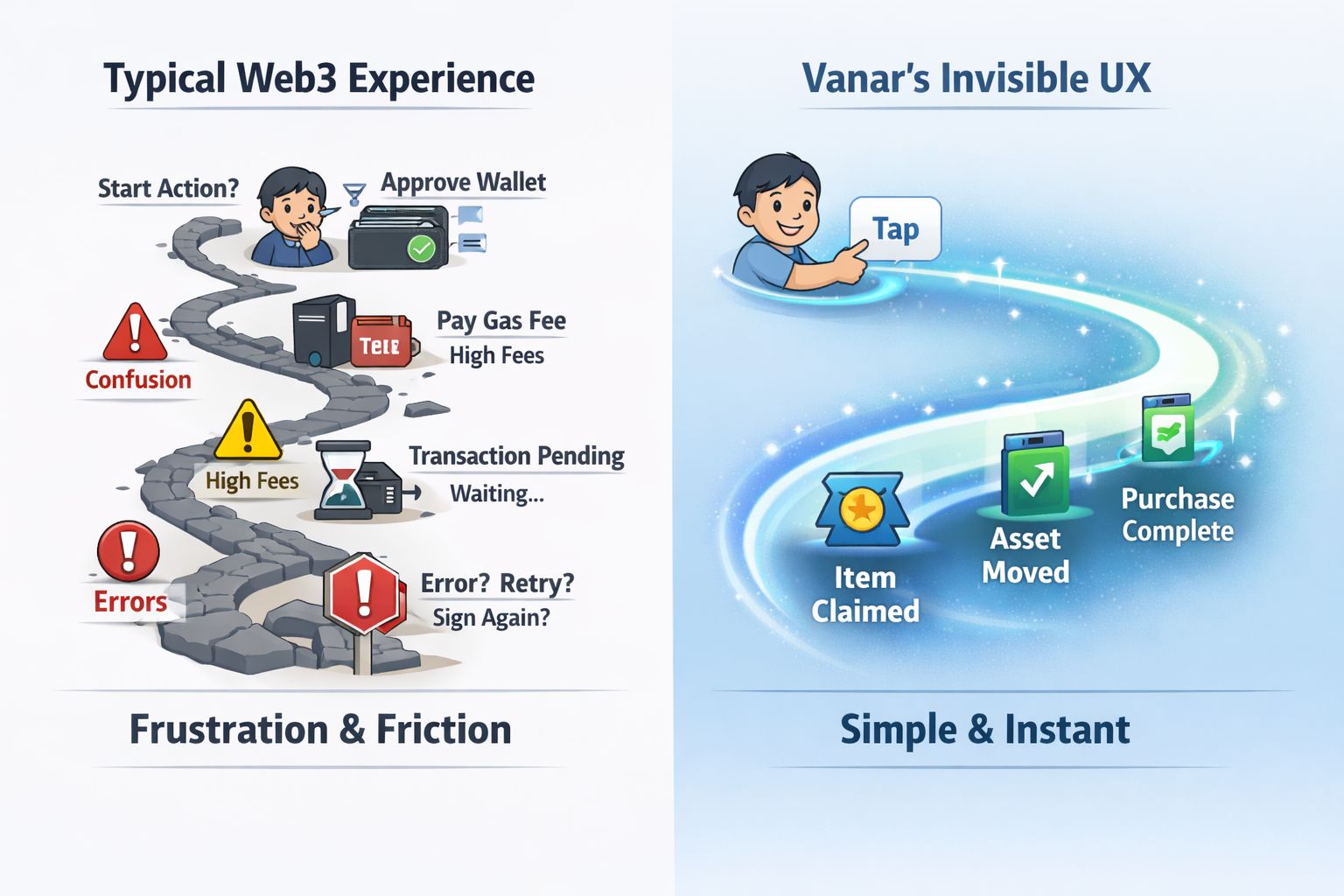
That’s exactly the gap Vanar is trying to close.
Vanar is an L1 blockchain, but the point isn’t “it’s an L1.” The point is what it’s designed for: real people using real consumer products. The Vanar team’s background in games, entertainment, and brand work shows up in the way they think about technology. They’re not building for crypto-native users who enjoy fiddling with settings. They’re building for the next wave—the “next 3 billion” who will only use Web3 if it feels as simple as any modern app.
The best way to understand Vanar is through one idea: invisible blockchain. If the blockchain experience is done right, users shouldn’t even notice it’s there. They shouldn’t have to think about gas. They shouldn’t have to wonder why something is pending. They shouldn’t feel like they need a tutorial just to click a button. They should tap, it works, and they move on.
That might sound like a small thing, but it’s actually the entire adoption battle.
Because mainstream users have almost no tolerance for friction. Crypto people are used to weird steps. They’ve learned patience. They’ve learned how to troubleshoot. Most consumers won’t. They’re not being rude—they’re just busy. The moment something feels confusing or unpredictable, they leave. And when they leave, they usually don’t come back.
This is why consistency matters more than hype. Trust doesn’t come from big claims. Trust comes from the experience being steady. Same action, same behavior. No surprises. The “feels normal” factor is what turns curiosity into habit.
A big part of why many chains struggle with mainstream adoption is simple: fees and congestion turn the experience into a gamble. On a lot of networks, fees behave like surge pricing. When things get busy, costs jump. The user doesn’t feel empowered; they feel punished. It’s even worse when the underlying system encourages “pay more, go first” behavior. Fee auctions create a world where whoever bids higher gets included faster, and normal users get stuck behind them. That might be acceptable for traders. It’s a terrible feeling in consumer apps. Nobody wants a bidding war just to claim a collectible or buy an item in a game.
If you want a mental model that clicks instantly, think of it like traffic and tolls. Dynamic gas fees are like a busy highway where the toll price changes constantly based on demand. You’re trying to get somewhere, but the cost keeps shifting. Predictable fees are like seeing a clear price tag before you buy something. You trust it. You decide. Another way to see it is a store checkout. Some networks feel like an auction house—pay more or you might wait forever. Consumer systems should feel like a normal line at the counter—fair, predictable, and calm.
This is where Vanar’s positioning starts to make sense. The story isn’t “we’re the fastest chain.” It’s “we’re the steady chain.” Steady fee, steady experience. The aim is predictable transaction handling, the kind that supports consumer products without turning every user action into a mini stress event.
And that consumer focus isn’t abstract. It connects directly to the kinds of things Vanar highlights: gaming, metaverse experiences, entertainment, and brand solutions. These aren’t just trendy categories—they’re extremely demanding environments. Gaming especially is a brutal stress test because users make high-frequency actions, demand instant responses, and leave quickly when the experience feels laggy or confusing. If a blockchain can feel smooth inside a game loop, that’s a strong signal it can work in many other mainstream contexts too.
That’s why ecosystem anchors matter. When people mention Virtua Metaverse and VGN games network in the Vanar context, the point isn’t just “look, partners.” The point is: these are real consumer environments where a chain has to behave reliably under pressure, where the user experience can’t afford to be fragile. Metaverse flows and game-network flows expose friction immediately. If anything is confusing, users notice. If anything is slow, they leave.
Now, to keep this honest and not promotional, there’s always a trade-off in how networks pursue “steady experience.” Many chains that optimize for reliability early on begin with a validator approach that favors known or reputable operators. That can bring stability and accountability, which is valuable when brands and consumer apps are involved. But it also creates a fair critique: if the validator set doesn’t open up over time, you risk long-term centralization. Stability-first can make sense early, but permanent permissioning undermines the “public network” promise.
The most credible version of the story is simple: start stable, but keep widening. Prove decentralization growth over time. If Vanar wants to win trust beyond just product UX, that evolution matters. Saying that out loud doesn’t weaken the narrative—it strengthens it, because it tells people you’re not pretending trade-offs don’t exist.
Then there’s the token side. Vanar is powered by the VANRY token, but the healthiest way to talk about VANRY is not as a hype symbol. The grounded narrative is utility. A working token. It exists to make the network run—used for network activity like fees and tied to security dynamics through staking and delegation mechanics. In other words, value is framed as usage-driven, not attention-driven. If consumer apps grow, onchain activity grows. If onchain activity grows, the token becomes more central to how the system operates. That’s a much more durable story than “price talk.”
Vanar also leans into an AI angle, and it’s easy for AI narratives to become fluffy. The practical version is the only one that matters: AI systems need structured, verifiable data objects—searchable, owned, permissioned, auditable. Real apps don’t win because diagrams look futuristic. They win because outcomes are trustworthy. If Vanar’s AI story ties back into real, verifiable, user-facing utility—where people can actually point to results—then it becomes meaningful. If not, it becomes noise. “Results over diagrams” is the standard consumer lens again.
If you step back, Vanar’s whole identity feels less like a crypto project and more like an infrastructure company trying to make Web3 usable. The vibe isn’t flashy. It’s calm. It’s predictable. It’s consumer-first.
And in a weird way, that’s exactly what a mainstream chain should be.
Because the most important systems in daily life are boring in the best way. Payments are boring. Internet routing is boring. Electricity is boring. They don’t create drama. They just work.
That’s the “invisible blockchain” thesis in one line: the future isn’t users becoming blockchain experts. The future is blockchain becoming invisible enough that users don’t have to be.
Tap. It works. You move on.
