
Dusk Network stands as one of the more intriguing evolutions in blockchain technology, a project born out of the realization that decentralized ledgers could not truly serve mainstream financial markets without reconciling two seemingly opposing forces: privacy and regulatory compliance. Founded in 2018 in Amsterdam, Dusk set out with a bold vision to build a Layer 1 blockchain that could underpin regulated financial infrastructure while preserving confidentiality and meeting real-world legal standards. Today, that vision is shaping into a reality as Dusk moves beyond theory and into a working ecosystem geared toward institutional adoption and real-world asset tokenization. 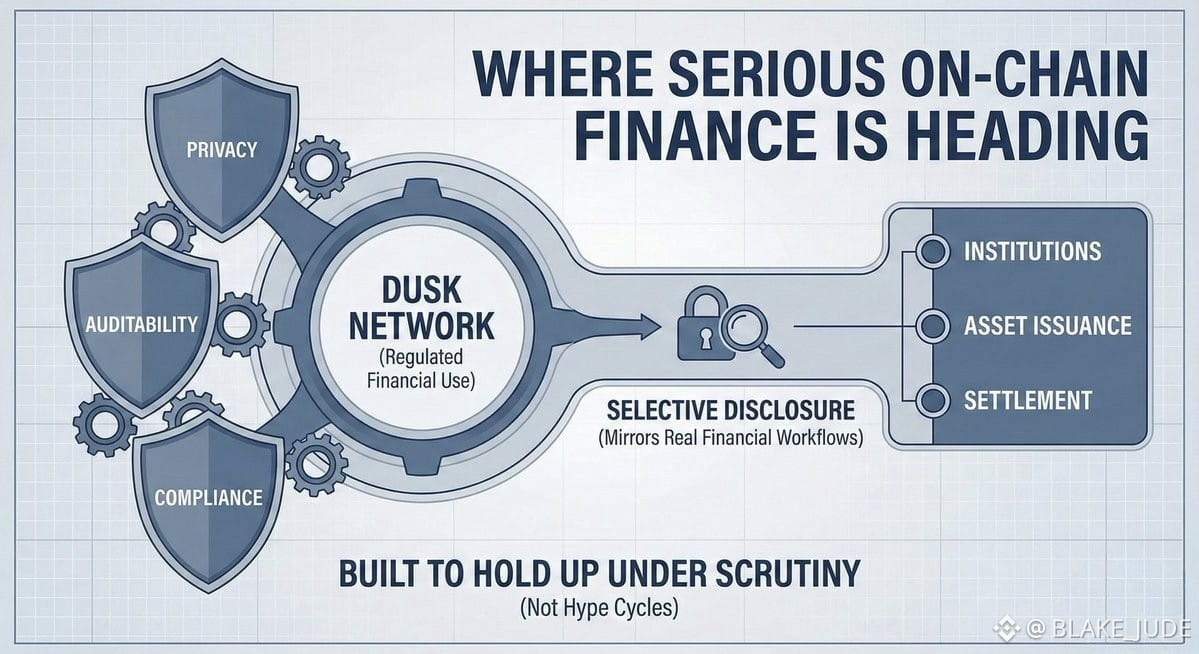
At its core, the founding philosophy of Dusk was born from frustration with how traditional markets operate. Most financial markets still rely on centralized, siloed systems where settlement processes are slow, counterparty risk is inherent, and the flow of critical data is exposed to too many intermediaries. Dusk aimed to change this by offering a decentralized market infrastructure that eliminates unnecessary intermediaries, speeds up settlement, and embeds compliance with regulatory frameworks such as the EU’s MiFID II, MiFIR, MiCA, and GDPR directly into the protocol rather than leaving it as an afterthought.
What makes Dusk particularly distinctive is its emphasis on privacy by design. Traditional blockchains like Bitcoin or Ethereum publish every transaction on a public ledger, which is at odds with how regulated markets function, where confidentiality is a necessity and public exposure can be a liability. To solve this, Dusk leverages cutting-edge zero-knowledge proof (ZKP) technology, allowing transactions and balances to remain confidential to the public while still verifiable and auditable by authorized parties like regulators. This ensures institutions can operate on-chain without exposing sensitive details to competitors or the general public, yet still satisfy compliance and audit requirements
This balance of privacy and transparency is more than a slogan—Dusk has built a modular architecture to make it technically feasible. At the base is DuskDS, a settlement and consensus layer that ensures data availability, privacy, and finality. Above it sits DuskEVM, an Ethereum-compatible execution environment that enables developers to deploy smart contracts with familiar tools but with privacy primitives integrated. Dusk also supports DuskVM, optimized for high-privacy applications written in WASM languages such as Rust, giving developers flexibility in how they build decentralized applications (dApps).
Driving these layers is a novel consensus mechanism called Succinct Attestation, a proof-of-stake protocol designed for financial use cases where fast settlement finality is essential. Unlike networks that tolerate lengthy reorganizations or probabilistic confirmations, Dusk’s approach delivers deterministic finality, meaning once a transaction is confirmed, it’s final—crucial for financial markets where settlement certainty underpins virtually every operation.
But the innovation doesn’t stop with architecture; it extends deep into the transaction models themselves. Dusk uses different transaction types that let developers and market participants choose the appropriate visibility level. Some transactions can be fully public where transparency is required, while others can be fully shielded, with transaction details encrypted on-chain but provable. This level of control is essential for institutions that need to handle KYC, AML, and other compliance checks without undermining individual privacy or regulatory obligations. 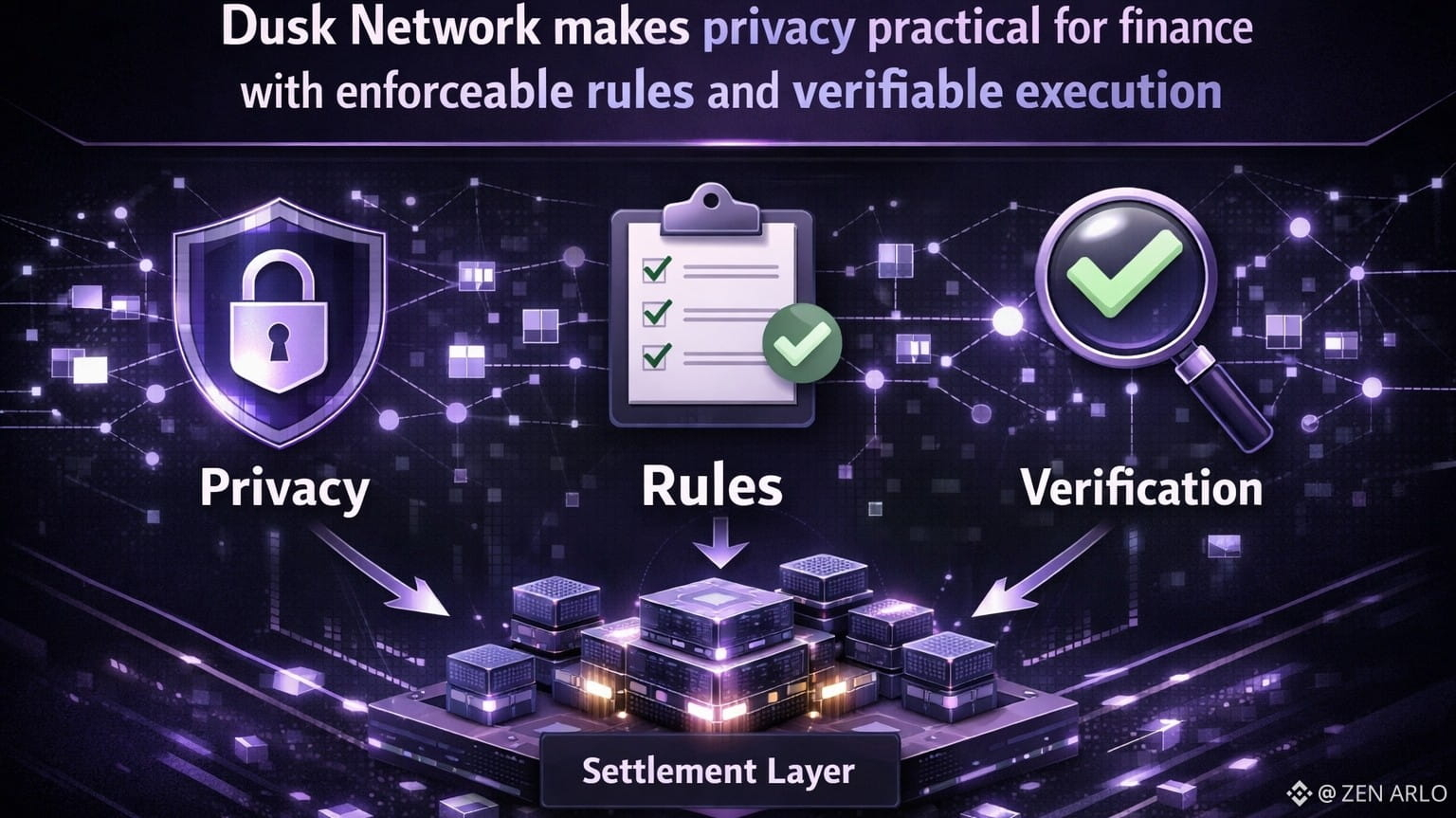
Beyond the technology, Dusk has been building meaningful real-world partnerships and infrastructure that signal its transition from concept to practical deployment. For instance, a regulated Dutch exchange, NPEX, plans to build tokenized securities markets on Dusk, embedding licensed financial operations directly on the blockchain. Another significant integration is with Quantoz to bring a MiCA-compliant euro-denominated stablecoin (EURQ) to the platform, a critical piece for on-chain settlement in regulated currency terms. The network has also adopted Chainlink’s oracle technologies to feed regulated European exchange data on-chain, marrying real and decentralized data streams.
Dusk’s approach to real-world asset (RWA) tokenization is equally noteworthy. Instead of treating tokenization as a mere novelty, Dusk’s infrastructure supports the Confidential Security Contract (XSC) standard, a suite of tools that allow companies to issue securities like shares, bonds, or funds on-chain with compliance logic embedded directly into the asset’s lifecycle. These contracts can automate corporate actions such as dividend distribution and voting rights, syncing them with regulatory requirements while maintaining privacy through zero-knowledge proofs.
The Citadel self-sovereign identity protocol further strengthens Dusk’s value proposition. Identity in financial systems is not just about identifying users but doing so in a way that protects personal data and satisfies legal demands for disclosure. Citadel allows users to prove compliance with identity requirements without exposing unnecessary personal details, aligning with modern data protection standards and paving the way for broader institutional trust in decentralized systems.
As the ecosystem matures toward mainnet and expands its developer community, Dusk’s potential impact on regulated finance continues to grow. It seeks not just to host decentralized finance applications but to enable a new class of institutional-grade financial services that are auditable, compliant, confidential, and decentralized. This vision resonates widely because it bridges the gap between the flat, transparent data models of blockchains and the complex, nuanced needs of financial markets regulated by law.
In sum, Dusk is more than another blockchain project; it is an ambitious attempt to reconcile two worlds that have long been in tension blockchain decentralization and real-world financial regulation. By embedding privacy, compliance, and modular architectural design at the core of its protocol, Dusk offers a compelling blueprint for the future of digital finance one where regulated assets can be issued, traded, and settled on a decentralized ledger without compromising confidentiality or legal integrity. As the network evolves, partnerships deepen, and the ecosystem grows, Dusk stands as a testament to what’s possible when privacy and regulation are not merely accommodated but embraced as foundational pillars
