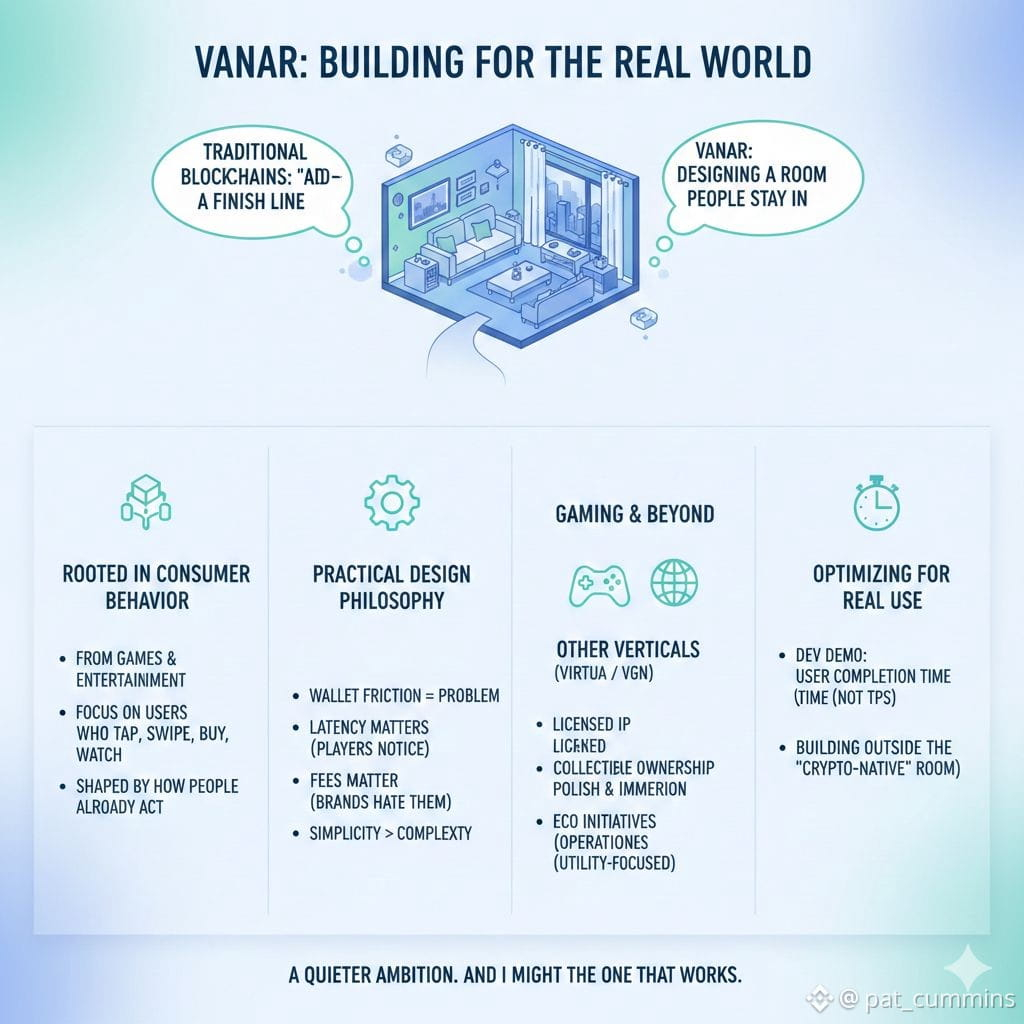
Most blockchains talk about “adoption” like it’s a finish line. Vanar treats it more like a room you have to design properly, or people won’t stay.
That difference shows up fast when you look at where the Vanar team comes from. Games. Entertainment. Brands that care about users who don’t read whitepapers and don’t want to. People who tap, swipe, buy, watch, and move on with their day. Vanar wasn’t shaped around crypto culture first it was shaped around consumer behavior, which is honestly rarer than it should be.
There’s a practical calm to the chain’s design. Things are meant to work quietly. Wallet friction is treated as a real problem, not a philosophical one. Latency matters because players notice it. Fees matter because brands hate explaining them. If something feels confusing, it probably doesn’t survive a product meeting. That mindset leaks into everything.
Gaming is where this becomes most obvious. Through products like Virtua, Vanar isn’t chasing abstract metaverse hype. It’s dealing with licensed IP, collectible ownership, and users who expect polish. If an ingame asset lags or breaks immersion, that’s not “early tech,” that’s just bad design. Vanar seems unusually aware of that line.
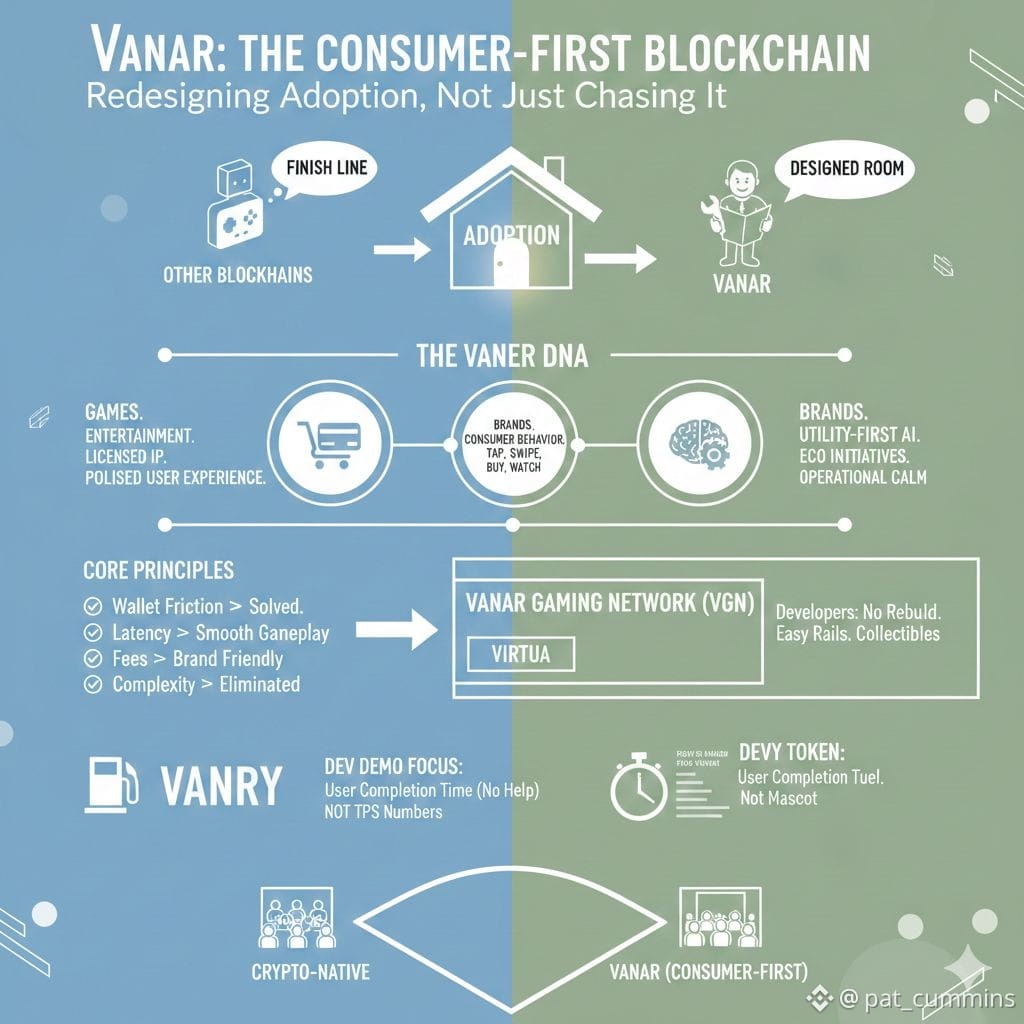
The same logic runs through the VGN games network. Developers don’t want to rebuild their entire pipeline just to touch Web3. They want rails that don’t get in the way. Vanar meets them there, instead of asking them to meet crypto halfway. That’s a subtle shift, but it changes who shows up.
There’s also a quieter expansion happening across other verticals. Brand tools that don’t scream “blockchain.” Eco initiatives that feel operational, not performative. AI integrations that focus more on utility than buzzwords. None of it feels rushed. Some of it feels almost boring which, in this space, is a compliment.
One micro detail I like: a developer demo where the emphasis wasn’t on TPS numbers, but on how long it took a noncrypto user to complete an action without asking for help. That tells you what they’re optimizing for.
Vanar is powered by the VANRY token, but it’s not framed as the star of the show. VANRY behaves more like infrastructure fuel than a marketing mascot. That choice won’t excite everyone. It’s also probably the point.
Here’s the blunt part: chains that build for crypto-native users only are arguing over a shrinking room. Vanar is clearly building outside of it.
Not everything will land perfectly. Some integrations will take longer than planned. A few experiments won’t matter in six months. That’s normal. Realworld adoption isn’t clean.
But the direction feels grounded. Less “what if Web3 changes everything” and more “how do people already behave, and how do we not break that.”It’s a quieter ambition. And it might be the one that actually works.