
Most people don’t care about blockchains. They care about whether money arrives, whether fees are predictable, and whether sending value feels simple instead of stressful. Stablecoins became popular because they solved a real problem—moving dollars quickly and globally—but the experience is still awkward in a way that only crypto can make awkward. You’re sending “digital dollars,” yet you often need a separate volatile token just to pay the network fee. You wait for confirmations that don’t feel final. You worry about choosing the wrong network. That gap between what stablecoins promise and how they actually feel to use is exactly where Plasma is trying to build.
Plasma’s idea is straightforward: it’s a Layer 1 designed for stablecoin settlement, not a general chain that happens to support stablecoins. The bet is that stablecoins are already crypto’s most proven product, so the next leap comes from making stablecoin payments faster, cleaner, and more reliable—closer to a modern payments rail and further away from a technical ritual.
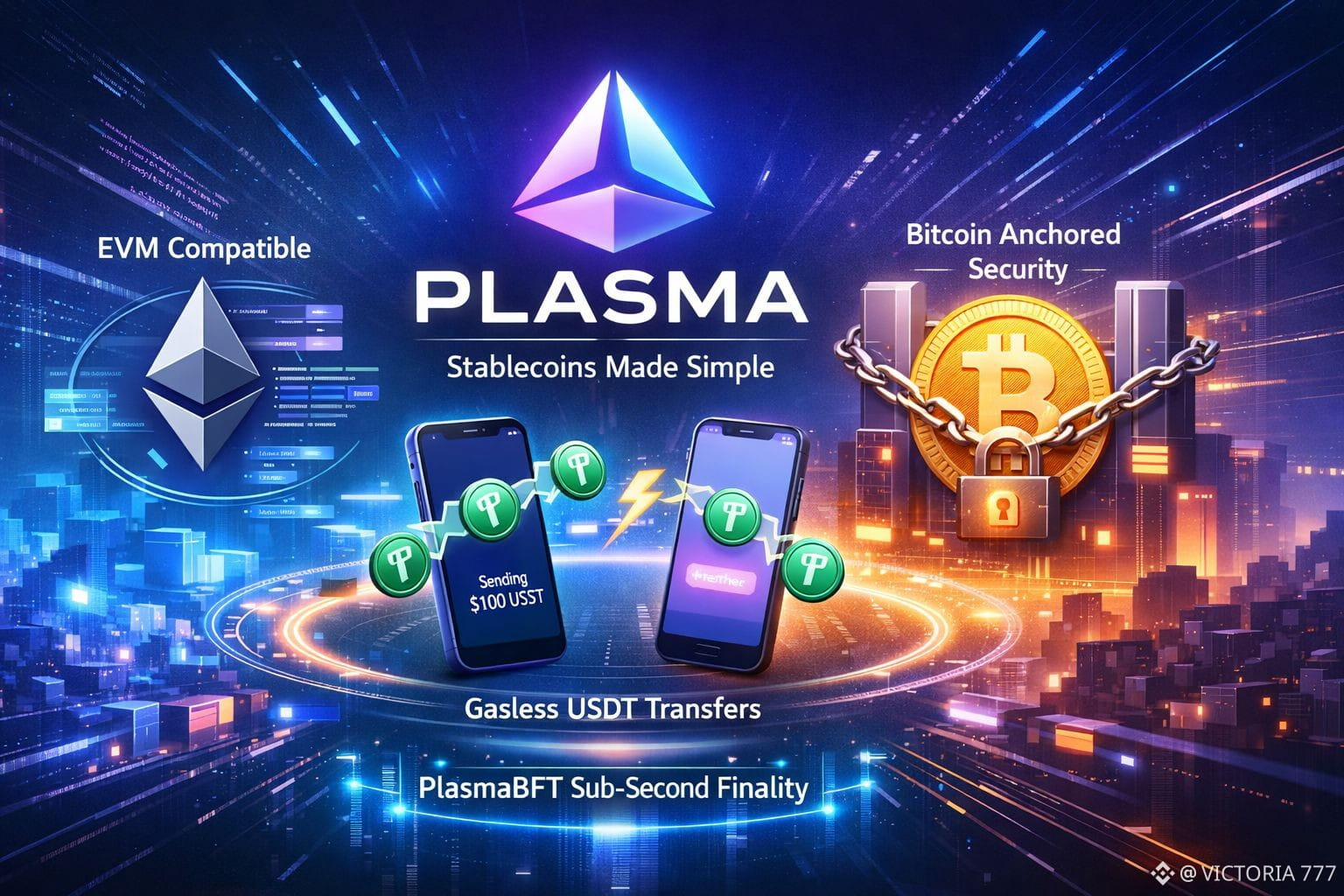
One smart part of Plasma’s approach is that it stays familiar where familiarity helps adoption. It is fully EVM compatible and uses a Reth-based execution layer, which means developers can deploy Ethereum-style smart contracts and reuse the existing toolchain instead of learning an entirely new environment. That matters because payments infrastructure grows through integrations—wallets, exchanges, bridges, payment apps, custody providers—not through ideology. Plasma is essentially saying: keep the developer surface area recognizable, then improve the settlement experience underneath.
That “underneath” is where Plasma tries to differentiate. Payments have a different standard than trading. When you pay, you want the payment to be finished, not “probably finished.” Plasma’s consensus design, PlasmaBFT, aims to deliver very fast deterministic finality so that transfers feel complete almost immediately. If Plasma can sustain this under real stress—spikes in volume, messy network conditions, validator issues—it becomes genuinely useful for payment flows. If it can’t, fast-finality marketing turns into reputational debt quickly, because payments are a trust business and users remember failure more than they remember throughput claims.
Then comes the problem end users actually feel: gas. The most damaging onboarding moment is telling someone they can send stablecoins, but first they need to buy a volatile asset just to pay fees. It doesn’t feel like money. Plasma leans into stablecoin-first features such as gasless USDT transfers and stablecoin-first gas to reduce that friction. The goal is emotional as much as technical: stablecoin transfers should feel like sending money on an app, not like managing a tiny portfolio just to cover network costs.
But “gasless” also creates the most important economic question: who pays? Nothing is truly free. If the user isn’t paying directly, someone else is subsidizing it—an application, a sponsor, a liquidity program, or the protocol itself. Subsidies can bootstrap adoption, but they can also attract low-quality activity that disappears as soon as incentives fade. Plasma’s credibility will come from proving that fee abstraction is sustainable and that transaction growth reflects real payments behavior rather than incentive loops.
This is where $XPL matters, and where Plasma’s token story becomes more nuanced than typical retail narratives. Plasma’s native token is meant to secure and coordinate the network—validators need incentives, the chain needs a native asset for core operations, and the ecosystem needs a mechanism for long-term alignment. But Plasma is also designing the user experience so that ordinary stablecoin users may not need to hold XPL day-to-day. That creates a real tension: if the best user experience reduces the need for the token at the consumer layer, what drives token demand?
The most realistic answer is that XPL’s demand may be concentrated among operators, not everyday users. If Plasma becomes a serious settlement rail, the people who care about XPL most will likely be validators securing the network, infrastructure providers running nodes and RPCs, liquidity players guaranteeing throughput, and institutions interacting with the system at scale. In that model, XPL behaves less like “a coin people spend” and more like “the coordination and security asset of the rail.” That can still support a meaningful token economy, but it depends on the network capturing real stablecoin flow and building a robust validator and ecosystem layer around it.
Tokenomics then becomes more than a chart; it becomes the chain’s growth budget and its supply pressure schedule. Plasma’s published model includes a large ecosystem allocation intended to fund adoption—integrations, liquidity, developer incentives, and goto-market executionalongside team vesting and public sale allocations. That’s normal for infrastructure, but it creates a clear risk profile. If ecosystem spending creates durable habits and sticky usage, it buys real network effects. If it mainly buys temporary “mercenary” capital and short-lived volume, it leaves behind unlock-driven sell pressure and a network that doesn’t retain users when rewards cool.
Plasma also emphasizes Bitcoin-anchored security as part of its neutrality and censorship-resistance story. In plain language, it is trying to strengthen trust in Plasma as a settlement layer by linking parts of its security narrative to Bitcoin’s established robustness. The idea can be meaningful, but it should never be treated as magical. “Anchored to Bitcoin” can mean different implementations with different guarantees. The practical investor question is always: what exactly is anchored, how frequently, and what concrete safety property does it provide if something goes wrong?
The bigger question for Plasma is not whether the narrative is attractiveit is. The question is whether Plasma can turn the narrative into boring, consistent proof. Settlement rails win by reliability, integration depth, and regulatory endurance. The next phase that matters is measurable: do stablecoin balances and transfers grow for real usage reasons rather than incentives? Do transactions reflect genuine payments behavior? Do fees and validator economics remain sustainable? Do payment apps and infrastructure providers integrate Plasma because it genuinely improves UX and settlement finality? Do institutional-grade compliance pathways and operating standards mature enough for serious partners?
If Plasma succeeds, it won’t feel like “another Layer 1.” It will feel like infrastructurequiet, dependable, and used by people who don’t care which chain they’re on. That’s what real adoption looks like, and it’s also the best way to judge $XPL : not by short-term hype, but by whether Plasma becomes a stablecoin rail people rely on repeatedly, even when incentives fade and the market stops cheering.
