Let’s step back for a second.
Crypto started as an experiment. Then it became a casino. Then it became a laboratory for new financial ideas. Somewhere along the way, people began asking a serious question.
Can this technology actually support real financial markets?
Not trading memes. Not yield farming loops. Real regulated finance.
That is where Dusk comes in.
Founded in 2018, Dusk Network is a layer 1 blockchain built for regulated and privacy focused financial infrastructure. But that description feels cold. The real story is more human than that.
Dusk is trying to solve a tension that almost everyone in crypto quietly ignores.
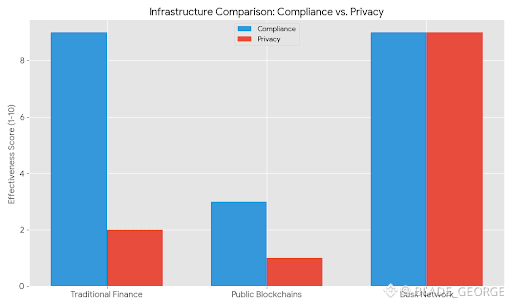
Public blockchains are transparent. Financial markets are private. Both are correct in their own way. But they clash.
Dusk is an attempt to reconcile that clash.
The Problem Most Chains Do Not Want to Deal With
If you move traditional financial products on chain, something strange happens.
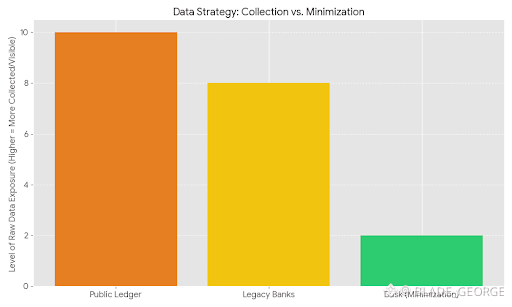
On a typical public blockchain, everything is visible. Wallet balances. Transfers. Contract logic. Transaction history. Anyone can inspect it.
That is great for trustless systems. It is terrible for institutions.
Imagine issuing company shares on a fully transparent chain where every investor’s position is public. Imagine settling bonds where competitor firms can see capital flows in real time. That does not work.
At the same time, fully private blockchains defeat the purpose of decentralization. If everything is hidden inside permissioned databases, then you are just recreating legacy systems with a new label.
So here is the real problem.
How do you build a blockchain that allows privacy where it is necessary, but still provides verifiability and compliance?
That is the narrow road Dusk is walking.
What Dusk Actually Is
Dusk is not trying to be the fastest chain. It is not chasing social hype. It is not competing for meme traffic.
It is building infrastructure for regulated digital assets.
That means tokenized securities. Real world assets. Financial instruments that require identity checks and legal compliance.
The core idea is selective privacy
Instead of making everything public or everything hidden, Dusk uses zero knowledge cryptography to prove things without revealing sensitive details.
For example, a participant can prove they passed compliance requirements without publishing personal information on chain. A transaction can be validated without exposing its exact financial data to the whole network.
That is a subtle but powerful difference.
It means privacy is not an afterthought. It is built into the architecture.
How It Works Without Getting Lost in Technical Fog
Under the hood, Dusk uses zero knowledge proofs to separate proof from data exposure. That is the foundation.
It also runs on its own consensus mechanism called Segregated Byzantine Agreement. In simple terms, this structure helps maintain network security while supporting confidential transactions.
Smart contracts on Dusk are designed to execute with privacy. This is important. On many chains, even if you hide wallet identities, contract logic remains visible. On Dusk, parts of contract execution can remain confidential.
The network is modular, which means it can evolve over time without breaking everything.
If you zoom out, Dusk looks less like a playground and more like a financial engine room.
It is not flashy. It is engineered
The Role of the DUSK Token
The DUSK token is the economic glue of the network.
Validators stake DUSK to secure the chain. Staking is not just about earning rewards. It creates accountability. If validators behave badly, they risk losing their stake.
DUSK is also used for transaction fees. So real economic activity on the network creates demand for the token.
This is important. The long term value of a token depends on whether it supports real economic throughput.
If Dusk becomes a backbone for tokenized assets and compliant financial applications, DUSK gains organic utility. If not, it remains mostly speculative.
The token model is relatively straightforward. It focuses on security and participation rather than complex incentive tricks.
The Ecosystem Feels Different
If you look at many layer 1 chains, you see gaming projects, NFT drops, experimental DeFi farms, social tokens.
Dusk’s ecosystem feels quieter.
It leans toward financial tooling and infrastructure. Token issuance frameworks. Compliance oriented applications. Building blocks for regulated markets.
That makes growth slower. But it may also make it stickier.
Retail users move fast. Institutions move slowly, but once integrated, they rarely switch infrastructure overnight.
Dusk appears to be aiming for that slower but potentially more stable segment of Web3.
Where It Seems to Be Heading
Over time, Dusk has focused on strengthening its mainnet, improving privacy systems, and refining staking infrastructure.
The broader market trend is shifting toward tokenization of real world assets. Governments, asset managers, and fintech firms are experimenting with blockchain settlement and digital securities.
If that direction continues, chains that are designed for compliance from the start may have an advantage.
Dusk seems to be preparing for a future where blockchain is not just for traders, but part of financial plumbing.
It is positioning itself as infrastructure, not a trend.
The Real Risks
Let’s be honest.
Institutional adoption is slow. Regulatory clarity is uneven across countries. Competing chains are also targeting tokenized assets.
There is also a deeper challenge. Crypto culture is built on openness and speed. Financial markets are built on caution and control. Bridging those mental models is not easy.
Technical complexity is another factor. Zero knowledge systems are powerful, but they require expertise. Developer onboarding must be handled carefully.
And of course, token value depends on usage. Infrastructure without traffic struggles to justify itself.
Dusk is building for a future that has not fully arrived yet. That is both its strength and its risk.
A System Level View
At a higher level, Dusk is trying to help crypto mature.
The first phase of crypto proved that decentralized systems can exist. The second phase explored financial creativity. The next phase may require integration with regulated capital.
For that integration to happen, privacy and compliance must coexist with decentralization.
Dusk is one attempt at solving that structural tension at the base layer.
It is not trying to be loud. It is trying to be usable by institutions without abandoning the core principles of blockchain.
That is a difficult balancing act.
Whether it succeeds depends on execution, adoption, and timing. But the problem it is addressing is real.
And in a space often driven by noise, there is something refreshing about a project focused on building quiet infrastructure for the long term.