 Most blockchains are built like big cities. They try to host everything, trading, NFTs, gaming, social apps, governance experiments. Stablecoins live there too, but they are just one more resident in a crowded place.
Plasma feels more like a town built around one purpose. It looks at crypto today and says something simple, most real economic activity revolves around stablecoins. People trade with them. They save with them. They send them across borders. In many countries with inflation or limited banking access, stablecoins are already acting like digital dollars. Yet the infrastructure underneath them was not designed specifically for them.
That is the starting point.
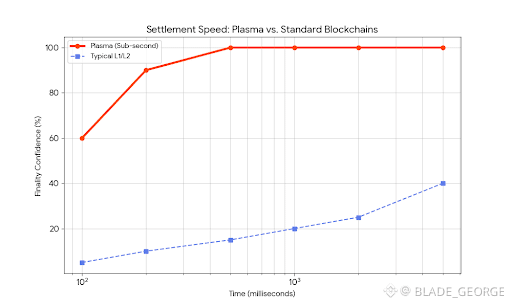
Plasma is a Layer 1 blockchain built specifically for stablecoin settlement. It supports full EVM compatibility through Reth, which means developers can use Ethereum tools and smart contracts without learning a new system. It runs on its own consensus model called PlasmaBFT, designed for sub second finality. In practical terms, that means transactions can feel almost instant and final very quickly. It also introduces stablecoin first features like gasless USDT transfers and the ability to use stablecoins as gas instead of forcing users to hold a separate volatile token. On top of that, it anchors its security to Bitcoin, aiming to benefit from Bitcoin’s reputation for neutrality and censorship resistance.
Those are the mechanics. But the heart of the project is more emotional than technical.
Imagine someone in a country where the local currency loses value every year. They get paid in stablecoins. They store savings in stablecoins. They send money to family in stablecoins. Now imagine they are told they must also buy another token just to pay network fees. That token goes up and down in price. It adds confusion and risk. For crypto natives this may feel normal. For everyday users, it feels unnecessary.
Plasma tries to remove that extra layer. If you hold USDT, you can send USDT, and you can pay fees in USDT. That simplicity matters. Adoption does not fail because of lack of technology. It fails because of small frictions that make people uncomfortable.
The sub second finality plays a similar role. When you send money in the real world through a digital banking app, you expect clarity. Did it go through or not. Many blockchains are fast, but still require waiting for confirmations to feel safe. Plasma’s design aims to make settlement feel decisive. For institutions moving large sums, that confidence reduces operational stress. For retail users, it reduces doubt.
The decision to be fully EVM compatible is also very human. Instead of asking developers to start from zero, Plasma meets them where they already are. Ethereum’s ecosystem is mature. Wallets, tooling, smart contracts, developers, audits, they already exist. Plasma plugs into that world rather than trying to replace it. That increases the chance of real apps being built instead of empty promises.
The Bitcoin anchoring is almost symbolic. Bitcoin is often viewed as the most neutral and censorship resistant blockchain. By tying part of its security to Bitcoin, Plasma is signaling that it wants to be seen as politically neutral infrastructure. For institutions especially, neutrality is not a slogan. It is a requirement. No one wants to settle millions of dollars on a system that could be easily influenced.
At a deeper level, Plasma is addressing a coordination problem in crypto. Stablecoins are everywhere, but they are scattered across many chains. Liquidity is fragmented. Users bridge assets from one network to another, increasing risk. Fees change depending on network conditions. It is messy.
Plasma is asking a simple question. What if there were a chain optimized specifically for digital dollar movement. Not for hype cycles. Not for endless experimentation. But for settlement.
If that focus works, it changes the economic model too. The value of the network would depend less on speculation and more on consistent transaction flow. Retail transfers. Merchant payments. Remittances. Institutional clearing. That kind of activity is less dramatic, but more durable. It is closer to infrastructure than to entertainment.
Tokenomics becomes a balancing act. Plasma will still need a native token for staking, validator incentives, and governance. Security does not run on goodwill alone. But if users are paying fees in stablecoins, the system must carefully route value back to validators and token holders without breaking the simple user experience. That tension will define whether the model is sustainable.
The ecosystem around Plasma will decide a lot. A settlement chain without wallets that feel intuitive will struggle. A payment chain without merchants or processors integrated will remain theoretical. If Plasma wants to serve both retail users in high adoption markets and institutions in finance, it must build bridges in both directions. That requires partnerships, integrations, and patience.
There are also real risks. Many chains already offer low fees and fast transactions. Plasma must convince users that specialization is worth moving for. Stablecoin regulation is evolving worldwide. A network centered on stablecoins is indirectly exposed to policy changes affecting issuers like USDT. And speed must never come at the cost of security. Sub second finality sounds attractive, but only if it holds under pressure.
In the end, Plasma feels like an attempt to calm crypto down a little. Instead of chasing every new trend, it focuses on what people already use daily. Stable value transfer. It treats stablecoins not as a side product of DeFi, but as the foundation of digital finance.
That approach may not generate the loudest headlines. But infrastructure rarely does. If Plasma succeeds, it might become one of those systems that people rely on without thinking about it. And in finance, being quietly reliable is often more powerful than being loudly innovative.