
Traditional transaction systems were designed to look finished before they actually are.
That decision has a cost.
Most financial infrastructure optimizes for confirmation, not completion. A transaction is marked successful because the interface needs closure, even when the underlying system is still resolving. This gap between appearance and reality is where delays, reversals, and disputes are born.
Dusk exists inside that gap.
Transactions are treated as moments.
Reality treats them as processes.
In legacy systems, a transaction is framed as a single event. Click, approve, done. But money does not behave that way at scale. It passes through checks, batching, clearing windows, and settlement layers. Traditional design hides this complexity, creating the illusion of certainty while uncertainty quietly accumulates underneath.
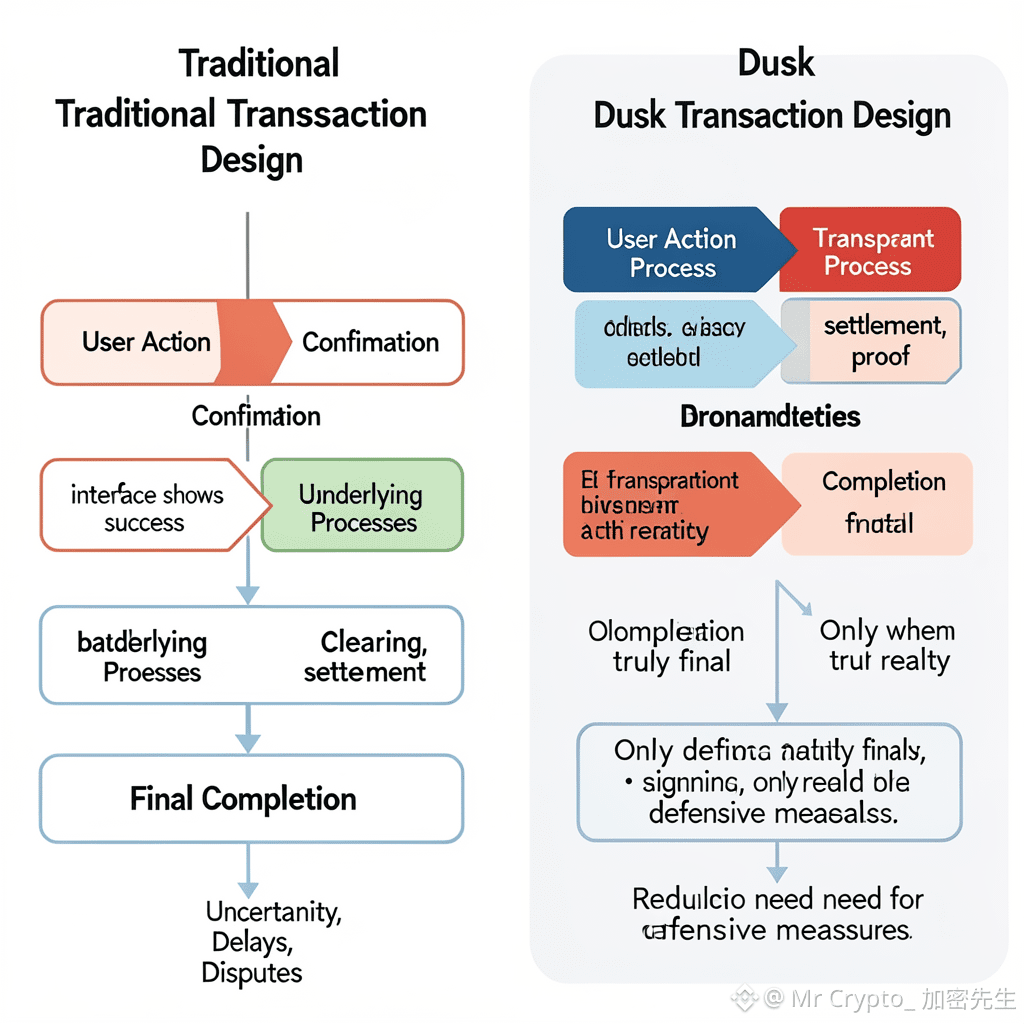
Dusk refuses to hide it.
The real cost is not slowness.
It is misalignment.
When systems signal completion too early, responsibility shifts incorrectly. Users believe money has moved. Businesses assume obligations are settled. Finance teams inherit the mismatch later. Reconciliation becomes forensic work. Support teams absorb frustration that originated in system design, not human error.
Dusk aligns signals with reality.
Design choices shape operational behavior.
Because traditional rails are unpredictable, platforms compensate defensively. They introduce payout windows. They delay withdrawals. They hold excess buffers. They create exception-handling teams whose only job is to clean up edge cases. These costs rarely appear on a balance sheet, but they shape growth decisions every day.
Dusk reduces the need for defense.
Finality is not a feeling.
It is a condition.
Dusk treats settlement as a state that must be earned, not assumed. A transaction is only considered complete when it is provable, traceable, and consistent across systems. This creates fewer surprises later, even if it feels less comforting in the moment.
Comfort is expensive.
Certainty is efficient.
Traditional systems externalize complexity.
They push reconciliation downstream. They push risk onto users. They push explanation onto support. Dusk internalizes complexity instead. It handles ordering, proof, and resolution at the protocol level, where it belongs.
This is quieter infrastructure.
Quiet scales better.
When transactions behave predictably, behavior changes.
Platforms can pay faster without fear. Finance teams can close books with confidence. Expansion into new regions feels less risky. Trust compounds because failures stop being routine.
Predictability unlocks momentum.
The hidden tax of old design is cognitive.
People stop trusting confirmations. They double-check balances. They open tickets preemptively. They wait longer than necessary. Systems that cry success too early train users to doubt them.
Dusk retrains expectations.
This is not innovation for spectacle.
It is innovation for alignment. Dusk challenges the assumption that transactions must perform certainty instead of producing it. By respecting the full lifecycle of a transaction, it lowers costs that most systems have learned to tolerate.
The future of transactions is not faster screens.
It is fewer corrections, fewer exceptions, and fewer apologies. Dusk does not eliminate complexity. It places it where it can be managed.
That is the real savings of better transaction design.
