
Most blockchains feel like they were designed by engineers arguing in a lab. Plasma feels more like it was designed by someone standing in a currency exchange line behind a migrant worker trying to send $200 home.
That difference in starting point changes everything.
Plasma is built around a simple, almost unfashionable idea: stablecoins are no longer a side quest in crypto — they’re the main event. Instead of treating USDT and other dollar-backed tokens as just another asset living on a general-purpose chain, Plasma treats them like the default reason the chain exists. The tech stack — EVM compatibility through Reth and fast finality through PlasmaBFT — matters, but mostly because it supports that one goal: move stable value quickly, cheaply, and predictably.
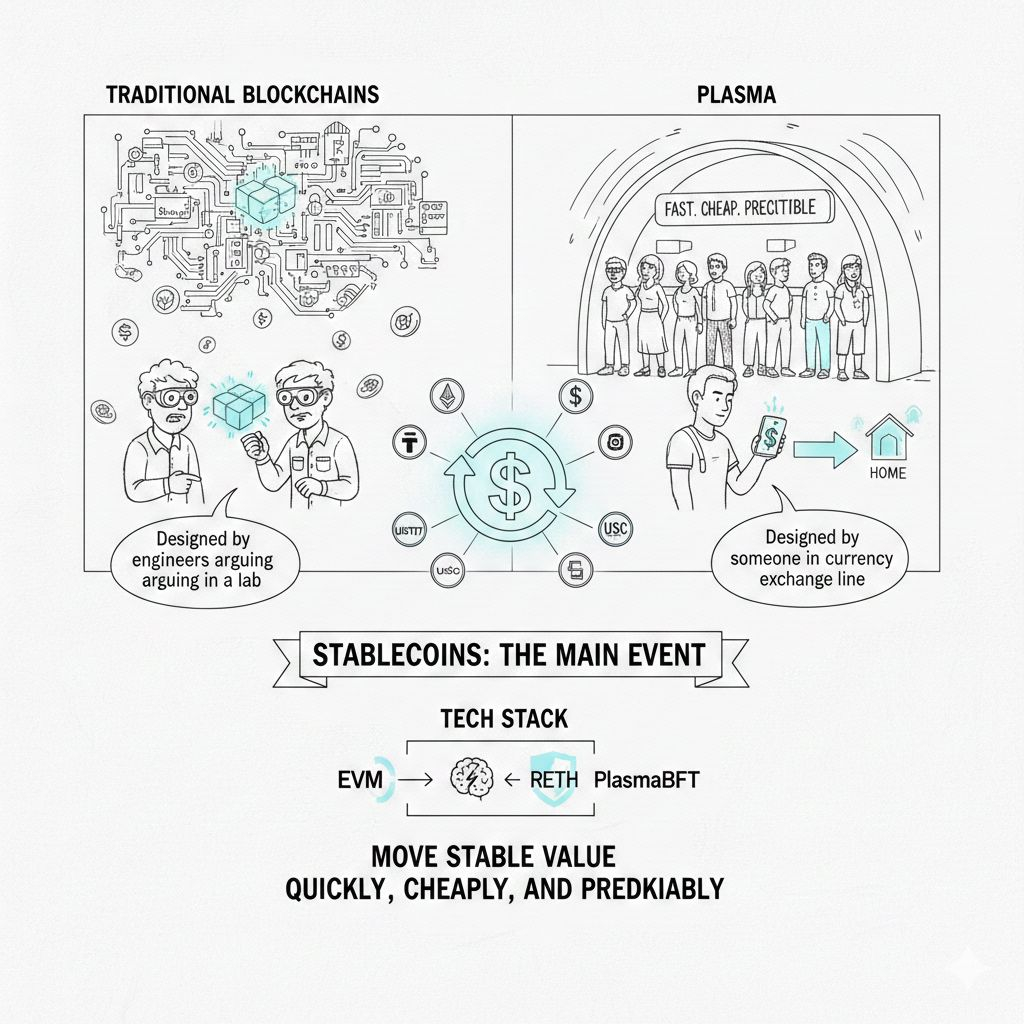
The first thing that stands out is what Plasma removes. On most chains, sending a stablecoin comes with a small but deadly bit of friction: you need a different token just to pay gas. That’s trivial for people deep in crypto. For everyone else, it’s where confidence collapses. Plasma’s approach to gasless USDT transfers, handled at the protocol level through a paymaster system, is less about “innovation theater” and more about social engineering. It removes the moment where a user has to ask, “Why do I need two kinds of money to send one kind of money?”
That single design choice quietly shifts the target audience from crypto natives to actual humans with actual financial stress. Remittance senders, freelancers paid in stablecoins, small merchants in high-inflation economies — these users don’t want to manage a portfolio of gas tokens. They want digital dollars that behave like digital cash.
Plasma pushes this logic further by allowing fees to be paid in assets people already hold, including stablecoins themselves. From a product perspective, that’s elegant. From a business perspective, it’s huge. Companies building payment flows on-chain don’t want their cost base swinging with the price of a volatile token. When fees are effectively denominated in dollars, budgeting and pricing start to look like normal finance again, not a speculative side bet.
Under the hood, Plasma is careful about where it experiments and where it doesn’t. It sticks with the EVM world so developers don’t have to relearn everything. That’s a pragmatic move: if you want apps and liquidity, you don’t ask builders to abandon their tools. The novelty lives in consensus and system design. PlasmaBFT is tuned for fast, near-instant finality — not because low latency sounds impressive in a benchmark, but because payments feel broken when you have to wait and hope.
Then there’s the Bitcoin angle. A lot of people read “Bitcoin-anchored security” as branding. I see it more as a signal about neutrality. Stablecoin rails are financial infrastructure, and financial infrastructure gets political fast. By anchoring its state to Bitcoin, Plasma is trying to inherit some of Bitcoin’s reputation as a hard-to-bully, hard-to-rewrite base layer. Whether that fully plays out in practice will depend on details like validator decentralization and governance, but the intent is clear: be a payments network that’s harder to quietly pressure or reshape.
What makes Plasma especially interesting is how closely it’s tied to real stablecoin usage patterns, not just crypto narratives. In many emerging markets, USDT is already functioning as a parallel dollar system. It’s used to hedge against inflation, to move money across borders, and to store value outside fragile banking systems. Plasma isn’t trying to convince those users to adopt stablecoins — they already have. It’s trying to give their existing behavior a better highway.
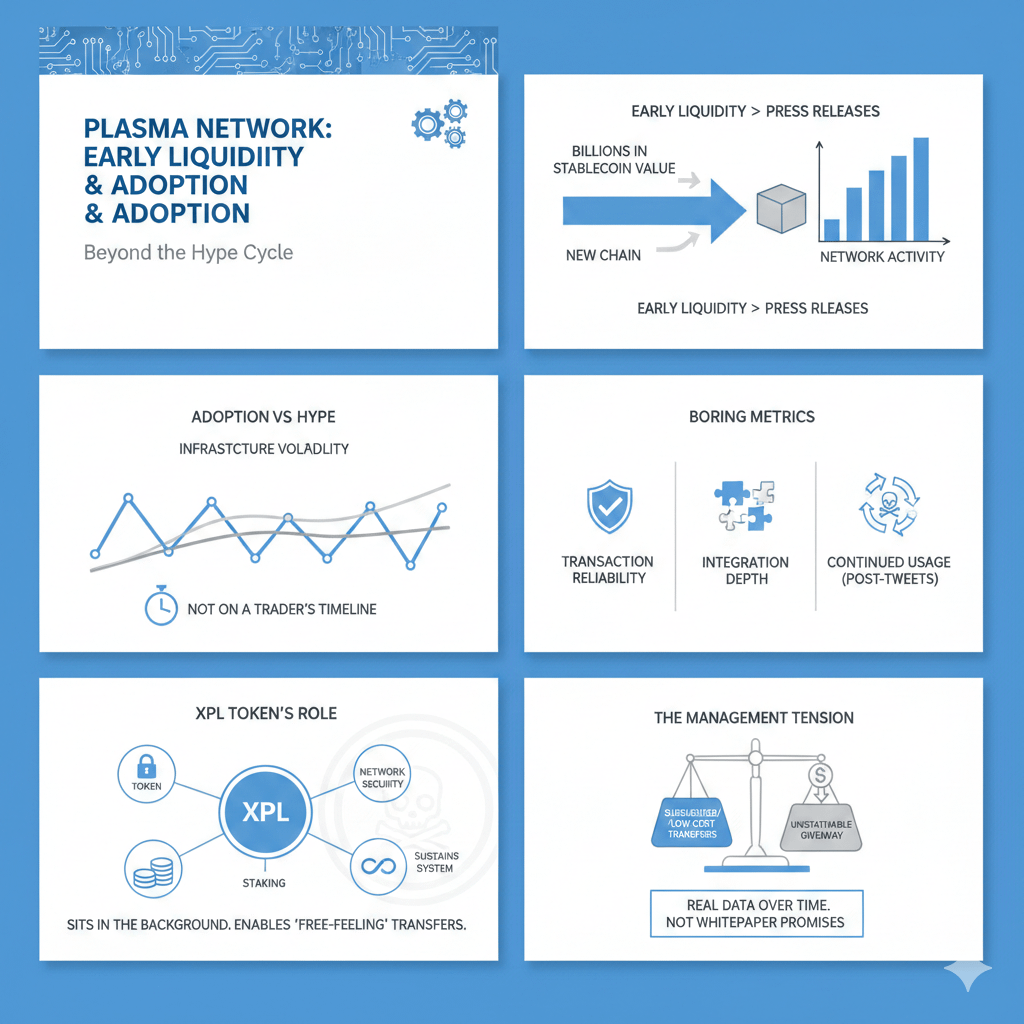
Early liquidity and activity on the network matter more than press releases. Billions in stablecoin value moving onto a new chain signals that major players are at least willing to test these rails. At the same time, token price volatility and the typical post-launch hype cycle remind us that infrastructure adoption doesn’t happen on a trader’s timeline. A payments chain lives or dies on boring metrics: transaction reliability, integration depth, and whether people keep using it when nobody is tweeting about it.
The role of the native token, XPL, is also more restrained than on many Layer 1s. Users are not meant to feel it constantly. It sits in the background, tied to staking and network security, helping sustain the system that makes “free-feeling” stablecoin transfers possible. That creates a subtle tension Plasma will have to manage: how to fund subsidized or low-cost transfers without turning the system into a spam magnet or an unsustainable giveaway. The answer will come from real data over time, not whitepaper promises.
The bigger picture is that Plasma represents a shift from blockchains as experimental playgrounds to blockchains as financial plumbing. Plumbing isn’t glamorous. When it works, nobody notices. That’s exactly the kind of invisibility Plasma seems to be aiming for. If it succeeds, users won’t talk about Plasma the way people talk about hot DeFi chains or meme ecosystems. They’ll just send money, across borders, at odd hours, in dollar-denominated tokens and it will quietly go through.
To me, that’s the most radical part. Plasma isn’t trying to make crypto louder. It’s trying to make it disappear into the background of everyday financial life.