
@Dusk There’s a small moment in online gaming that carries more weight than it should: you decide to deposit, you hit confirm, and you wait to see whether the money lands cleanly or the screen coughs up an error. That pause is where excitement can turn into doubt. Nuvei recently put some hard numbers behind that feeling. In a survey of 6,000 gamers, 55% said they abandoned a purchase in the past 12 months because of a payment or checkout issue, and 91% said they worry about unauthorized charges.
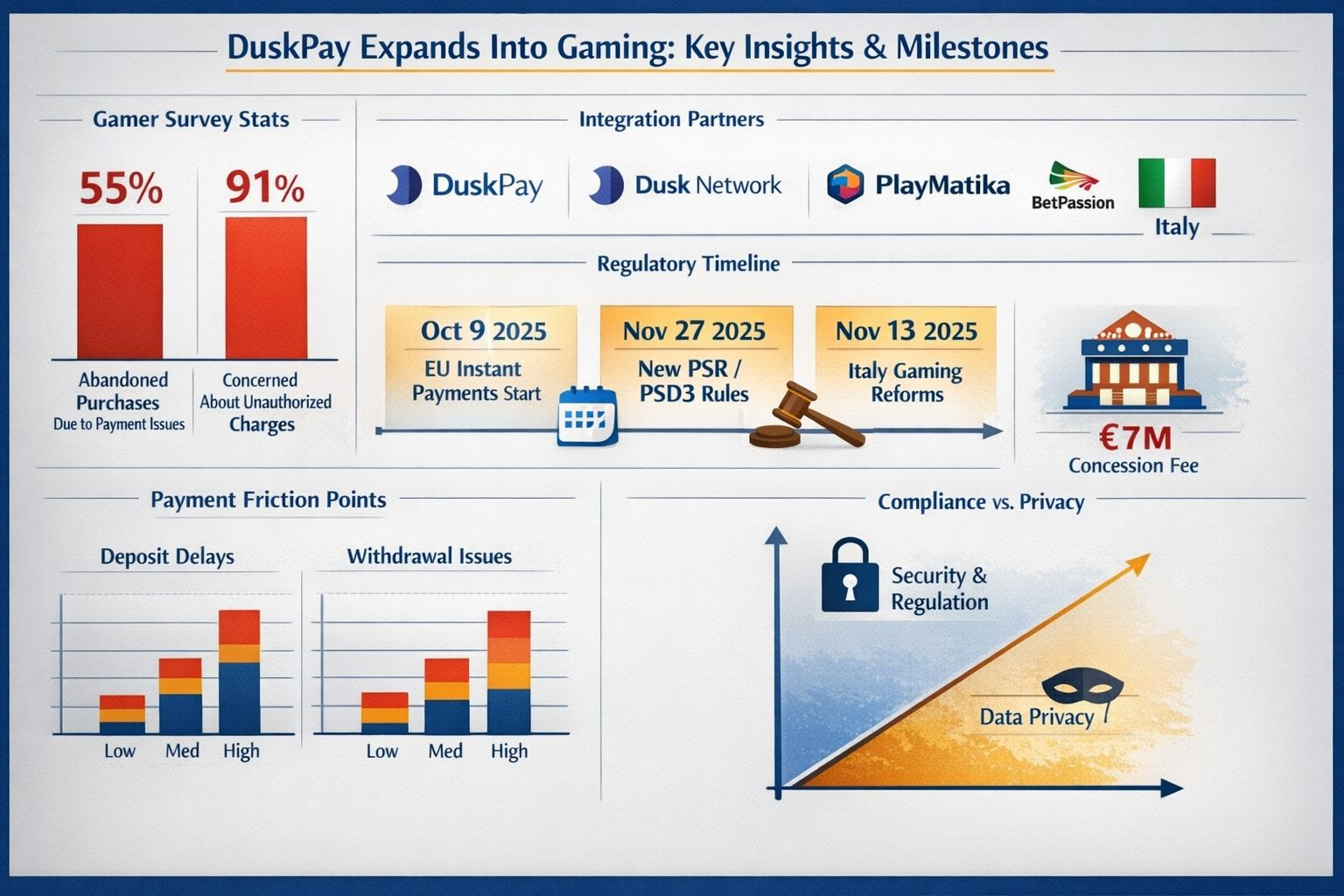
That’s the backdrop for why DuskPay’s move into gaming has gotten attention outside the usual crypto bubble. Dusk Network says it launched DuskPay as a payment infrastructure built for “speed, security, and compliance,” and that PlayMatika and BetPassion—both authorized Italian online gaming operators—will integrate it into their platforms. If you strip away the buzzwords, the headline claim is simple: this is meant to be invisible to the player. No “learn crypto,” no weird wallets, no extra steps—just a payments layer that’s supposed to work quietly in the background while still satisfying the kind of rules that make most consumer fintech products flinch.
The part that matters most here is the “Dusk Network” piece. Dusk isn’t positioning itself as a general-purpose chain for anything and everything. In its own documentation, it describes itself as a privacy blockchain for regulated finance—built so institutions can meet regulatory requirements on-chain while keeping balances and transfers confidential, with the option to reveal what’s needed to authorized parties. That design goal is exactly the tension gaming operators live with every day: you need strong fraud controls, identity checks, and auditability, but you also need to protect player data and keep the user experience smooth. Dusk has been explicit about the idea that privacy and compliance don’t have to be enemies, pointing to “zero-knowledge compliance” and selective disclosure as ways to prove rules are met without exposing everything. DuskPay, in that sense, is less a side project and more a “show your work” moment for what the underlying network claims it’s good at.
Gaming is also a brutally honest environment to test payment ideas, because it punishes friction fast. A delayed deposit is annoying anywhere, but in a game it feels like the whole experience is stalling at the door. Withdrawals are even more sensitive. If players don’t trust the payout flow, everything else—the interface, the odds, the community—starts to feel shaky. I’ve watched people quit a platform over payment weirdness long before they’d ever leave because of the actual game. They don’t file a complaint. They just stop trying. Nuvei’s data basically confirms that silent behavior at scale.
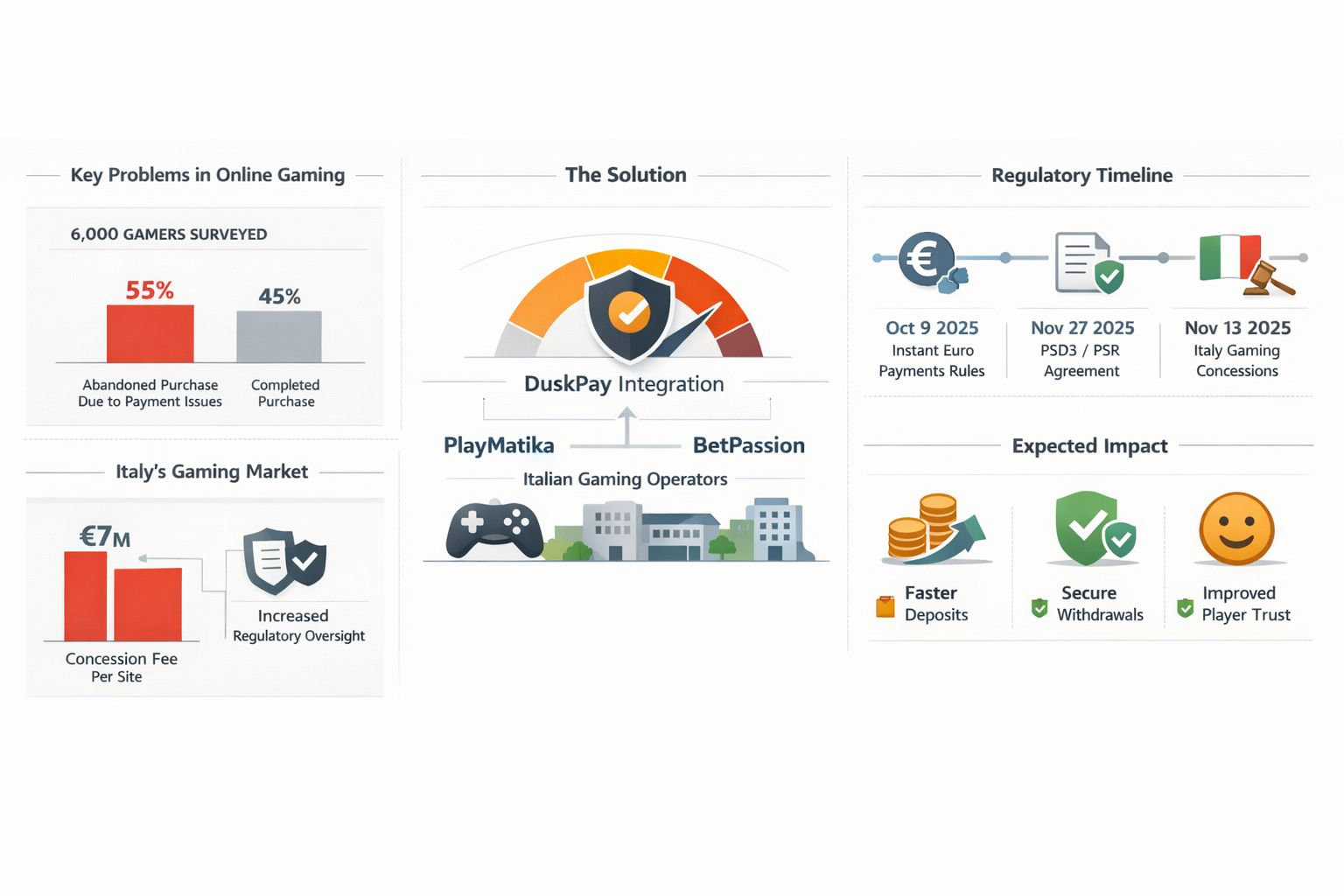
The timing is doing DuskPay a favor, too. Europe has been raising the bar on what “good payments” should look like in practice. New EU rules around instant euro payments kicked in on October 9, 2025, pushing the market toward 24/7 instant transfers and stronger checks like verification of the payee. And on November 27, 2025, the Council and Parliament announced a provisional agreement on a new payments framework (PSR/PSD3) aimed at stepping up anti-fraud measures and increasing transparency—explicitly including IBAN-name checks and liability expectations for payment service providers. You don’t have to be a policy nerd to feel what that means: “fast” isn’t the only target anymore. “fast, but safer—and provably so” is where things are heading.
Italy adds another layer of why this particular integration feels current. Legal analysts have described the new remote gaming concessions coming into force on November 13, 2025 as a tightening and reorganization of the market, with more emphasis on operational transparency and responsible gaming. And the economics are serious: Italy’s remote gambling regime has been widely reported as involving a €7 million concession fee per website/concession under the newer framework, which is the kind of number that makes operators care deeply about payments reliability and audit trails.
So when the title says “DuskPay expands into gaming,” it’s really saying: Dusk Network is trying to prove its regulated-finance thesis in a high-volume, tightly supervised market where payments are part of the product. Dusk’s own announcement frames DuskPay as instant, cross-border, and compliant—designed for regulated sectors like online gaming—while arguing that this is the sort of real-world payment flow blockchain should be able to handle.
Will it work the way it’s described? That’s the fair question, and it’s where the hype should end and the practical details should begin. “Instant” is easy to promise and hard to deliver consistently when real users, real banks, and real fraud attempts show up. The meaningful test won’t be whether DuskPay is blockchain-based. It’ll be whether PlayMatika players simply notice fewer failed deposits, fewer confusing delays, and fewer moments where trust slips. If Dusk Network’s privacy-and-compliance approach actually helps operators thread that needle—keeping sensitive data protected while staying audit-ready—then the integration won’t just be relevant to the title. It’ll be relevant to where European payments are headed right now.