
The verification finished.
Clean. In-window. No ambiguity in the path that ran. The result exists, anchored to the execution that produced it, sealed the way Dusk seals things when nothing violates the rule frame.
And then the room tried to look at it together.
One person could open it. Another couldn’t. A third saw a reference that resolved into nothing at all. Same transition. Same hash. Same moment. Different visibility, depending on who was asking.
That’s when the friction starts.
Because nobody is arguing about whether the result is real. Everyone agrees it is. The disagreement is quieter: can we all confirm it at the same time?
On Dusk, verification doesn’t promise that.
The proof resolves where it’s entitled to resolve. Viewer scoping is set at execution, not negotiated afterward. Dusk's Disclosure timing already passed its boundary. What you’re allowed to see now is exactly what you were allowed to see then. No widening. No courtesy replays.
So the verification sits there, correct and finished, but not jointly inspectable.
Someone tries to bridge it with a screen share.
“Can you scroll down?”
“I don’t have that field.”
“Refresh?”
Nothing changes.
The person who can see it starts narrating instead. Reads values out loud. Describes the structure. Hesitates before repeating something that feels like it wasn’t meant to travel by voice.
Someone else asks for the export.
There isn’t one.
Not because it failed to generate. Because nothing portable was ever minted. The verification is bound to context. It resolves inside scope. It’s not a thing you pass around to make everyone feel aligned.
That absence does more damage than a hard denial would.
No error banner to rally around. No rejection to explain. Just an awkward asymmetry where half the room is staring at something the other half can’t confirm even exists.
The meeting stalls on a strange question.
“How do we sign off on something we can’t all see?”
No one answers quickly, because everyone understands what the real answer implies.
You don’t.
Not together.
Dusk doesn’t treat shared visibility as a default condition of truth. Validity isn’t a social object. It’s not improved by being observed by more people. The verification doesn’t get stronger because more eyes touch it.
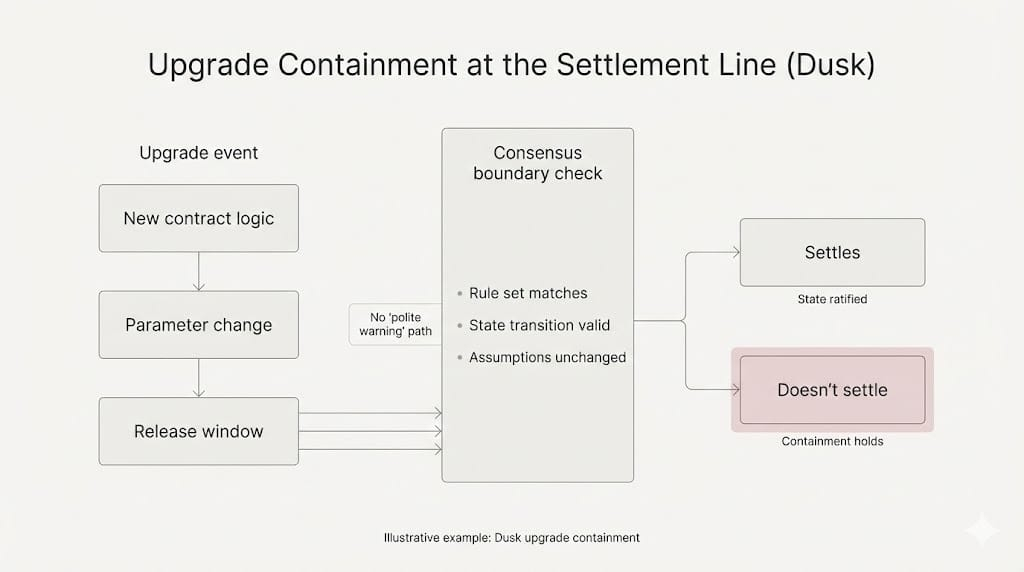
But organizations are built around shared inspection. Reviews assume everyone in the room can point at the same thing. Trust is procedural, not scoped. When that assumption breaks, the process starts shedding parts.
Someone suggests producing a summary.
Who writes it. Under which scope. Based on which view. And who’s responsible if the summary drifts just enough to matter later.
Silence again.
Another idea... add more people to the viewer set.
That ship sailed earlier. Disclosure timing closed with execution on @Dusk . You don’t reopen it because a meeting feels uncomfortable.
So the verification remains where it is.
Finished. Correct. Unevenly visible.
The people who can see it stop trying to convince the others. They know persuasion isn’t the problem. The others stop asking for proof. They know asking again won’t widen the scope.
The process adapts the only way it can.
One person attests verbally. Another records that attestation. A third logs the fact that a verification occurred without attaching anything that could be forwarded later. It feels thin. It feels fragile. It feels like a downgrade.
But nothing on the chain degraded.
The verification didn’t fail. It didn’t half-complete. It didn’t wait. It did exactly what it was allowed to do, exactly where it was allowed to do it.
The discomfort lives entirely outside that boundary.
The result stays valid.
The room never quite shares it.