
When I first looked at Dusk, I stopped thinking about “another layer-1” and started thinking about a bank vault with a glass wall.
Not glass that lets everyone on the street peek in. More like museum glass: it protects what’s inside, but it’s also designed for controlled viewing when someone has a key, an authorization letter, and a reason to inspect. That’s the feel Dusk is going for—privacy that doesn’t collapse the moment compliance shows up, and compliance that doesn’t require broadcasting everyone’s financial life to the world.
A lot of blockchains end up choosing a personality by accident. Some are basically public bazaars where every move becomes a signal to competitors. Others lean so hard into secrecy that proving anything to anyone becomes a separate project. Dusk’s pitch—regulated, privacy-focused infrastructure—lands differently because it’s not trying to make finance “edgy.” It’s trying to make finance work the way it already has to work in real life: confidential by default, auditable when necessary.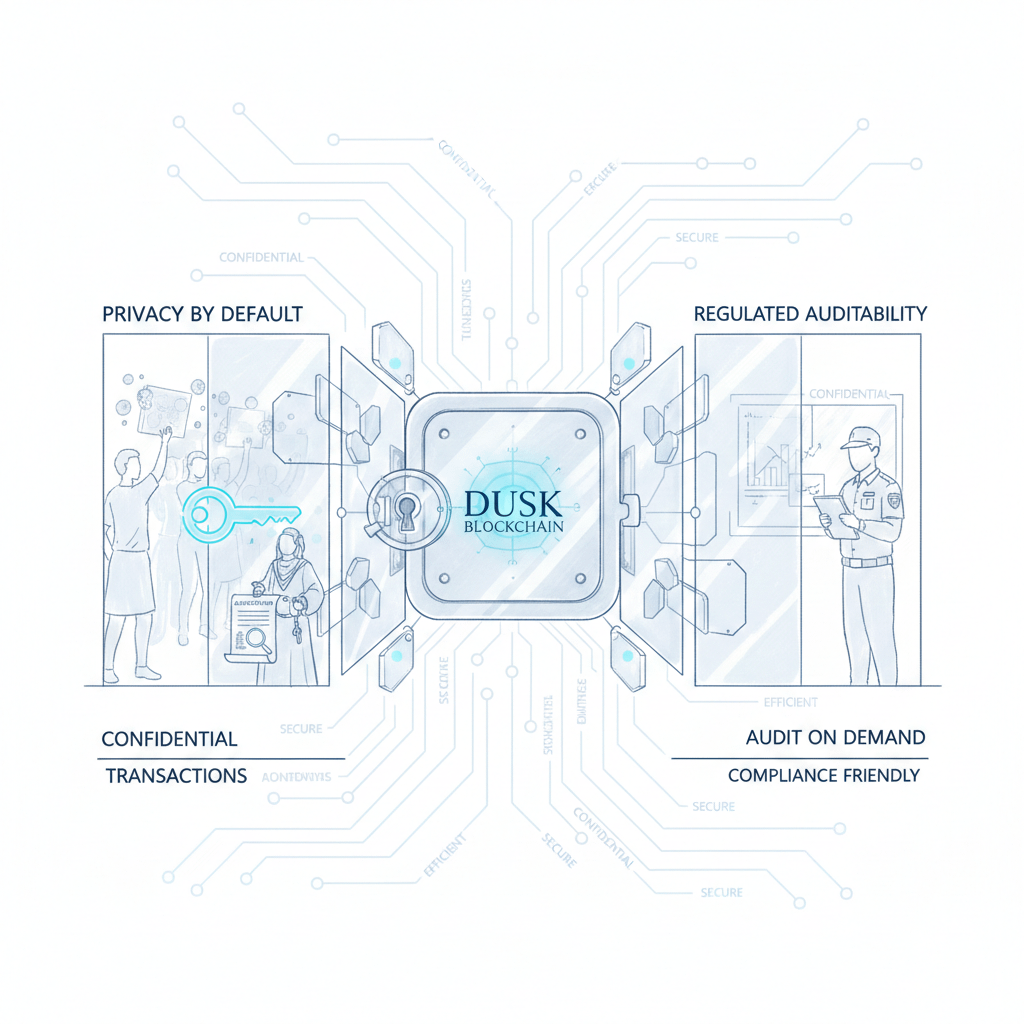
The thing that makes that feel less like a slogan and more like engineering is how Dusk splits its design. In Dusk’s own documentation, the stack is modular: there’s a base layer (DuskDS) for settlement/consensus/data availability, and an execution layer (DuskEVM) that supports EVM-style development. I read that like a building with two systems: the structural skeleton is built to be stable and boring, while the interior can be upgraded without touching the foundation. That’s exactly how you design for institutions—because “move fast and break things” is a cute motto until the thing that breaks is settlement finality.
And the EVM side isn’t just a vague “we’ll support developers.” Even the bridge guide makes a direct point: once you’re operating in the DuskEVM environment, DUSK is used as the gas token for interacting with contracts. That matters because it ties the network’s token utility to actual usage rather than narrative.
I also like looking at chains the way you’d look at infrastructure rather than hype: does it have a steady heartbeat? On Dusk’s explorer, you can see operational stats like average block time around ~10 seconds and the cadence implied by the daily block counts shown on the blocks page. That sounds mundane—and it is—but regulated finance is basically a religion built around predictable routines. A chain that can’t stay steady under normal conditions has no business calling itself financial infrastructure.
Then there’s DUSK itself. The tokenomics aren’t written like a treasure map; they’re written like an operator manual. Staking is framed as participation in consensus, fees cover network usage and deploying applications, and there are explicit mechanics around staking minimums, activation delays measured in epochs, and penalties for misbehavior or poor uptime. That’s not “buy and hope.” That’s “operate and be accountable.”
Even small details tell you what kind of product mindset is behind it. Dusk prices gas in LUX, where 1 LUX = 10⁻⁹ DUSK. That’s just a unit, but it’s also a quiet UX choice: people hate squinting at long decimals just to understand a fee.
Where it starts to feel most real, though, is when you look at how Dusk is trying to plug into regulated market structure instead of just repeating “RWA” like a magic spell. Dusk has publicly described its partnership with NPEX in terms of building toward a blockchain-powered securities exchange environment—issuance and trading of regulated instruments, not just tokenizing something for a demo.
Independent analysis adds more context around how NPEX relates to the EU’s DLT Pilot Regime and why a regulated venue would care about the particular features a blockchain can offer (and the constraints it has to meet).
And then there’s the “cash leg,” which is the part people skip when they talk about tokenized securities. Quantoz Payments’ post about EURQ frames it as a digital euro initiative involving Quantoz Payments, NPEX, and Dusk. I’m not reading that as a marketing bullet. I’m reading it as an attempt to get the settlement plumbing right—because moving assets around is only half the job; you also need a credible, regulated way to settle value.
Interoperability falls into the same bucket for me. In crypto, it’s sold as “more liquidity.” In regulated markets, it’s closer to “less friction and fewer bespoke integrations.” The announcement around Dusk/NPEX adopting Chainlink CCIP frames it as interoperability and data standards for regulated institutional assets on-chain. If you’re serious about institutions, you can’t just build a nice island—you need bridges that don’t turn into compliance nightmares.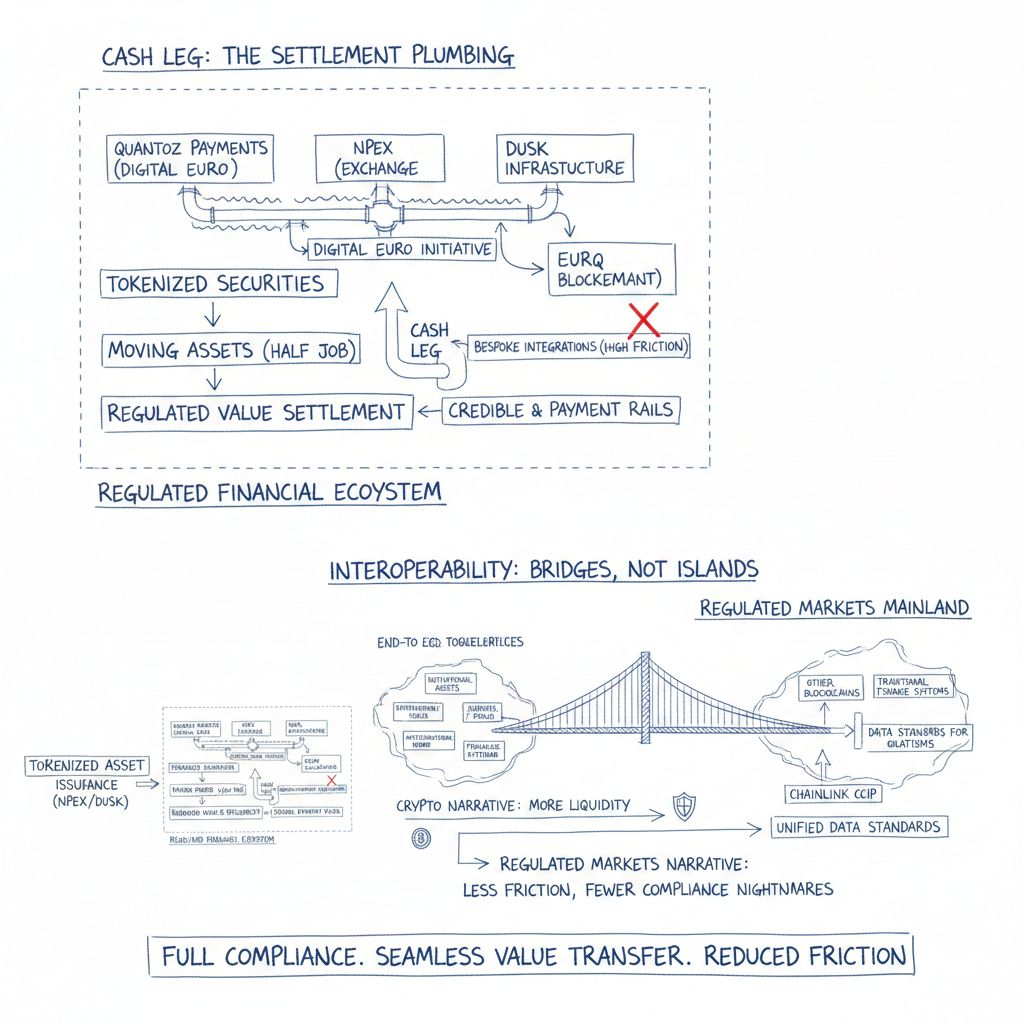
My honest takeaway is that Dusk isn’t really competing with whatever chain is trending this week. It’s competing with spreadsheets, reconciliations, and the whole informal machine of back-office workflows that exists because the alternatives either leak too much information or don’t satisfy compliance.
If Dusk can keep building in this direction—steady chain operation, an EVM environment that makes it easier to ship apps, token utility that maps to real network activity, and partnerships that actually resemble regulated market structure—it could end up being one of those projects that looks “quiet” in the crypto timeline but turns out to matter in the places where quiet reliability is the whole point.