
When I first started looking into Vanar, what stood out wasn’t a flashy metric or a loud promise. It was the tone of the project itself. Vanar doesn’t feel like it’s trying to win an argument on Crypto Twitter. It feels like it’s trying to quietly solve a problem that most blockchains avoid because it’s not glamorous: how do you make blockchain technology behave in a way that normal people, normal companies, and normal products can actually rely on every day?
A lot of Layer 1s are built with engineers talking to other engineers. Vanar feels like it was shaped by people who have shipped consumer products and learned the hard way where things break. If you’ve ever worked in gaming, entertainment, or brand-driven platforms, you know that users don’t care about decentralization philosophy or throughput charts. They care about whether something loads instantly, whether it costs the same today as it did yesterday, and whether it works without forcing them to think.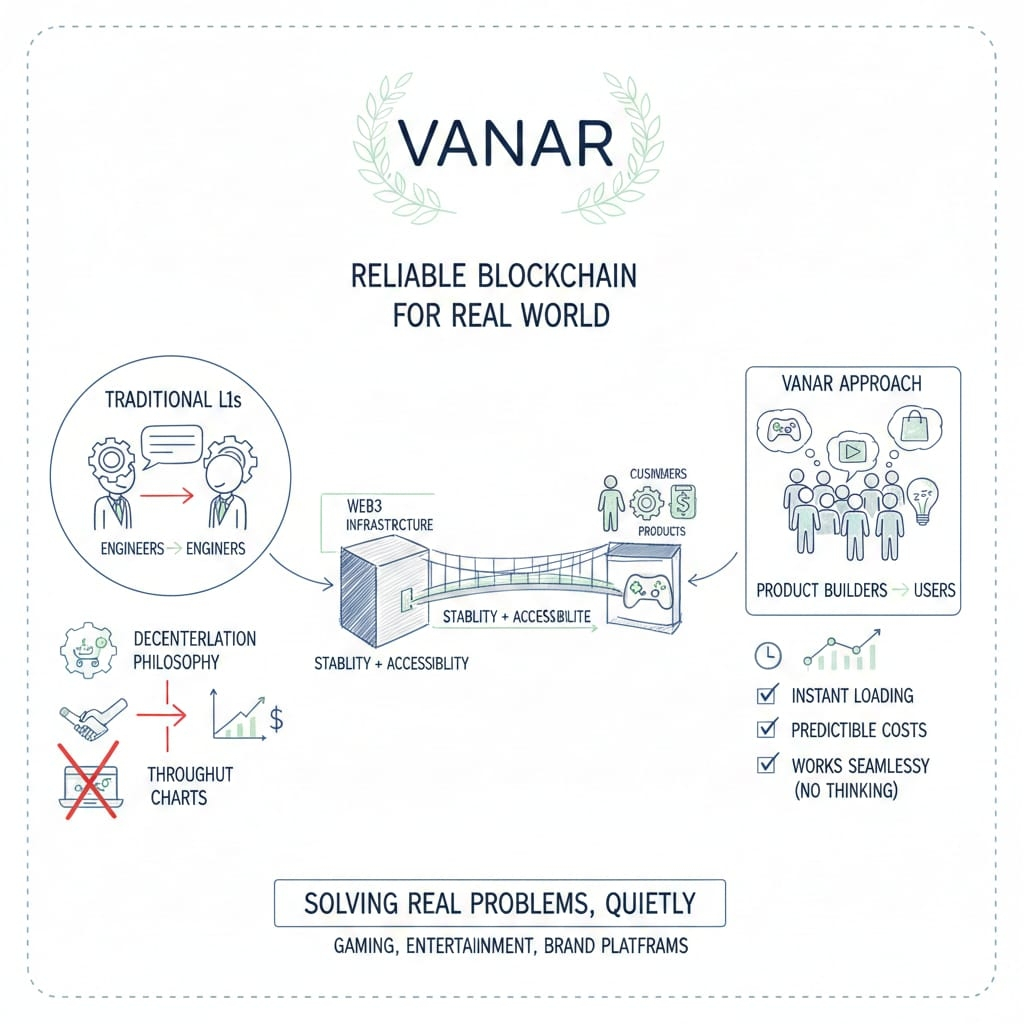
That mindset shows up immediately in how Vanar approaches fees. Instead of celebrating volatility as “market-driven,” Vanar leans into predictability. A transaction costing a fraction of a cent doesn’t sound revolutionary until you imagine millions of micro-actions happening inside a game, a metaverse environment, or a loyalty platform. At that scale, unpredictable costs don’t just hurt margins—they destroy product design. Vanar’s focus on stable, low transaction fees feels less like a blockchain feature and more like a product requirement someone learned by watching users drop off when things got complicated.
What really separates Vanar from the endless stream of “next-gen L1s,” though, is how it treats data. Most blockchains treat data like a receipt stuffed into a drawer. It proves something happened, but it’s not something you can easily work with afterward. Vanar’s Neutron layer flips that idea around. Instead of just anchoring hashes, it tries to compress, structure, and store information in a way that makes it meaningful and retrievable later. The concept of turning large files into compact, AI-readable “Seeds” isn’t just about storage efficiency—it’s about making on-chain data useful beyond simple verification.
That matters a lot more than it might seem at first glance. Real-world adoption doesn’t come from one-off transactions. It comes from systems that remember things: ownership histories, credentials, licenses, in-game assets, brand agreements, identities. Neutron feels like Vanar acknowledging that memory is just as important as speed, and that blockchains need to evolve beyond being glorified ledgers if they want to support real economies.
Then there’s Kayon, which is where Vanar’s thinking gets even more interesting. Kayon is positioned as a reasoning layer—something that can evaluate conditions and rules before actions take place. In plain terms, it’s about reducing the gap between “data exists” and “something happens because of it.” That gap is where most real-world blockchain use cases fall apart. They end up relying on off-chain scripts, manual approvals, or fragile middleware. Vanar’s attempt to bring logic and decision-making closer to the chain itself suggests they’re thinking about workflows, not just transactions.
Of course, no system is purely on-chain in practice, and Vanar won’t be an exception. But there’s a meaningful difference between chains that bolt AI and logic on as an afterthought and a chain that’s architected with reasoning in mind from the beginning. Kayon feels like an acknowledgment that automation, compliance, and intelligence aren’t optional if blockchain wants to leave the experimental phase.
The VANRY token sits at the center of all of this, but not in a vague “utility token” way. It’s used for transaction fees, staking, validator incentives, and governance, which is fairly standard. What’s more telling is that Vanar doesn’t pretend liquidity elsewhere doesn’t exist. The ERC-20 version of VANRY on Ethereum, bridged to the native chain, is a practical decision. It’s Vanar saying, “We’ll build our own rails, but we’re not going to isolate ourselves from where users and capital already are.” That kind of pragmatism is rare in a space that often confuses purity with progress.
Looking at the on-chain data for VANRY, you can see a project that’s still early but very real. Thousands of holders, consistent daily transfers, and a defined total supply create a baseline that can be observed over time. This isn’t just a concept floating in a whitepaper—it’s an ecosystem that already has movement, even if it’s not yet mainstream.
What really ties the whole story together is Vanar’s connection to consumer-facing products like Virtua. This is where a lot of blockchains fall short. They build incredible infrastructure and then hope developers eventually create something people want. Vanar comes at it from the other direction. With roots in gaming and entertainment, and products like Virtua and the VGN games network, Vanar already has surfaces where users interact without needing to understand the underlying tech. That’s how adoption actually happens—not by convincing people to care about blockchains, but by letting them enjoy experiences that quietly run on one.
Stepping back, Vanar feels like it’s trying to make Web3 boring in the best possible way. Predictable costs. Fast confirmations. Data that can be remembered and reasoned over. Infrastructure that fades into the background while products take center stage. That’s not the kind of vision that generates hype cycles overnight, but it’s exactly the kind that survives long enough to matter.
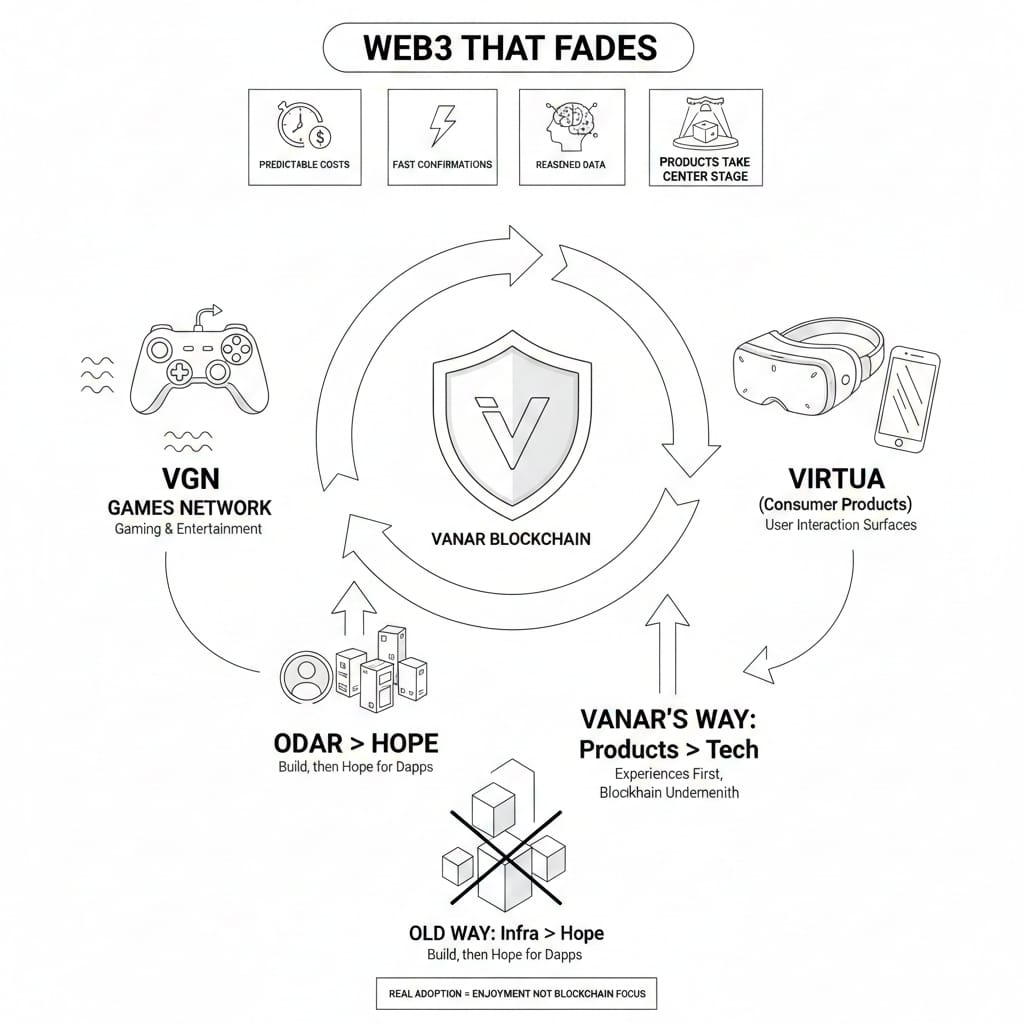
If Vanar succeeds, most users will never say “I use Vanar.” They’ll play a game, collect an asset, verify ownership, or interact with a brand—and never once think about the chain making it possible. That’s the quiet irony of real-world adoption: the better the blockchain, the less visible it becomes.