

When I first looked at Plasma’s EVM compatibility, it wasn’t because I needed another place to deploy a Solidity contract. It was because the market has been acting like fees are no longer the main villain, while stablecoins are quietly becoming the main unit of account anyway, and that combination creates a strange gap. Builders keep optimizing for “cheaper than Ethereum,” but users keep behaving like the only thing they truly want is USDT that moves with no drama, no surprises, and no “why did this cost me that much” moments.
Right now, the stablecoin story is not subtle. Tether’s USDT has about $187 billion in circulation, which is a number you feel in the plumbing, not just on a chart, because it means liquidity, settlement habits, and merchant corridors have already formed around it. At the same time, Ethereum gas has been sitting around roughly 1 gwei on recent snapshots, which translates to the odd experience of the base layer feeling cheap again, at least some of the time. So if fees are not consistently crushing people, why does a “stablecoin-first” chain with EVM compatibility matter?
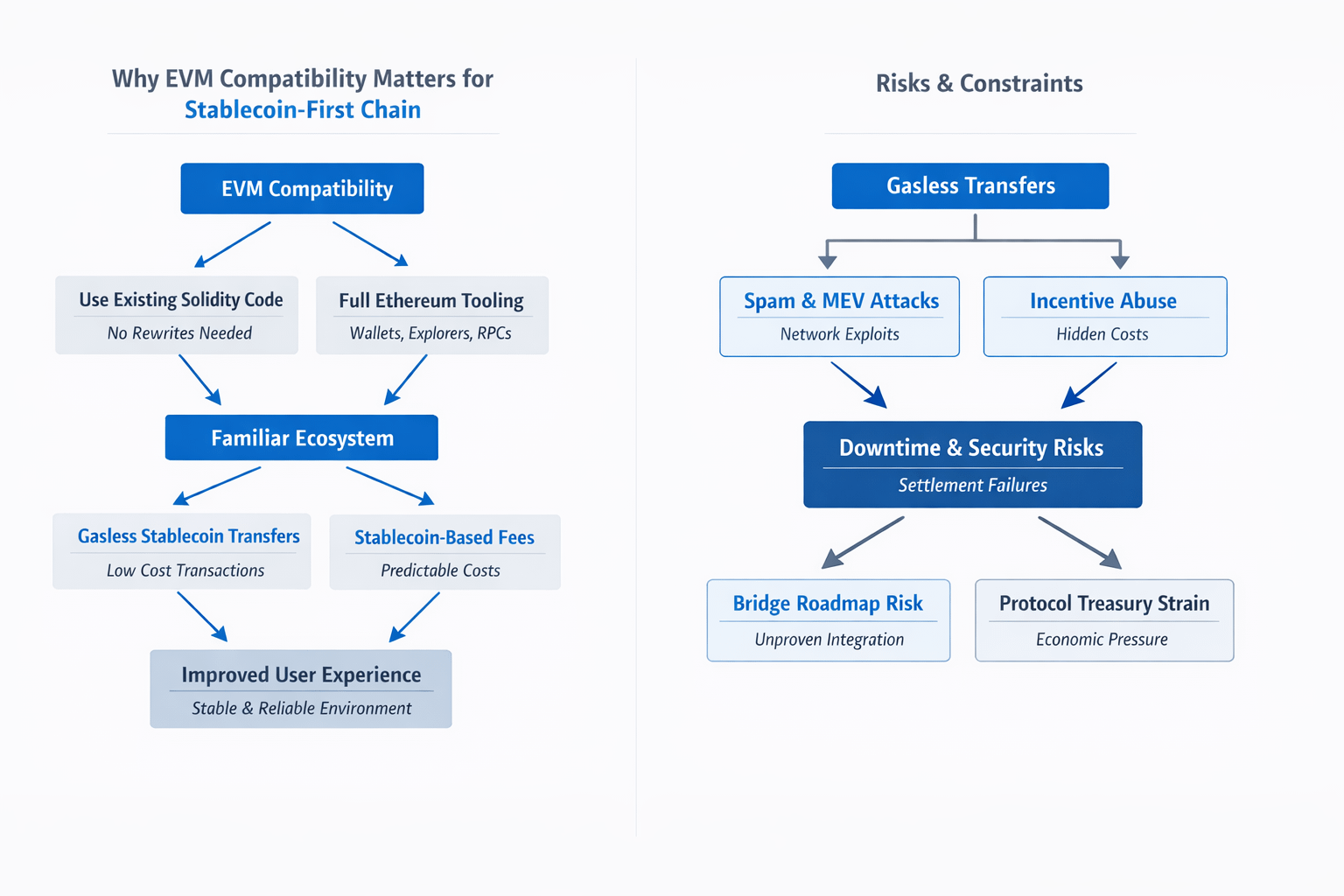
Because EVM compatibility is not primarily about saving developers from learning new syntax. It’s about saving teams from rebuilding everything underneath their app: wallets, block explorers, RPC infrastructure, indexers, audit tooling, custody integrations, and the boring compliance hooks that make serious money move. Plasma leaning into an EVM execution environment built around a Reth-based engine is basically a statement that it wants the whole Ethereum toolchain to feel familiar on day one, even if the chain’s priorities are different. Builders do not just ship contracts, they ship operational stacks, and EVM compatibility is the difference between “port the product” and “recreate the company.”
On the surface, this means you can take an existing Solidity codebase and deploy it without rewriting core logic. Underneath, it means the surrounding ecosystem tends to “just work” sooner: the same libraries, the same mental models, the same debugging muscle memory. That familiarity is not glamour, but it is steady, and it is earned, and it shows up in time-to-market more than people admit.
What actually changes, though, is the texture of constraints. Plasma’s pitch is not “we are an EVM chain,” it’s “we are an EVM chain where stablecoins are treated like first class citizens.” The chain’s own materials emphasize things like gasless USDT transfers and stablecoin-denominated gas behavior. Translate that into builder language and you get a new default: the cost model and user experience are designed to keep people inside a stablecoin mindset instead of forcing them to acquire a volatile token just to do basic actions.
A concrete example helps. Think about a remittance app that pays out to merchants. On a typical EVM environment, you might charge fees in the native token, or you abstract gas with a relayer and eat the cost, then try to reconcile it later. On Plasma, the chain is explicitly trying to make “USDT goes in, USDT moves, USDT comes out” feel natural. If that holds, the builder can spend less time engineering around gas friction and more time engineering around reliability: retries, confirmations, dispute handling, and settlement guarantees. That is not a small shift, because most payment products fail at the edges, where support tickets live.
Now the data angle. Plasma’s token, XPL, is trading around $0.083, with a market cap around $150 million and 24-hour volume around $170 million depending on venue snapshots. Those numbers do not prove usage, but they do reveal attention. A $170 million daily volume against a $150 million market cap is the kind of ratio you see when a market is still negotiating what a network is worth, not calmly valuing cash flows. That creates upside if real transaction demand arrives, and it creates risk if attention moves on before habits form.
The deeper question is what EVM compatibility enables that is uniquely dangerous in a stablecoin first environment. The obvious upside is composability: you can bring AMMs, lending markets, payment routers, and stablecoin yield strategies into the same execution space. The obvious risk is that composability also imports failure modes. If you make stablecoin transfers “feel free,” you can attract spam, abusive MEV patterns, and incentive games that push costs somewhere else, often onto validators, relayers, or the protocol treasury. And when payments are the headline, downtime and reorg anxiety hit harder, because nobody shrugs off a failed settlement the way they shrug off a failed meme coin mint.
There’s also the bridge reality that people gloss over. Plasma talks about a trust minimized Bitcoin bridge as a core direction, but even friendly third-party writeups acknowledge it as still under active development rather than a fully lived-in feature today. Builders planning serious flows will treat that as roadmap risk, because bridging is where chains earn trust slowly, one calm month at a time.
If you zoom out, Plasma’s EVM compatibility is really a bet on the next phase of crypto UX: people do not want more tokens, they want fewer reasons to think about tokens at all. Stablecoins are already acting like the settlement layer for a huge chunk of activity, and the fight is moving from “which chain is cheapest” to “which chain feels predictable, audited, and hard to break when volume spikes.” Early signs suggest Plasma is aiming directly at that foundation, using EVM compatibility as the on-ramp, not the destination.
The part worth remembering is quiet: EVM compatibility on Plasma doesn’t mainly change what builders can write, it changes what builders can assume about the user’s balance, the fee they’ll tolerate, and the kind of reliability the product has to earn every day