

Most blockchain narratives begin with ambition.
Bigger throughput. Louder ecosystems. Faster growth curves.
Vanar begins somewhere quieter—almost in the background—by asking a different question: what if the real future of crypto isn’t about visibility at all, but about disappearance?
Because when infrastructure truly works, people stop noticing it.
Where Friction Still Lives in Consumer Crypto
Despite years of progress, consumer-facing blockchain experiences still carry subtle resistance.
Wallet prompts interrupt flow.
Gas fees force hesitation.
Execution delays create uncertainty at the exact moment users expect immediacy.
These aren’t catastrophic failures.
They’re smaller than that.
But in entertainment, gaming, and everyday digital interaction, small friction compounds quickly.
Traditional web products trained users to expect instant response and invisible complexity.
Crypto, even at its best, often still reminds users that a system exists underneath.
Vanar’s premise appears rooted in a simple observation:
mass adoption may depend less on new features and more on removing reminders that blockchain is there at all.
Execution Speed as a Design Philosophy
Many networks treat speed as a headline metric.
Vanar treats it more like behavioral infrastructure.
Faster state closure doesn’t just improve performance numbers—it changes how builders and users think.
When execution settles quickly, decisions stop lingering in uncertainty.
What ships becomes real almost immediately.
Feedback loops compress.
Expectation replaces experimentation.
This shift is subtle but meaningful.

Instead of designing for prolonged adjustment cycles, teams begin designing for instant lived experience.
And that pushes product quality forward in ways benchmarks alone never could.
Gas Abstraction and the Psychology of Action
One of the clearest expressions of Vanar’s direction is gas abstraction.
Removing visible transaction costs sounds like a usability upgrade, but its deeper impact is psychological.
When users don’t see fees:
They don’t pause to calculate value.
They don’t delay interaction.
They behave the way they do in traditional apps—naturally.
This creates a different kind of accountability.
If friction appears, it can’t be blamed on blockchain complexity.
The responsibility returns fully to the product experience itself.
For consumer ecosystems, that’s a powerful—and demanding—shift.
Designing for Consistency, Not Excitement
Crypto often celebrates volatility: rapid launches, experimental mechanics, explosive communities.
Vanar’s posture feels almost opposite.

The emphasis leans toward:
Predictable execution
Stable user experience
Quiet coordination beneath the surface
This orientation aligns closely with regions where users already treat digital platforms as daily infrastructure rather than speculative opportunity.
In those environments, the most important question isn’t how fast something grows, but whether it behaves the same tomorrow.
Consistency rarely trends.
But historically, it’s what infrastructure layers are built on.
The Role of VANRY in a Low-Drama System
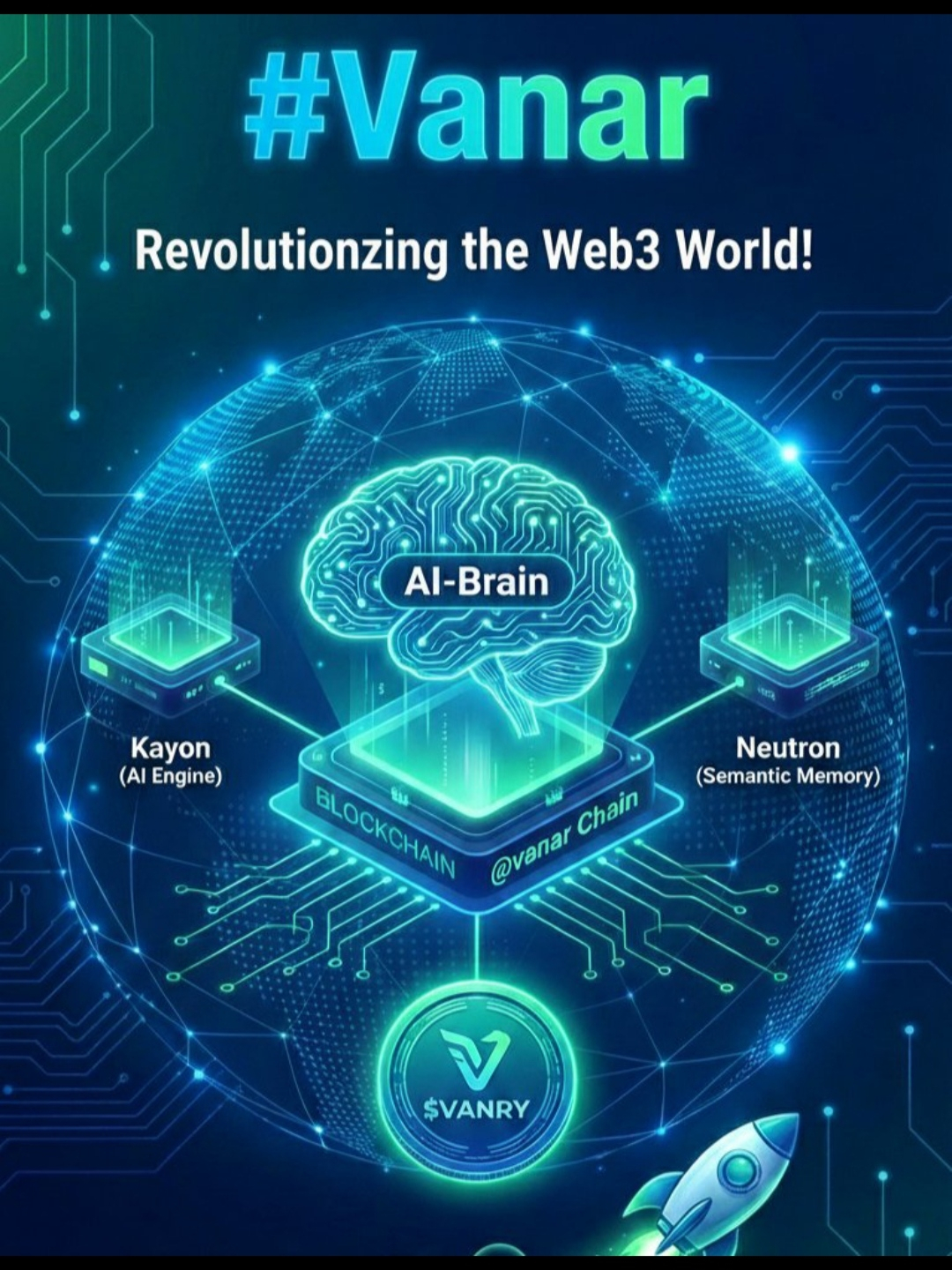
Within this structure, the VANRY token functions less like a narrative centerpiece and more like connective tissue.
Its purpose appears oriented toward alignment and coordination rather than visibility.
That distinction matters.
Speculative energy can accelerate awareness, but long-term systems usually depend on quieter mechanics—
validators remaining synchronized, execution remaining reliable, incentives remaining balanced.
If Vanar succeeds, the token’s most important achievement may be how little attention it requires.
And in infrastructure design, invisibility is often a sign of maturity.
Trade-Offs in Choosing Restraint
No architectural philosophy arrives without cost.
A system optimized for stability and seamless experience may naturally limit:
Rapid public experimentation
Chaotic creative bursts
Short-term narrative intensity
To observers seeking momentum, this can feel slow.
Even underwhelming.
But restraint changes the measurement of progress.
Instead of counting launches or headlines, progress appears as experiences that simply keep working.
History across technology suggests that once reliability crosses a certain threshold, adoption can accelerate quietly—
not through excitement, but through trust.
A Different Direction for the Next Phase of Crypto
If the next stage of blockchain evolution centers on consumer reality rather than speculative novelty,
the priorities shift:
From visibility → to invisibility
From experimentation → to dependability
From hype cycles → to everyday usability
#vanar seems positioned within that transition space.
Not trying to redefine crypto’s imagination,
but attempting to refine its behavior.
And behavioral shifts, while less dramatic, often prove more permanent.
The Shape of Success No One Notices
Should Vanar’s approach work, the outcome may not feel like a breakthrough.
There may be no single moment people point to and say, this changed everything.
Instead, change would appear gradually:
Interactions feeling smoother.
Delays becoming rare.
Complexity fading from awareness.
Until eventually, users stop thinking about chains at all.
And paradoxically, that quiet disappearance—
infrastructure doing its job so well it becomes invisible—
might be the clearest signal that something meaningful has finally settled into place.
