When I first looked into Vanar, it wasn’t out of excitement or urgency. It was one of those projects I bookmarked and left alone for a while. Weeks later, when I finally came back to it, I didn’t start with announcements or roadmap slides. I started by using it. I still remember my first interaction with the network and the thought that crossed my mind: nothing got in the way. No hesitation about fees. No friction. It felt quiet, almost intentionally so. That experience ended up shaping how I view Vanar more than any documentation ever could.
Most blockchains don’t struggle because they’re slow. They struggle because they’re unpredictable. Fees jump. Performance varies. Users hesitate. That uncertainty might be acceptable for traders or early adopters who expect friction, but it becomes a real problem the moment you try to build something meant for everyday users. Games, entertainment platforms, and consumer brands don’t get second chances. If something feels confusing or unreliable, people simply leave.
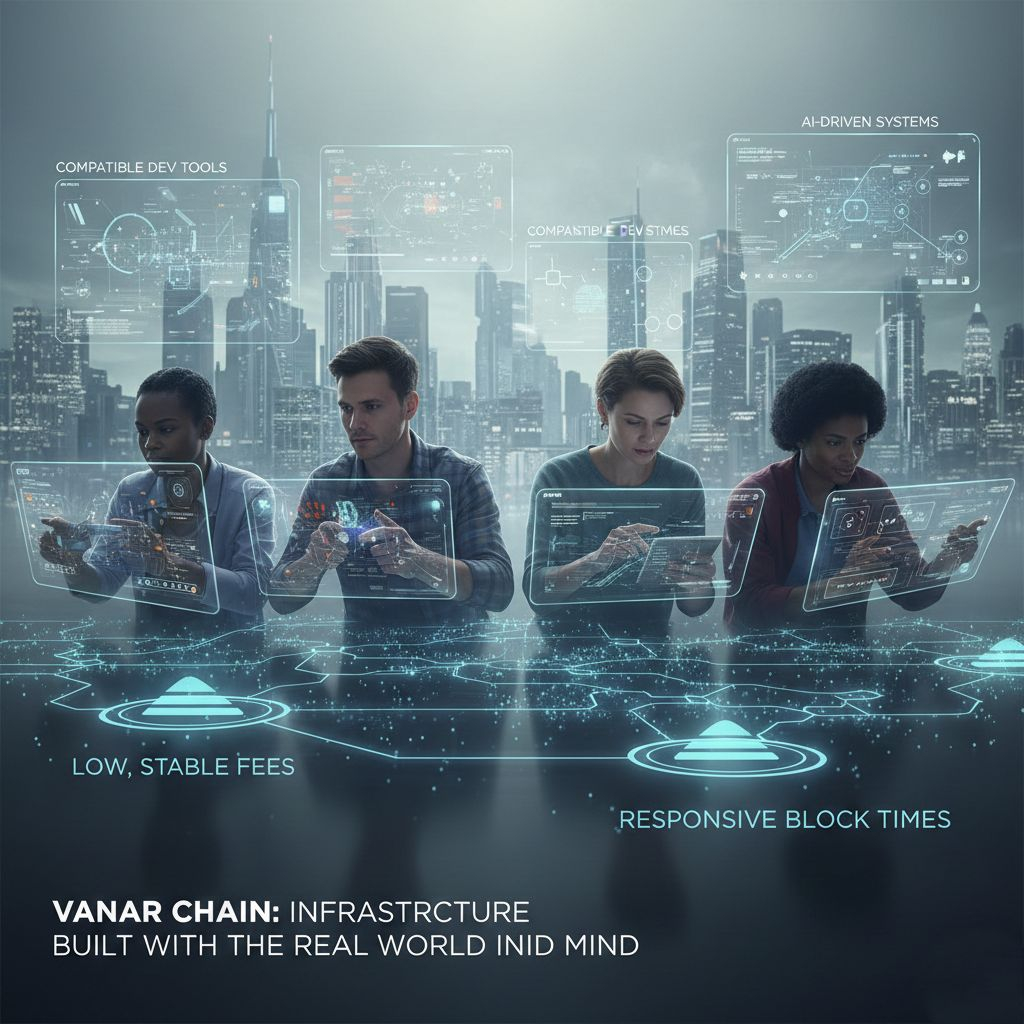
Vanar appears to start from that reality. Instead of optimizing for abstract metrics, it focuses on what infrastructure needs to look like when real people interact with it without knowing—or caring—that it’s blockchain-based. That philosophy shows up in its design. Fees are kept low and stable by intention, not as a temporary incentive. Block times prioritize responsiveness rather than headline-grabbing throughput. The network remains compatible with familiar development tools so builders can experiment without rewriting their entire stack.
Gas fees have always felt like one of the most underestimated blockers in this space. Not because they’re expensive in absolute terms, but because they break trust. The moment a user pauses before clicking a button, wondering what it might cost this time, the experience is already compromised. Vanar directly addresses that psychological barrier. It treats cost predictability as core infrastructure, not as a side benefit.
Another area where Vanar takes a slightly different approach is data. Instead of pushing complex logic and rich content off-chain by default, the network introduces ways to efficiently reference and compress meaningful data. This matters more as applications become more dynamic and adaptive. As AI-driven systems and interactive environments grow, blockchains need to act less like static settlement layers and more like dependable backbones. Vanar doesn’t try to turn the chain into a compute engine, but it does give developers room to build experiences that feel responsive and alive.
The ecosystem choices reinforce this thinking. Gaming networks and immersive environments aren’t just verticals Vanar supports; they’re stress tests. Games are unforgiving. Latency, unpredictable costs, or awkward onboarding show up immediately. By building where failure is obvious, the chain is forced to mature faster. It’s a different path from launching purely financial primitives and hoping consumer use cases arrive later.
Still, it would be dishonest to pretend the road ahead is simple. The Layer-1 landscape is crowded. Ethereum and its scaling ecosystem dominate developer attention, and switching costs are real. Being “invisible” infrastructure sounds elegant, but invisibility alone doesn’t guarantee adoption. Developers need reasons to commit, and users need reasons to stay. Vanar doesn’t just need to function well—it needs to prove that its approach translates into sustained usage.
Recent progress suggests the team understands this. Network upgrades, tooling improvements, and ecosystem initiatives point toward refinement rather than rushed expansion. Instead of chasing attention, the focus appears to be on tightening the connection between infrastructure and applications. It’s a slower approach, but one that tends to age better.
The VANRY token plays a supporting role in this structure. It exists to power transactions, secure the network, and enable access to services. It doesn’t try to carry the narrative on its own. That restraint is noticeable. Too often, tokens are asked to represent ambition before the infrastructure underneath is ready. Here, usage seems intended to come first.
Personal Verdict
Personally, I’m interested in seeing how Vanar performs during the next major gaming and consumer adoption cycle. Quiet infrastructure is powerful, but in a market this crowded, some level of visibility still matters. Invisibility for users is a strength; invisibility for builders can be a weakness. The real test will be whether Vanar can maintain its low-friction philosophy while earning enough attention to sustain growth. If it manages that balance, it won’t need to shout to be taken seriously.
Vanar doesn’t feel like a project trying to redefine blockchain overnight. It feels like an attempt to build infrastructure that people stop noticing because it simply works. And if Web3 is ever going to move beyond its current audience, it will likely do so through systems that look exactly like that.