

Most new blockchains enter the market claiming to be faster, cheaper, and more scalable. But the real question is not how fast a chain is on paper. The real question is what kind of financial system it is designed to support.
Fogo is not trying to reinvent crypto. It is trying to optimize it.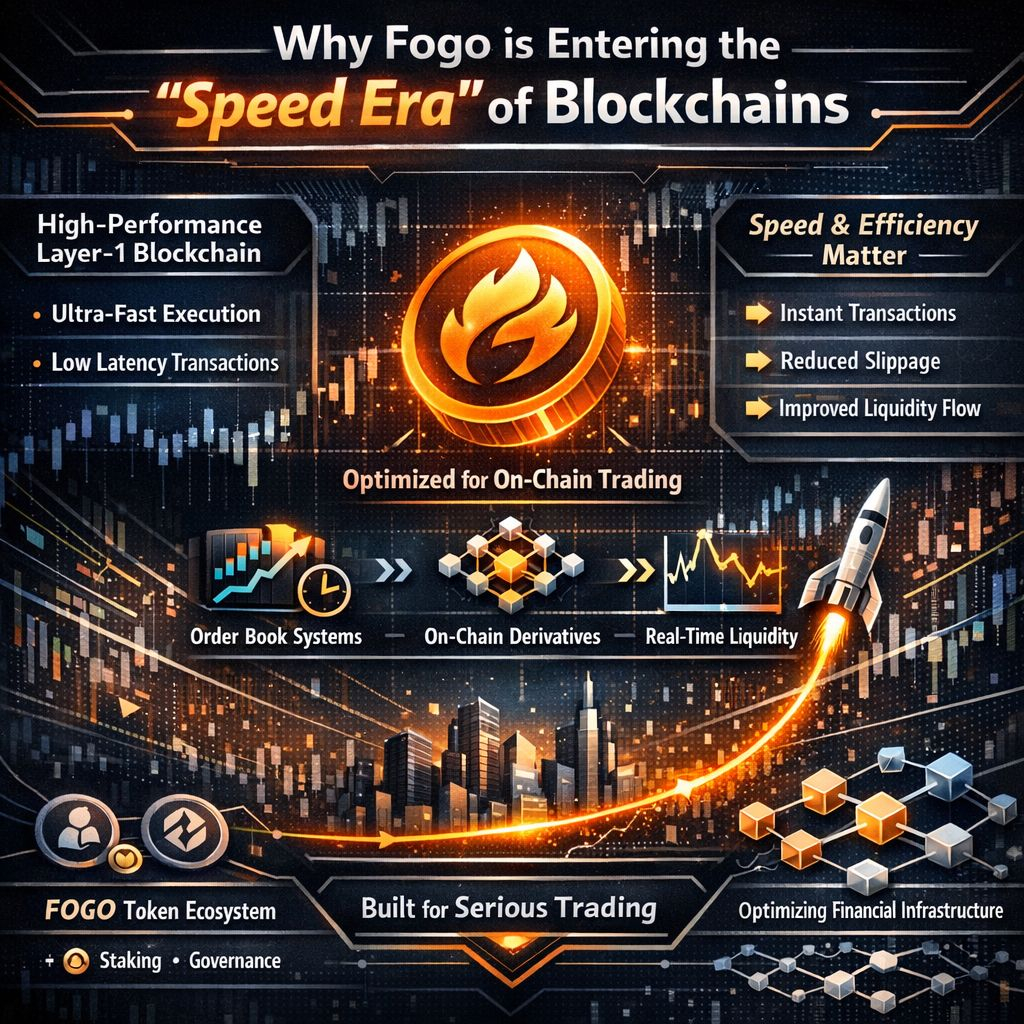
At its core, Fogo is a high-performance Layer-1 blockchain built specifically for low-latency execution. That might sound technical, but the idea is simple. In financial markets, speed changes everything. In traditional trading environments, milliseconds can impact order execution, slippage, and liquidity flow. On-chain markets are slowly moving in the same direction.
Many early blockchains were not designed with real-time trading infrastructure in mind. They were built for decentralization first, experimentation second, and financial optimization later. As decentralized finance matured, a gap started to appear. We now have advanced trading models, on-chain derivatives, and order book systems but the infrastructure beneath them often struggles under pressure.
This is where Fogo positions itself.
Instead of focusing broadly on every possible use case, Fogo concentrates on execution performance. Faster block production, reduced latency, and more predictable transaction confirmation are central to its design philosophy. The goal is not just speed for marketing purposes, but speed as infrastructure.
The FOGO token powers this ecosystem. It is used for transaction fees, staking participation, and governance involvement. Like other Layer-1 systems, it aligns economic incentives between network participants and validators. However, the token’s long-term value will depend less on hype and more on whether the network actually becomes a home for serious on-chain trading activity.
What makes Fogo interesting is timing. The crypto industry is entering what could be called the “infrastructure refinement phase.” The early innovation wave focused on launching tokens and protocols. The next phase is about optimizing the base layers that support real financial activity. If decentralized finance wants to compete with traditional systems, execution efficiency cannot remain an afterthought.
Fogo is building around that assumption.
Whether it succeeds will depend on adoption, developer interest, liquidity migration, and competitive pressure from other performance-focused chains. But conceptually, it represents a shift in thinking from general-purpose experimentation to specialized financial infrastructure.