
The first time I really looked at FOGO, I wasn’t thinking about price. I was thinking about friction.
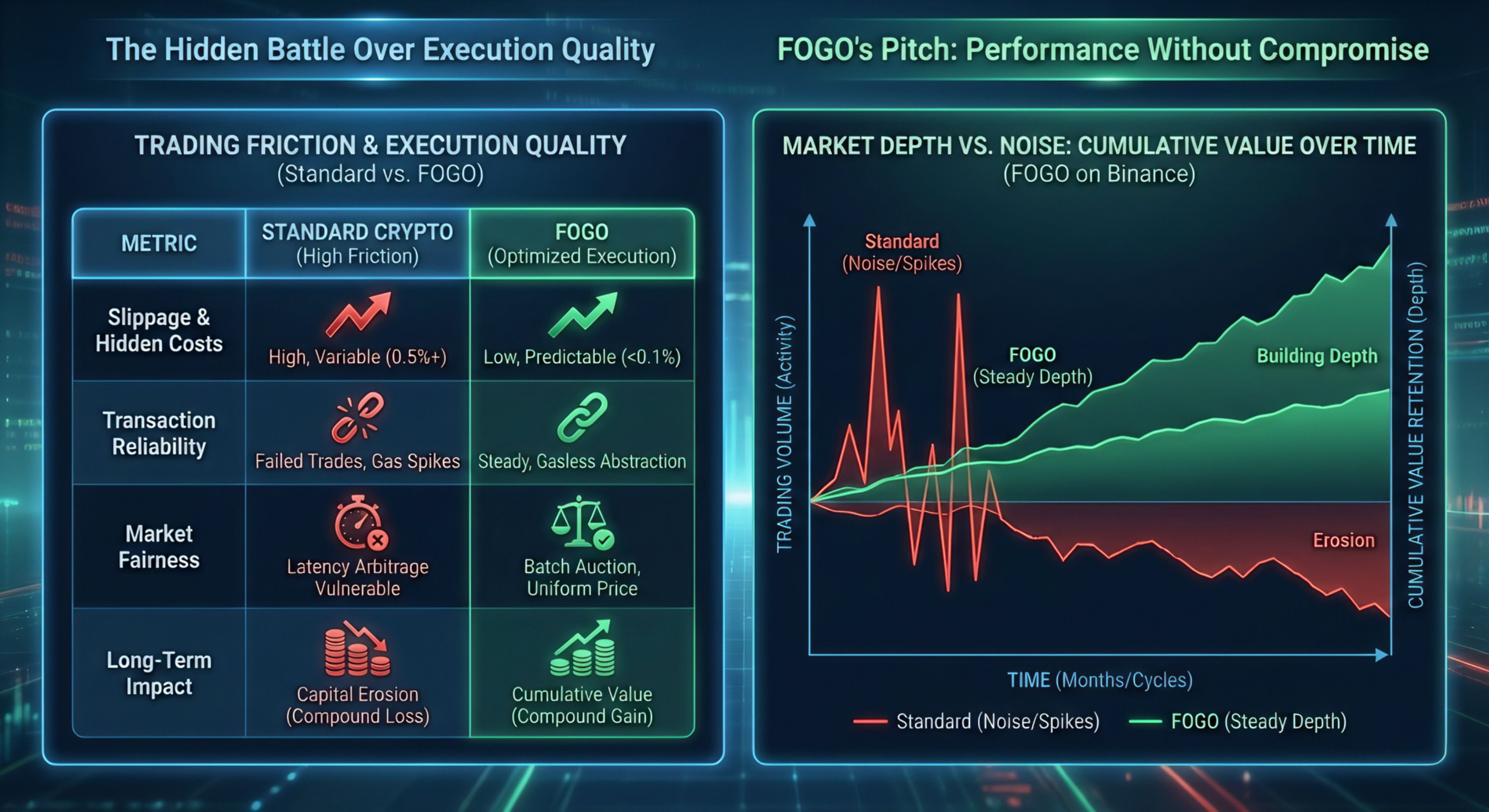
Because if you’ve traded long enough, you know that most of crypto’s problems don’t show up in token charts. They show up in slippage, failed transactions, gas spikes, and the subtle feeling that someone faster than you is always taking the better side of your trade. That texture of trading, the part most people accept as normal, is where FOGO is trying to intervene.
The market is really tense. Things are moving around in circles right now. Bitcoin is still the one that people think is safe, with fifty percent of the market. This means that people are putting their money into Bitcoin. On the hand altcoins are struggling to get people to buy and sell them they are not getting a lot of money flowing into them like they used to. Bitcoin is still the altcoins are just trying to find small groups of people who are willing to trade them. In that kind of environment, the difference between good execution and bad execution isn’t cosmetic. It directly shapes who survives volatility.
FOGO’s pitch is performance without compromise. On the surface, that sounds like throughput and speed. Underneath, it’s about how trades are matched and how users interact with the network.
Take gasless, wallet-agnostic trading. On the surface, it means you don’t need to hold the native token just to pay transaction fees. That lowers the entry barrier. But underneath, it shifts who carries the cost and how that cost is abstracted. Instead of every user manually managing gas balances, the protocol coordinates it. That changes behavior.
When users don’t hesitate before clicking “confirm” because of unpredictable fees, activity becomes steadier. And steady activity matters more than spikes. A network that handles 10,000 transactions all at once and then does nothing is not as healthy as one that processes 2,000 transactions steadily throughout the day. The one that handles 10,000 transactions at once makes a lot of noise. The other one, that processes 2,000 transactions consistently builds a foundation. The first creates noise. The second builds depth.
Depth is what serious traders look for.
Then there’s the dual flow batch auction model. On the surface, batch auctions group trades into time windows instead of executing them sequentially. That can sound technical, but the implication is simple. If everyone’s orders in a short window clear at a single uniform price, speed advantages matter less.
Underneath, this is a direct response to latency arbitrage. In traditional continuous order books, the fastest participant can see an incoming large order and reposition milliseconds ahead of it. That extracts value quietly. Batch auctions compress that advantage because execution is synchronized.
It has measurable effects. If liquidity providers feel less exposed to toxic flow, they’re more willing to tighten spreads. Tighter spreads mean lower implicit costs for everyone else. That feedback loop can compound. If this holds, FOGO’s structure could create a trading environment that feels less extractive over time.
Of course, the counterargument is obvious. Batch auctions introduce timing windows. Traders used to instant fills might resist waiting even a few seconds. Early signs suggest FOGO is trying to abstract that complexity away at the interface level, but user psychology is hard to rewire. In fast markets, even small delays feel amplified.
The validator design adds another layer. Performance claims are easy to make. Sustaining them under stress is harder. FOGO’s testnet experienced outages, and the post-mortem transparency matters more than the outage itself. Because what breaks when things get shows where the real problems are.
If a network can handle lots of transactions like 100,000 per second but slows down when lots of people use it at the same time that big number doesn't really matter.
What really matters is if the network can keep up with all those transactions for a time even when things get really busy and difficult.
The network needs to handle transactions under pressure.
Sustained performance, under conditions is what truly counts. Validator incentives, hardware requirements, and coordination rules all shape that. FOGO’s model appears to lean toward performance optimization while trying to avoid obvious centralization traps. Whether that balance holds as activity scales remains to be seen.
Then there’s tokenomics, which most traders reduce to supply numbers. But numbers without context don’t tell you much. If a token has a 1 billion supply but circulates slowly, price action behaves differently than a token with 100 million supply and high velocity. What matters is how often the token is actually used.
FOGO ties its token to ecosystem participation, validator economics, and season-based engagement campaigns. That structure encourages earned distribution rather than pure speculation. If users are receiving tokens through activity instead of passive holding, velocity increases. Increased velocity can either support network growth or suppress price, depending on how demand scales alongside it. That tension is real.
The bigger picture is important here. Centralized exchanges are having a time with regulators in a lot of places. When people feel good, about things they trade a lot on the blockchain. When they feel bad they do not trade as much. Centralized exchanges are still dealing with these problems. In 2024 and into 2025, we’ve seen weeks where decentralized exchange volumes crossed tens of billions of dollars, only to contract when volatility cooled. That instability shows how fragile user loyalty can be.
FOGO is positioning itself in that gap between centralized reliability and decentralized transparency. Gas abstraction reduces friction. Batch auctions adjust the matching mechanism. Validator optimization targets performance ceilings. None of that guarantees adoption. But it does signal a focus on the plumbing rather than the narrative.
When I zoom out, I see something interesting. The last cycle rewarded speed at any cost. The next phase looks like it’s rewarding quality of execution. Traders are becoming more aware of hidden costs. Slippage of 0.5 percent on a large order isn’t abstract. It’s measurable. Over 100 trades, that compounds into real capital erosion.
If FOGO can consistently reduce those hidden costs even marginally, that advantage becomes cumulative. A 0.2 percent improvement in execution on meaningful size isn’t flashy. But over a year of active trading, it matters more than short-term token volatility.
There are still risks. Adoption risk is real. Liquidity fragmentation is real. And if broader market liquidity contracts sharply, even well-designed infrastructure struggles. But the intent here feels different. It feels like an attempt to reshape the texture of trading rather than just attract temporary yield seekers.
What struck me most is how quiet the strategy is. No promises of instant domination. Just layered changes to how orders clear, how gas is handled, how validators coordinate. If this approach gains traction, it suggests the next competition in crypto won’t be over who is loudest. It will be over who makes trading feel fair without users even noticing why.
And that’s the part that lingers with me. In markets, the projects that last are often the ones that improve the invisible parts. Because when the foundation gets better, everything built on top of it starts to feel steady.