
AI and blockchain are often bundled together under a single narrative: trustless intelligence. It sounds elegant. In practice, the infrastructure layers don’t align. AI thrives on high-throughput GPUs and probabilistic outputs. Blockchains operate on deterministic consensus, gas constraints, and strict latency trade-offs.
That mismatch creates what I’d call the infrastructure gap. Most projects either overpromise full on-chain inference or underdeliver on verification guarantees. Mira positions itself directly inside that gap.
The question isn’t whether AI and crypto will intersect. It’s where that intersection becomes technically viable.
What is Mira?
Mira is a verification-focused AI infrastructure project designed to make AI outputs auditable, disputeable, and economically secured. Rather than pushing full model inference onto-chain, it separates execution from verification.
The architecture revolves around independent verifiers, staking incentives, and consensus-based validation of AI outputs. Heavy compute runs off-chain. Proofs, hashes, or consensus outcomes anchor on-chain.
This hybrid approach acknowledges a core constraint: Ethereum-like networks process roughly 15–30 transactions per second, while modern AI inference can require billions of parameters per query. The computational asymmetry is massive.
Mira’s model doesn’t try to eliminate that asymmetry. It works around it.
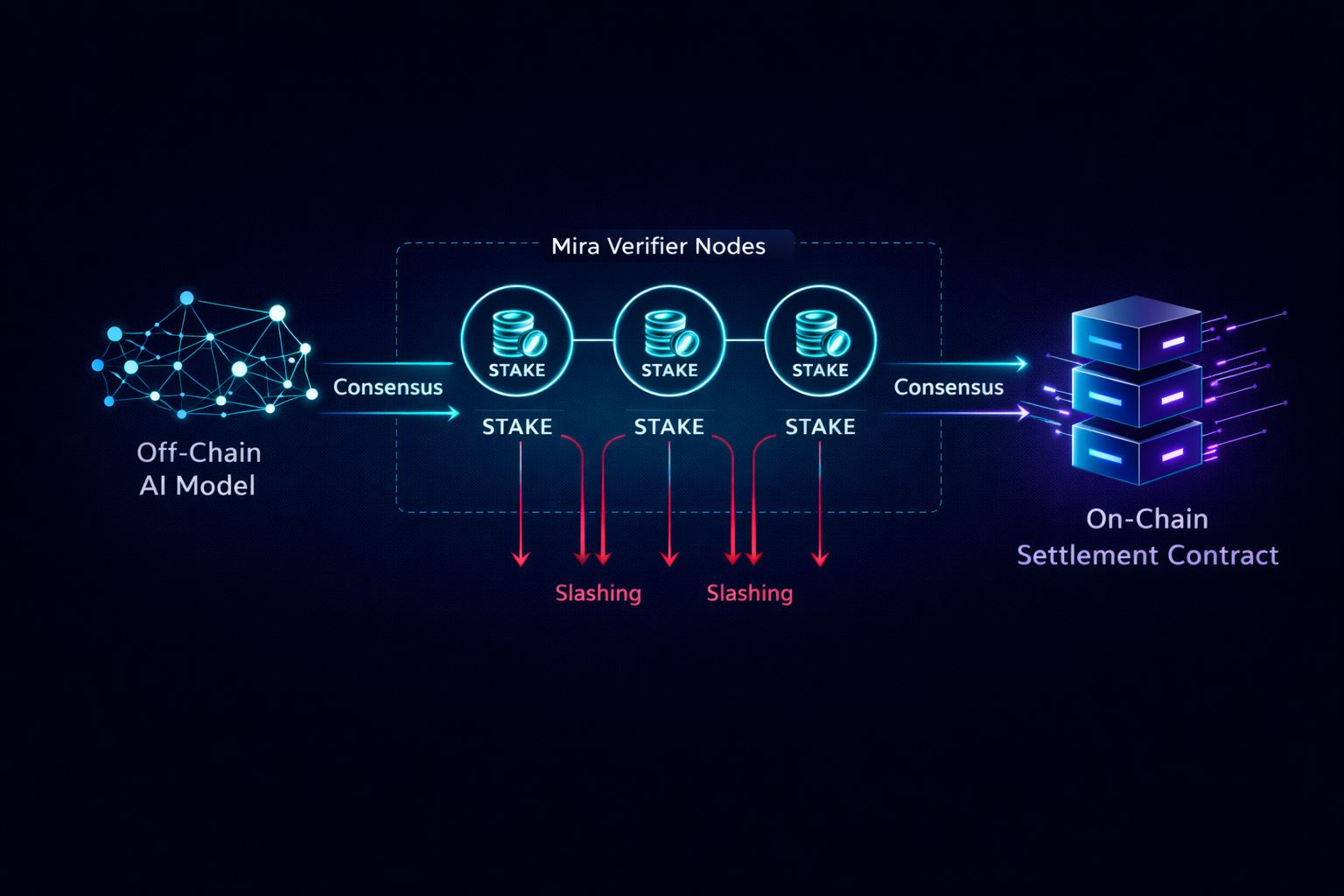
Focus: The Infrastructure Gap in AI x Blockchain — Where Mira Fits
The infrastructure gap stems from three structural mismatches:
Deterministic vs probabilistic systems
Gas-bounded execution vs open-ended compute
Latency-sensitive AI vs block confirmation times
Most on-chain AI experiments fail because they treat blockchains as compute layers rather than settlement layers.
Mira reframes the problem. Instead of asking, “Can we run AI on-chain?” it asks, “Can we verify AI outputs on-chain?”
That’s a different engineering question.
For example, assume an AI model produces an output that must be verified by N independent nodes. If each verifier stakes tokens and risks slashing for malicious validation, economic security scales with stake weight. If 60% of staked validators agree on a result, the system can treat that output as economically final.
(example calculation)
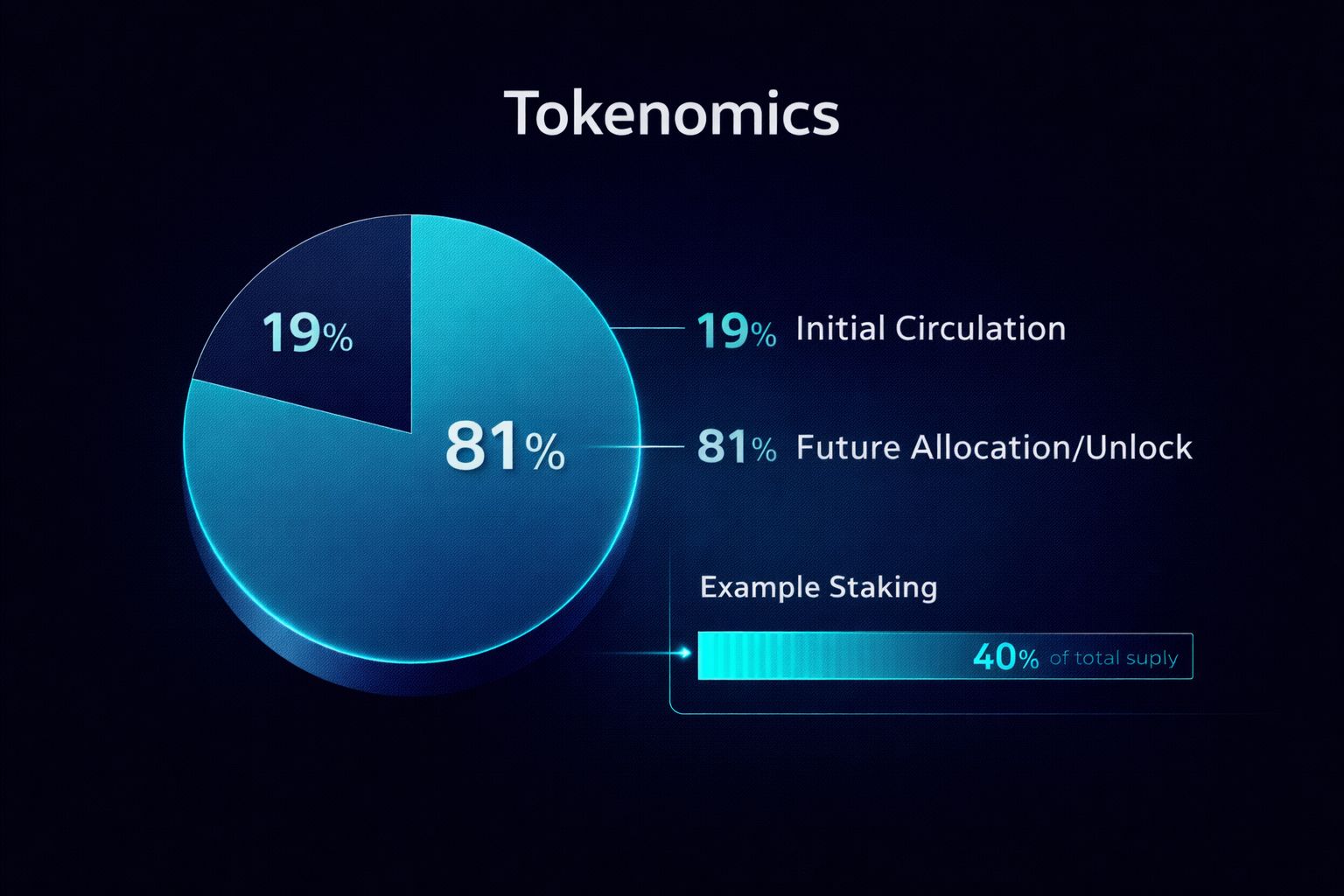
If total staked supply = 400M tokens (40% of 1B max supply) and the token price hypothetically equals $0.50, the economic security securing outputs would represent $200M in bonded value. Even without price assumptions, 40% staking participation significantly raises the cost of coordinated manipulation.
That’s where things get interesting.
Mira doesn’t compete with GPU infrastructure. It complements it.
Why This Matters Now
AI adoption is accelerating across consumer apps, trading tools, and autonomous agents. Meanwhile, trust in AI outputs is declining as model hallucinations and opaque training data raise credibility concerns.
Verification layers become critical once AI systems start interacting with capital, contracts, or autonomous financial agents.
The next phase of AI in crypto isn’t smarter models. It’s verifiable outputs.
Mira fits that narrative shift.
Tokenomics & Economic Design
Mira’s token supply is reportedly capped at 1 billion tokens [source: MEXC guide]. Approximately 19% entered initial circulation at launch.
That means roughly 81% of tokens are subject to future unlock schedules, ecosystem incentives, or team allocations. Token release velocity will influence long-term supply pressure.
If we assume (example calculation) a linear unlock of 10% of total supply annually, that would introduce 100M tokens per year into circulation. If network demand doesn’t scale proportionally, dilution risk becomes material.
On the positive side, staking mechanisms convert passive holders into security participants. A higher staking ratio reduces effective float and increases the cost of governance attacks.
The sustainability question becomes:
Is staking yield funded by real verification demand, or primarily token emissions?
Economic security must eventually be fee-backed. Otherwise, incentive structures weaken over time.
Competitive Landscape
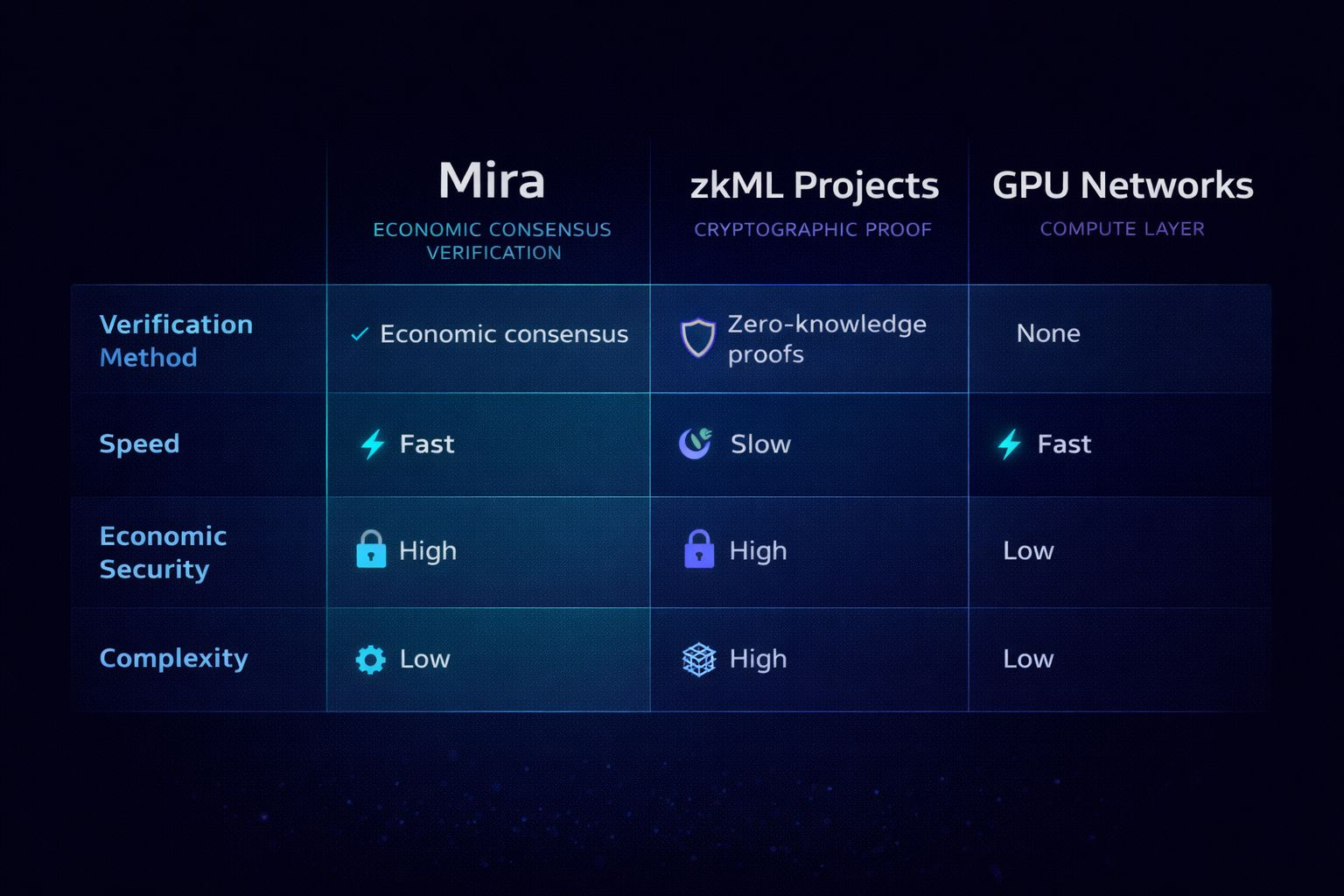
Mira operates in a growing but fragmented AI x crypto sector. Key adjacent categories include:
Decentralized compute networks (e.g., GPU marketplaces)
Oracle-based AI feeds
Zero-knowledge ML proof systems
Modular data availability layers
Projects focused on zkML attempt to cryptographically prove AI execution correctness. Others focus purely on decentralized GPU infrastructure.
Mira’s differentiation lies in social-economic consensus rather than cryptographic proof alone. That makes it lighter-weight, but potentially more incentive-sensitive.
Competition risk exists from both sides:
If zkML becomes efficient at scale, cryptographic verification could reduce the need for multi-verifier consensus.
If centralized AI APIs dominate Web3 applications, developers may not prioritize decentralization at all.
Narrative shifts happen fast in crypto.
Risks & Reality Check
No infrastructure thesis is risk-free.
Execution Risk:
Building reliable verifier networks requires careful game-theoretic design. Collusion or cartelization among validators remains a possibility if stake concentration grows.
Token Dilution:
With ~81% of tokens beyond initial circulation, unlock schedules could pressure markets if demand doesn’t expand.
Competition:
zk-based AI verification and modular rollup ecosystems are evolving rapidly.
Market Narrative Risk:
AI hype cycles can distort valuations, and when narratives rotate, liquidity often disappears quickly.
Verification layers are long-term plays. Markets don’t always reward patience.
Forward Outlook (6–12 months)
Over the next year, three metrics will matter:
Growth in active verification nodes
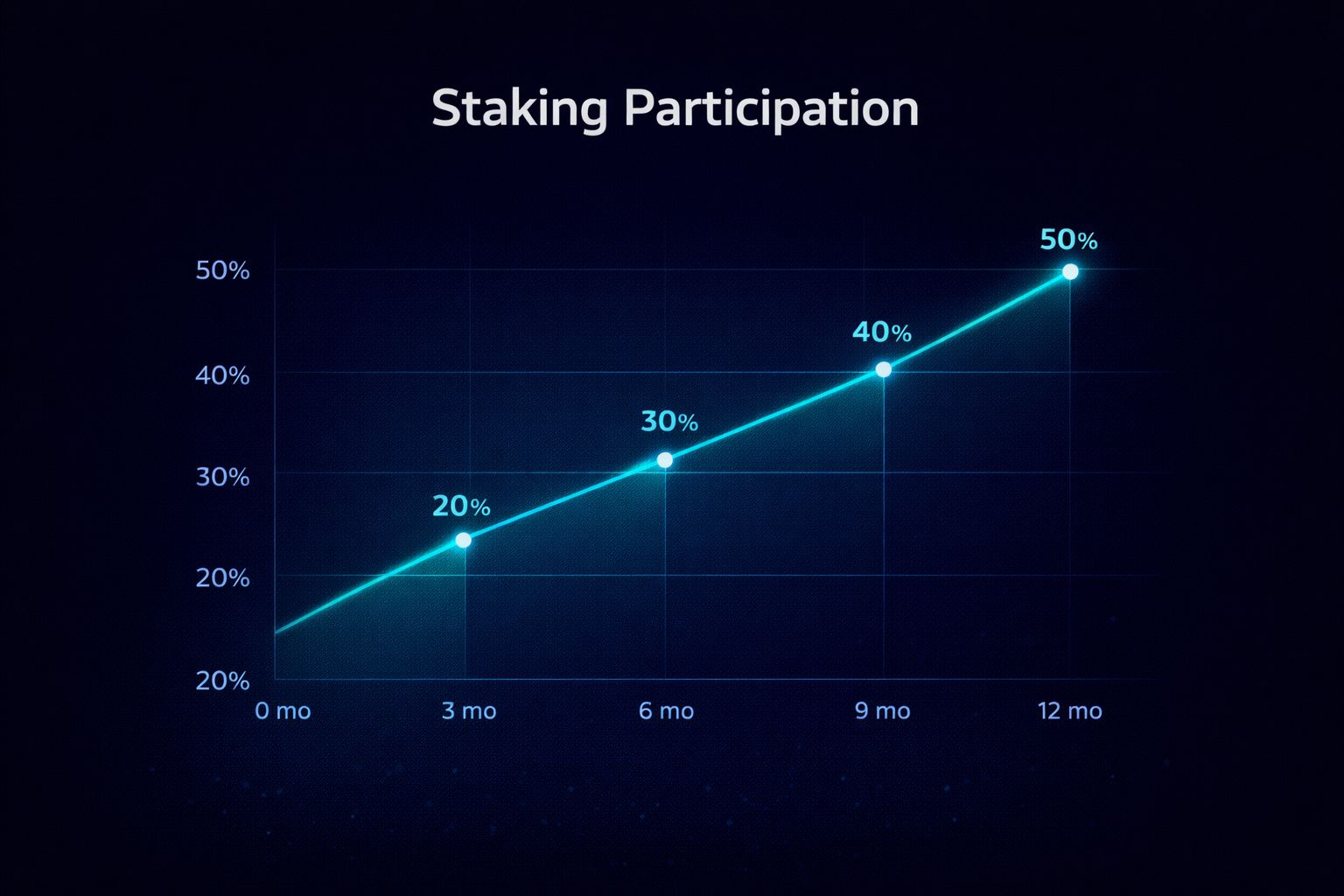
Staking ratio as % of circulating supply
Integration partnerships with AI-powered dApps
If Mira achieves, for example, a 50% staking participation rate and onboarding of 10+ meaningful dApps using verification APIs, the network effects could compound.
Conversely, if staking remains below 20% of circulating supply, economic security may be questioned.
The broader market context also matters. If AI agent frameworks expand across DeFi and gaming, verification demand could rise organically.
Infrastructure quietly becomes indispensable once applications scale.
Conclusion
The AI x blockchain narrative isn’t about merging two technologies into one layer. It’s about assigning each layer the role it’s best suited for.
Blockchains excel at settlement and incentive alignment.
AI excels at probabilistic computation.
Mira sits between them.
Whether it succeeds depends less on marketing momentum and more on validator economics, integration depth, and sustained staking participation.
Bridging infrastructure gaps isn’t glamorous.
But it’s often where durable value is built.
@Mira - Trust Layer of AI #Mira $MIRA