technology is moving today, I feel both excitement and responsibility because we are no longer just building software tools, we are building systems that can think, move, decide, and act in the physical world around us, and that changes everything about how trust must work. Fabric Protocol enters this moment with a powerful idea that feels both ambitious and necessary, because it is not just trying to build robots, it is trying to build a global open network where robots are constructed, governed, and improved in a way that is transparent, verifiable, and aligned with human values. They are not positioning themselves as another hardware startup or another artificial intelligence experiment, they are designing an ecosystem supported by the non profit Fabric Foundation that treats robotics as shared infrastructure for humanity rather than isolated products owned by a few corporations.

At the core of Fabric Protocol is the belief that general purpose robots should not evolve in secrecy or behind closed systems, because once machines are capable of interacting with humans in real environments, the question of accountability becomes as important as performance. I believe this is where the concept of verifiable computing becomes deeply meaningful, because instead of asking people to blindly trust that a robot is behaving correctly, the protocol records data, computation, and decision processes on a public ledger so actions can be audited and validated. They are creating a structure where machine behavior is not just intelligent but also provable, and that simple shift from trust me to verify me changes the emotional relationship between humans and machines in a profound way.
The new updates this year focus heavily on strengthening the agent native infrastructure that allows autonomous robotic agents to coordinate with each other and with humans through standardized modules. I see this as a move toward long term scalability because they are not building a single robot model, they are building a modular architecture where hardware components, software intelligence layers, safety policies, and governance rules can evolve together. They are treating robots like participants in a digital society where data flows securely, computations are verified, and updates are traceable, and that feels much closer to how we already manage financial systems on blockchain networks like Binance, where transparency and validation protect participants from hidden risks.
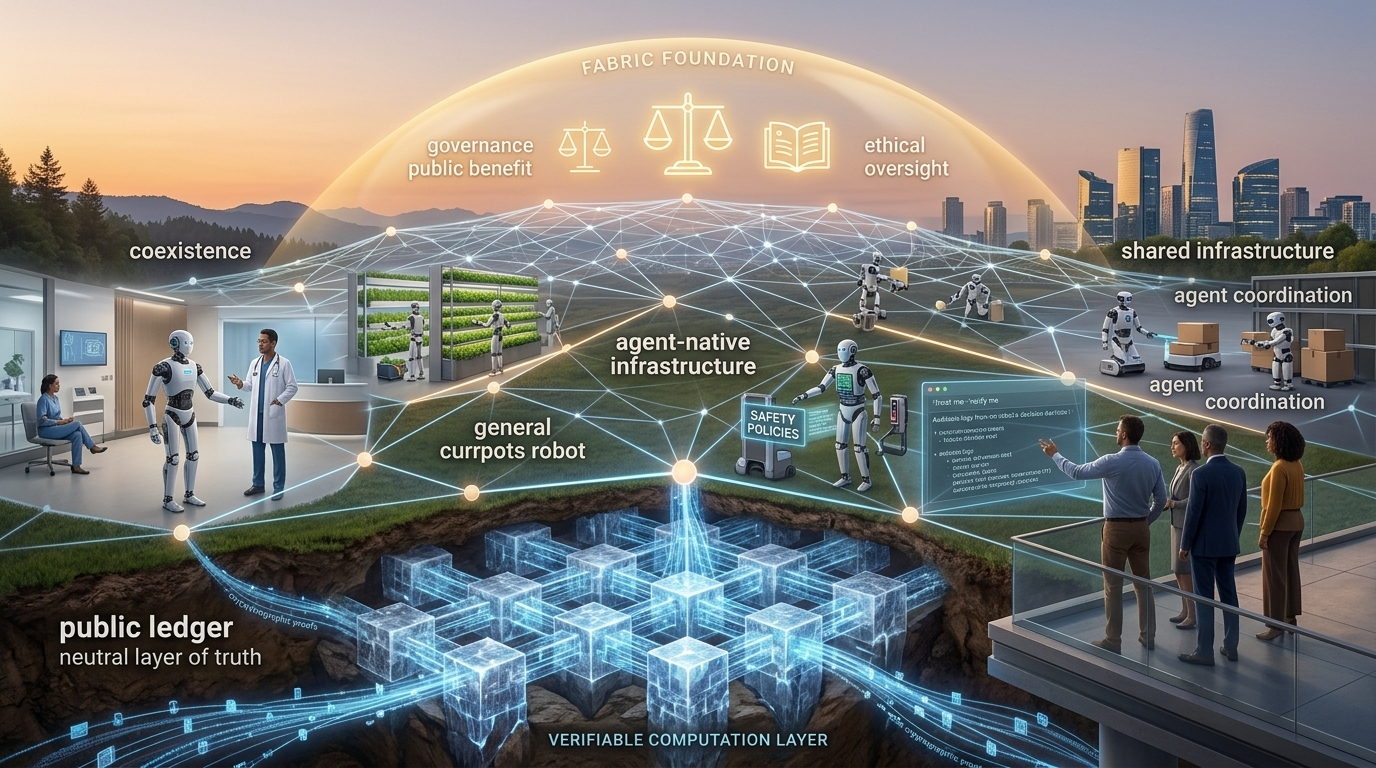
One of the most powerful aspects of Fabric Protocol is the way it coordinates data, computation, and regulation through a shared public ledger that acts as a neutral layer of truth. I often think about how fragmented robotics development has been in the past, where one company builds hardware, another builds AI models, and another controls deployment environments, and none of them share accountability in a unified way. Fabric changes this dynamic by aligning incentives across developers, researchers, manufacturers, and regulators, allowing collaborative evolution instead of competitive secrecy. They are building a network where improvements in perception models, motion planning, or human interaction frameworks can be contributed, validated, and adopted collectively, which makes the growth process more organic and less dependent on centralized authority.
I feel that what makes this protocol emotionally compelling is its emphasis on safe human machine collaboration, because many people are afraid that robots will replace or dominate human roles, yet Fabric approaches the future from a cooperative angle rather than a confrontational one. They are designing governance systems where human oversight is embedded into machine decision cycles, ensuring that autonomy does not mean isolation from ethical review. Through verifiable computation and structured regulation modules, robots operating under the Fabric ecosystem can prove compliance with safety standards and operational constraints, which builds confidence not only among developers but also among everyday people who may one day interact with these machines in hospitals, factories, farms, and homes.
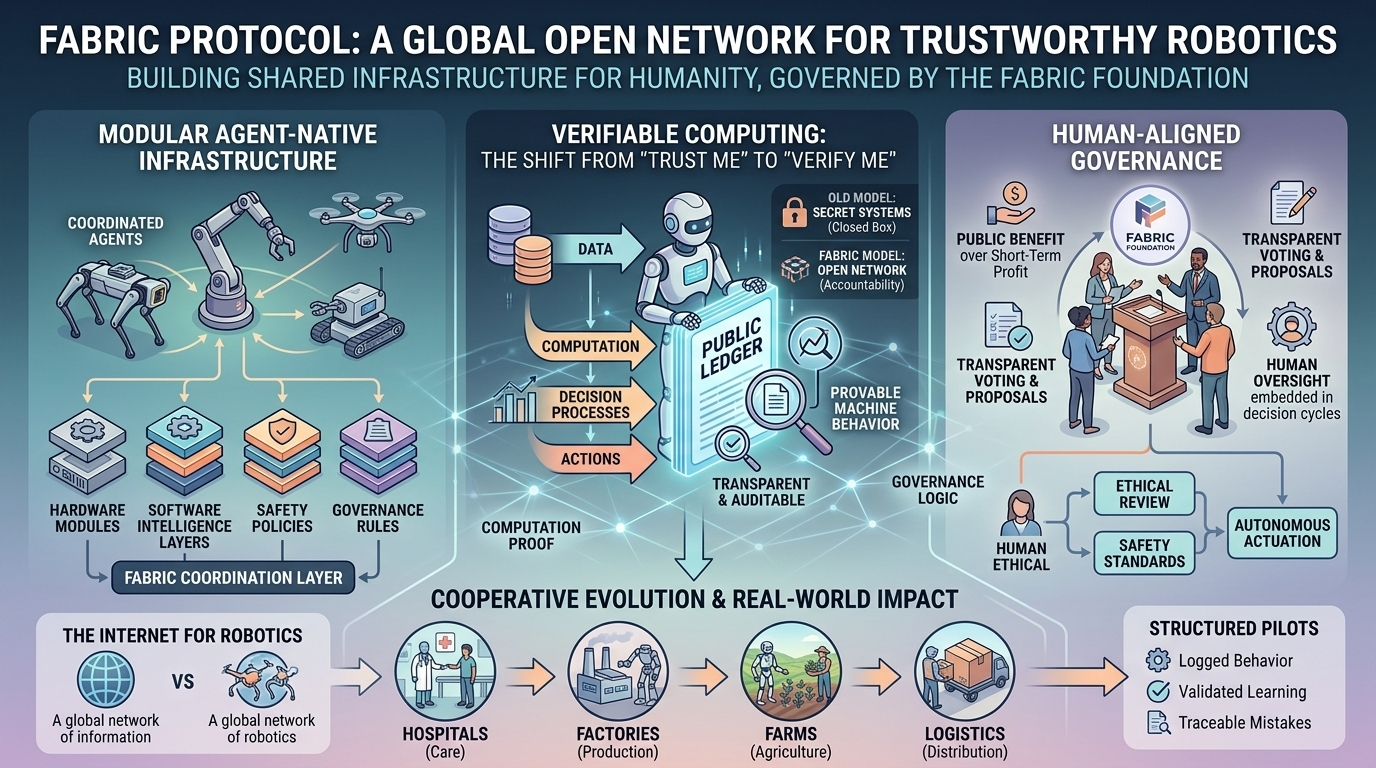
Another important update revolves around the strengthening of governance frameworks under the Fabric Foundation, where the non profit structure ensures that the protocol’s direction remains aligned with public benefit rather than short term profit motives. I appreciate this design because robotics at scale will influence labor markets, security systems, and public infrastructure, and without balanced governance it could easily drift toward concentration of power. They are working toward a transparent voting and proposal system that allows contributors and stakeholders to influence protocol upgrades, safety thresholds, and technical standards, which creates a sense of shared ownership that feels necessary in an age where machines are becoming active participants in society.
The modular infrastructure of Fabric Protocol is also a technical breakthrough that deserves deeper reflection because it allows independent innovation without breaking system integrity. I see it as a layered architecture where perception modules, actuation systems, identity verification layers, and compliance engines can plug into a unified framework, each validated through cryptographic proofs before being accepted into operational networks. They are building what could become a universal coordination layer for robotics, similar to how the internet became a universal coordination layer for information, and that analogy helps me understand the scale of their ambition because they are not thinking in terms of single devices but in terms of global ecosystems.
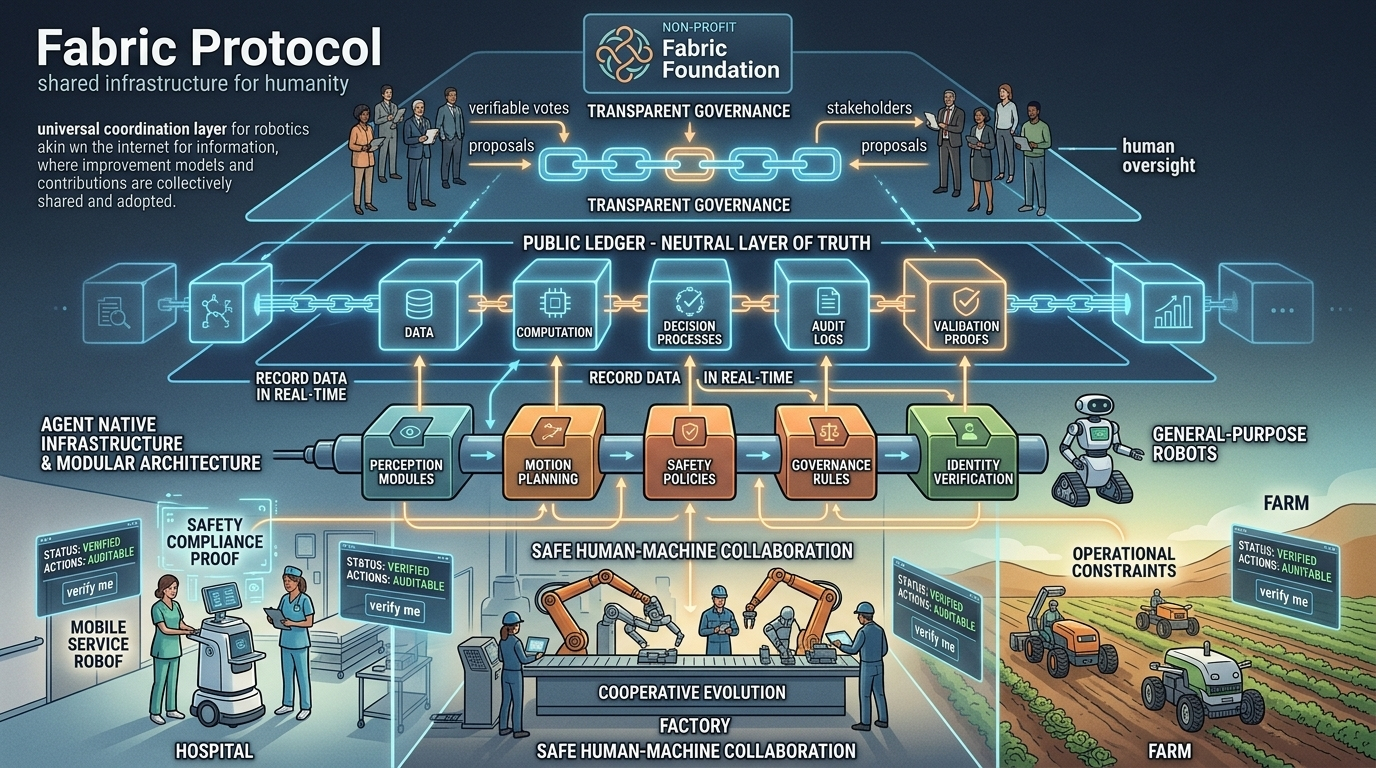
Emotionally, I sense that Fabric Protocol is responding to a deeper human need for control and clarity in a rapidly changing world, because when machines become capable of autonomous decision making, people naturally ask who is responsible and how can we be sure they are acting correctly. By anchoring computation to a public ledger and by designing agent native identity systems, they are offering a framework where robots are accountable entities rather than mysterious black boxes. This transparency reduces fear and increases trust, and trust is the foundation of any long lasting technological transformation.
As I reflect on the broader impact, I realize that Fabric Protocol is not only about robotics but about redefining infrastructure in the age of intelligent machines. They are connecting data flows, computational proofs, governance logic, and physical execution into a single coordinated protocol, which could influence industries ranging from manufacturing to healthcare and from logistics to disaster response. The ability to collaboratively evolve general purpose robots through open standards means innovation does not depend on a single breakthrough moment but can progress continuously through global contribution.
What makes this new update cycle particularly important is the emphasis on real world deployment testing and integration partnerships, because theory alone is not enough in robotics. They are focusing on structured pilots where machine behavior is logged, validated, and improved through the protocol’s ledger mechanisms, ensuring that learning is transparent and mistakes are traceable. I believe this iterative, accountable approach is what separates sustainable infrastructure from speculative hype, and it shows that Fabric Protocol understands the responsibility that comes with shaping the future of human machine interaction.
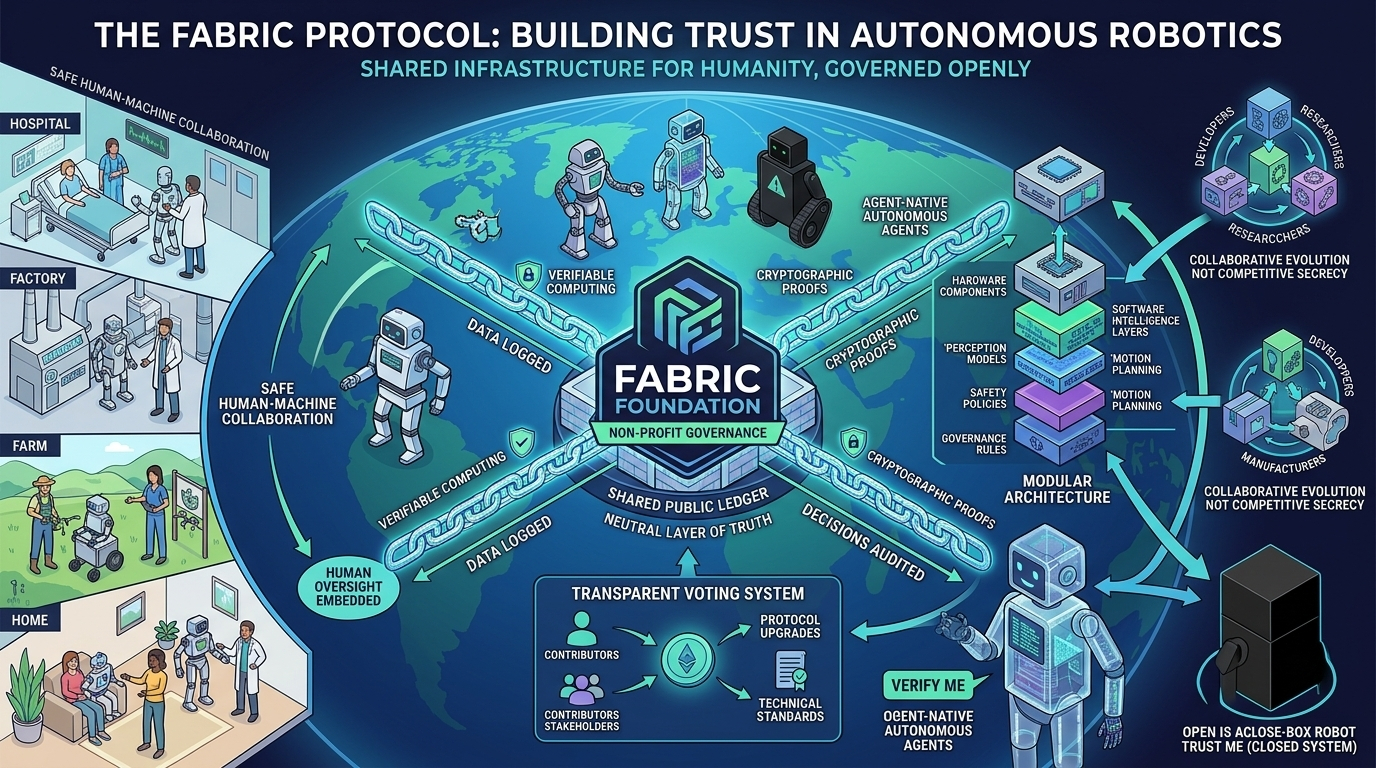
In the end, when I think about Fabric Protocol, I do not see just code or hardware, I see a vision of coexistence where humans and intelligent machines operate within a shared framework of trust, accountability, and collaboration. They are building an open network supported by the Fabric Foundation that aims to balance innovation with regulation and autonomy with oversight, and that balance feels essential for the next stage of technological evolution. If robotics is going to become part of daily life, then protocols like Fabric may determine whether that future feels chaotic and unsafe or coordinated and empowering, and that is why this project carries emotional weight beyond technical achievement because it speaks to our desire to move forward without losing control of the systems we create.
#FABRIC $ROBO @Fabric Foundation