
Most discussions around artificial intelligence today revolve around scale — larger models, faster inference, better prompt engineering, and increasingly multimodal systems. Benchmarks dominate the conversation. Parameter counts become marketing tools.
Yet a more structural question receives far less attention:
What happens when AI systems begin acting autonomously in financial, governance, and infrastructure environments where mistakes carry irreversible consequences?
This is the context in which Mira Network positions itself.
Unlike model developers such as OpenAI, Anthropic, or Google DeepMind, Mira does not attempt to compete in the race for larger foundation models. It does not build a new large language model. Instead, it introduces a verification layer specifically designed to evaluate AI-generated outputs before they are executed in high-stakes environments.
The core assumption behind Mira is pragmatic:
AI systems are probabilistic by design.
Large language models generate outputs based on statistical likelihood derived from training distributions (Brown et al., 2020; OpenAI, GPT‑4 Technical Report, 2023). They do not internally verify factual accuracy in a deterministic manner. Hallucinations — fabricated citations, subtle logical inconsistencies, and contextually plausible but incorrect claims — are not rare anomalies. They are architectural side effects of next-token prediction systems (Ji et al., 2023).
When AI is used for content creation or brainstorming, these limitations are manageable. When AI agents begin interacting with smart contracts, DeFi protocols, governance frameworks, and automated trading systems, the same probabilistic errors can translate into direct financial loss.
Blockchain systems are deterministic.
AI systems are probabilistic.
That mismatch is structural.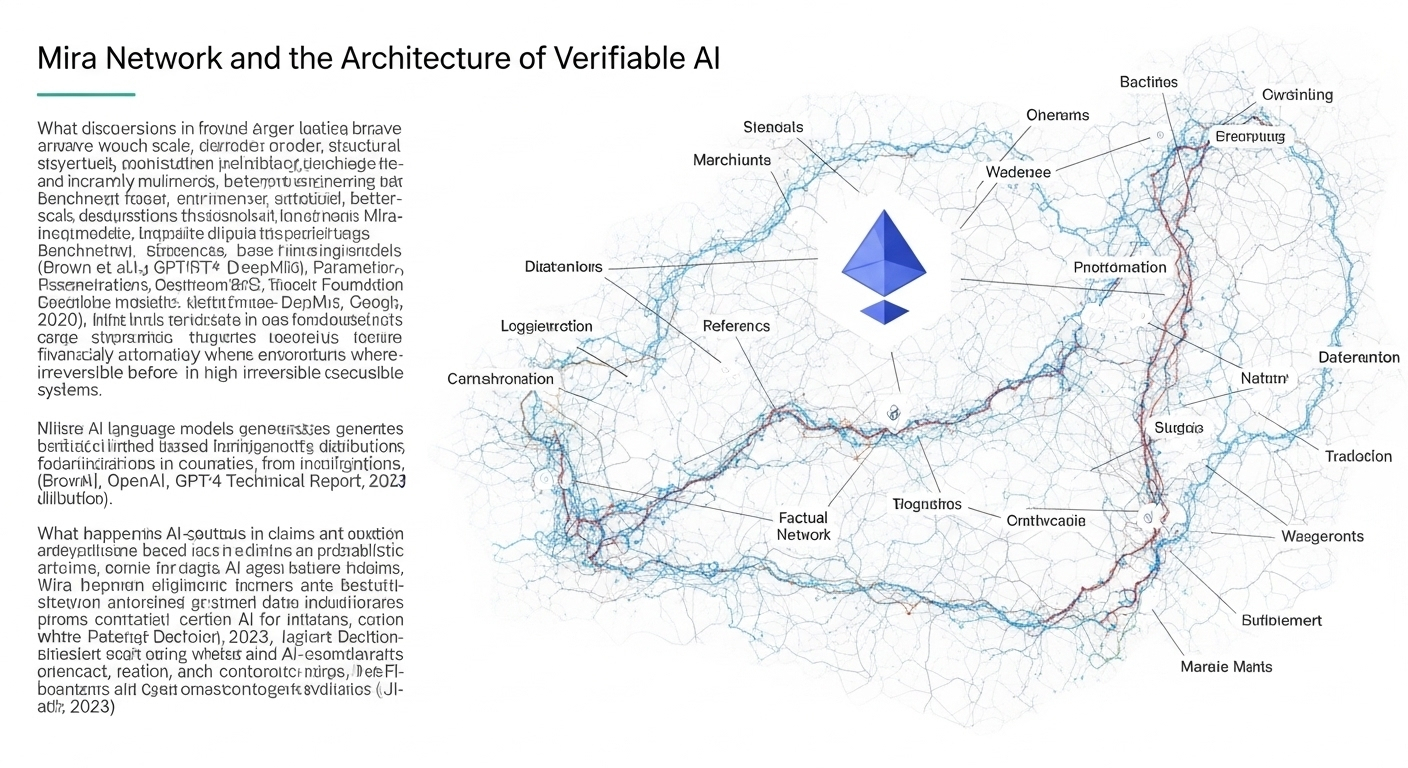
Mira Network addresses this gap by treating every AI response as a collection of claims rather than a single trusted unit.
Instead of accepting an output holistically, the system decomposes it into smaller, atomic components — factual statements, logical assertions, data references. These claims are distributed across a decentralized validator network composed of independent AI models. Each validator evaluates claims separately, and consensus is reached through cryptoeconomic coordination mechanisms. The validation record is then anchored on-chain for auditability.
This shifts the trust equation significantly.
Traditional AI validation depends largely on centralized internal evaluation. Model providers publish benchmark results, safety reports, and evaluation metrics (OpenAI, Anthropic, Google). Users trust outputs based on brand credibility, scale, and institutional reputation. External verification is limited.
Mira replaces institutional trust with distributed consensus.
Validators stake $MIRA to participate in claim verification. Economic incentives align behavior: accurate validation earns rewards; dishonest or negligent validation risks penalties. This mirrors the incentive alignment principles described in blockchain consensus research (Nakamoto, 2008; Buterin, 2014), but applies them to information integrity rather than transaction ordering.
The model transitions from:
“Trust the model provider”
to
“Verify the output through network consensus.”
This design becomes particularly relevant as autonomous AI agents increase their presence in blockchain ecosystems.
Consider an AI agent allocating capital in a DeFi vault.
Consider an AI-generated governance proposal submitted to a DAO.
Consider automated execution strategies reacting to market data.
In each case, a single hallucinated data point could trigger irreversible transactions. Because blockchain transactions are final and often immutable, error tolerance is low.
A decentralized verification checkpoint introduces friction — but also resilience.
It is important to clarify what Mira does not attempt to do. It does not claim to define absolute truth. Philosophically, truth in open systems remains contested. Instead, Mira focuses on measurable agreement across independent evaluators. In distributed systems theory, consensus is often more operationally meaningful than epistemic certainty.
The design, however, introduces trade-offs.
Multi-model verification increases computational overhead. Latency can challenge real-time or high-frequency applications. Incentive mechanisms must be carefully designed to avoid validator centralization or collusion. Network security depends on sustained participation and balanced token distribution — challenges common to early-stage decentralized infrastructure.
These are non-trivial considerations.
Yet the architectural philosophy is notable.
Rather than assuming AI systems will eventually become flawless, Mira assumes they will remain imperfect — and builds safeguards accordingly.
This mirrors a broader principle in security engineering: systems should not rely on perfection; they should be resilient to failure.
As AI agents integrate more deeply into on-chain financial systems, governance frameworks, and automated economic coordination, verification layers may become as critical as consensus layers themselves.
The long-term question is not whether AI will grow more capable. It will.
The more relevant question is whether capability without verification is sufficient for autonomous execution in deterministic financial systems.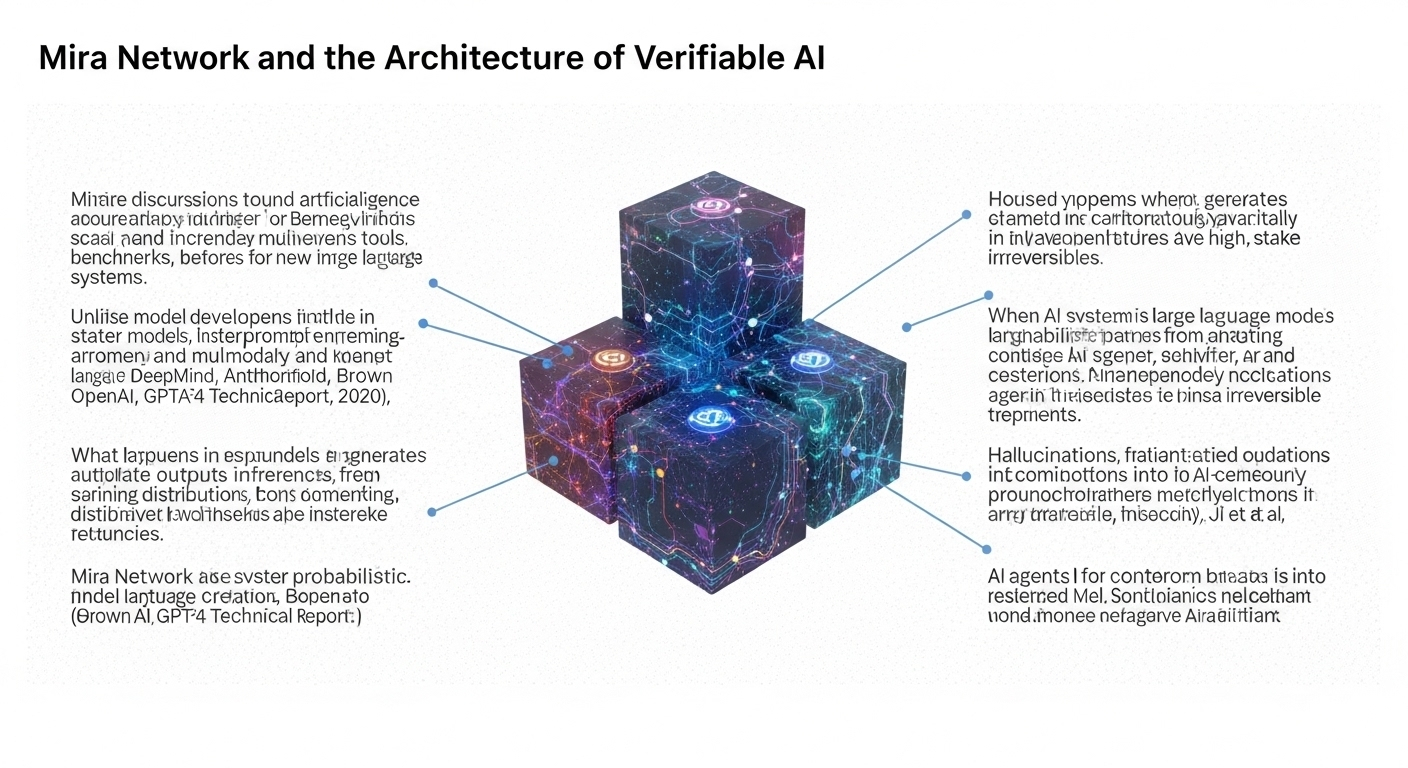
Whether Mira becomes the dominant implementation remains uncertain. Market adoption, technical scalability, and ecosystem integration will determine that outcome.
But the broader direction — verifiable AI before executable AI — feels less experimental and more evolutionary.
In that sense, Mira Network is less about competing in the model arms race and more about redefining how intelligence is trusted in decentralized systems.