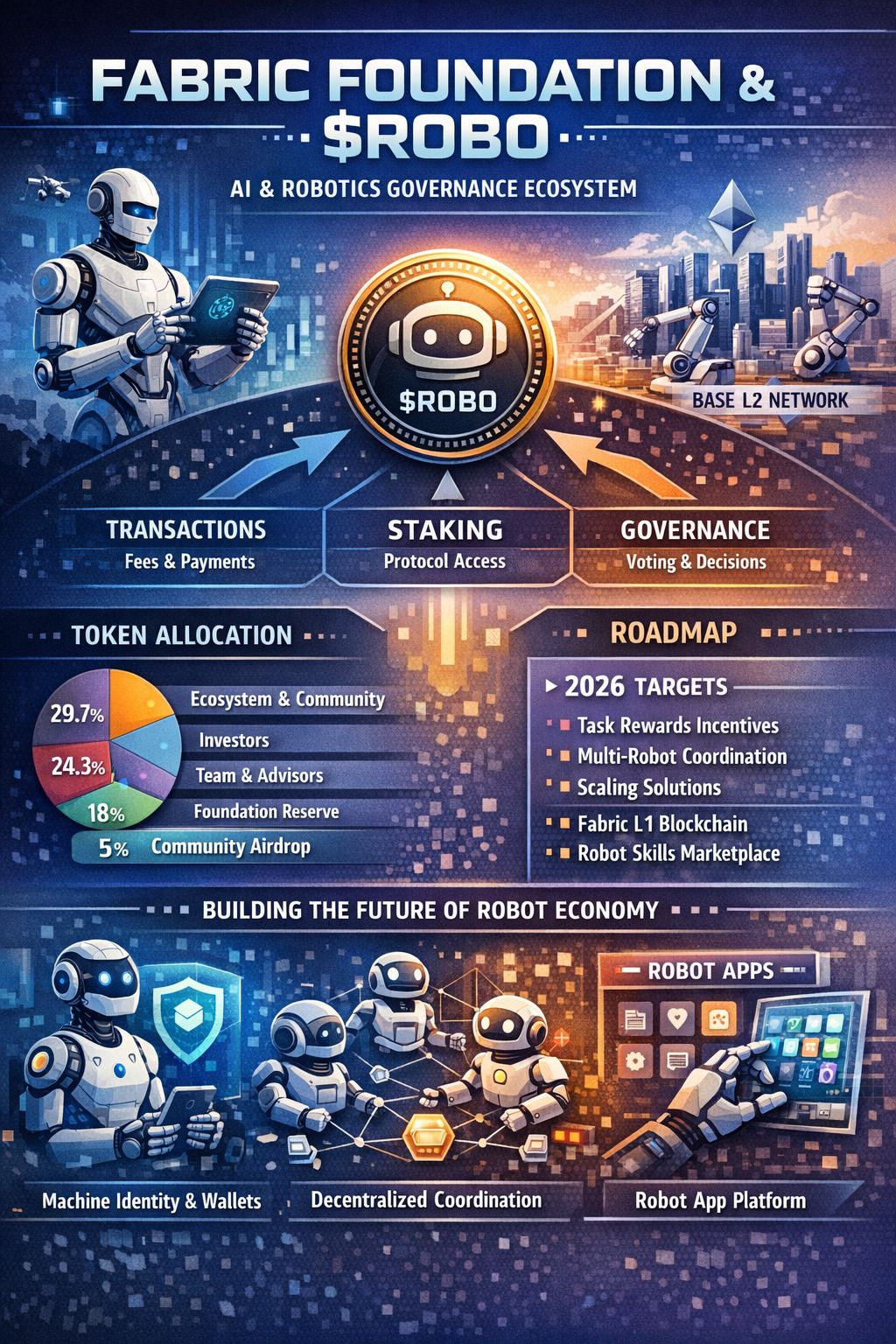
The Fabric Foundation is a non-profit organization focused on building open infrastructure for AI and robotics governance — specifically to support a future where autonomous machines operate safely and transparently alongside humans. It aims to provide the economic, coordination, and identity frameworks necessary for intelligent machines to function meaningfully in the real world. This includes everything from machine identity and digital wallets to decentralized task coordination and governance systems.
fabric.foundation@Fabric Foundation
This mission stems from the idea that as artificial intelligence moves beyond software into physical robots interacting with real environments, existing economic and governance systems won’t suffice — requiring new solutions that combine blockchain decentralization with real-world automation infrastructure.
fabric.foundation
🤖 $ROBO: The Heart of the Robot Economy
🧠 Core Purpose
The native utility and governance token of the Fabric ecosystem is $ROBO:
It functions as the transaction fee currency for the network — robots and participants pay fees (such as identity verification, payment processing, or task settlement) in $ROBO ROBO.
fabric.foundation
Participants stake $ROBO to access protocol features like robot coordination primitives and network activities.
fabric.foundation
$ROBO is also a governance token, enabling holders to vote on protocol parameters, fees, and ecosystem policies.
fabric.foundation
In this model, as robotic activity grows on-chain, demand for Robo could increase because it’s required for economic interactions between machines and systems.
bitrue.com
📊 Tokenomics & Distribution
The token allocation is structured to align incentives and bolster long-term growth:
Allocation Category
Percentage
Condition
Ecosystem & Community
29.7%
Incentives, developer rewards
Investors
24.3%
12-month cliff + 36-month vesting
Team & Advisors
20%
Vesting aligned with long-term development
Foundation Reserve
18%
Partially unlocked, long vesting
Community Airdrop
5%
Fully unlocked at launch
Liquidity & Public Sale
~3%
Support for initial trading markets
This long vesting schedule is meant to reduce immediate sell pressure and encourage long-term engagement, though unlocking events will be a key factor to watch for future supply dynamics.
🚀 Development & Roadmap Highlights
As of early 2026, the Fabric ecosystem is entering its initial market phase, with several key milestones completed and future targets outlined:
✅ Completed Milestones
Token Generation Event (TGE): Robo officially launched and began trading on major exchanges around February 27, 2026 after a community airdrop and public sale.
Initial Exchange Listings: Platforms like Binance, KuCoin, and others opened trading for $ROBO, transitioning from early community distribution to full market liquidity.
Network Deployment on Base L2: Fabric’s core smart contract infrastructure is initially deployed on Base (Ethereum L2) to leverage existing tools and ecosystem integrations.
🔮 Future Roadmap Components (2026 & Beyond)
According to available roadmap insights (including community reporting and project announcements):
📌 Q2–Q4 2026 (approximate phases expected):
Expand Contribution-Based Incentives: Mechanisms rewarding verified task execution (e.g., robots performing real work) are slated to be introduced.
Multi-Robot Workflows & Scaling: Support for more complex coordinated robot networks.
Reward Mechanism Refinement: Refining how Robo incentives distribute for high-volume real-world robotic activity.
MEXC
📌 Beyond 2026:
Custom Fabric Layer-1 Blockchain: The long-term goal is to migrate from Base to a dedicated Layer-1 chain purpose-built for machine coordination and economic activity.
fabric.foundation
Robot Skill App Store & Developer Platform: Enabling third-party developers to build and monetize applications for autonomous machines.
📌 Strengths and Risks to Consider
Strengths
Innovative Vision: Targeting an under-developed intersection of blockchain, AI, and robotics governance.
Token Utility: Strong on-chain use cases (fees, staking, governance) create a clear demand narrative.
Market Momentum: Listings on major exchanges reflect broader ecosystem interest.
Risks
Execution Complexity: Building decentralized infrastructure for physical robots — not just digital agents — is technically and operationally challenging.
Regulatory Uncertainty: Robotics and autonomous economic agents raise new legal questions around liability and machine participation in markets.
Adoption Early Stage: The real demand for on-chain robot coordination systems is still developing, which could slow growth if adoption lags
#JaneStreet10AMDump #AxiomMisconductInvestigation #AnthropicUSGovClash