Fundamental Analysis of Robo Coin ($ROBO)
Overview: What is Robo Coin?
$ROBO (#ROBO ) is a cryptocurrency designed to support decentralized robotics infrastructure and AI-powered autonomous systems. It acts as both a utility token and governance token, enabling robots, developers, and network participants to interact economically on a decentralized network known as the Fabric Protocol. 
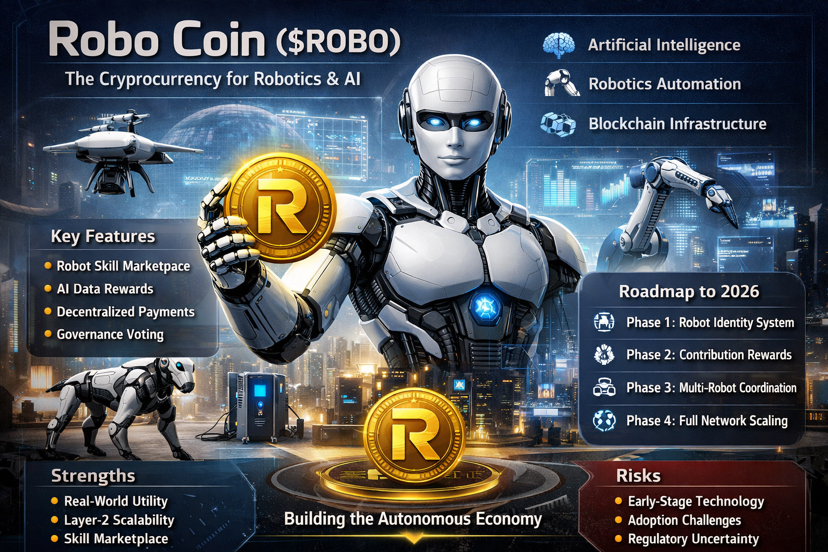
Unlike traditional cryptocurrencies focused solely on payments or finance, Robo Coin aims to create a machine-native economy, where robots, AI agents, and humans can transact, collaborate, and earn rewards autonomously. This positions Robo Coin at the intersection of three major future-growth sectors:
• Artificial Intelligence
• Robotics automation
• Blockchain infrastructure
This combination gives Robo Coin a unique long-term narrative compared to standard meme coins or payment tokens.
⸻
Core Fundamentals and Utility
1. Real-world robotics economy integration
The main utility of Robo Coin is enabling robots and AI agents to participate directly in decentralized economic systems. The Fabric Protocol allows robots to perform tasks, receive payments, and operate autonomously using smart contracts. 
Key features include:
• Robot-to-robot and robot-to-human payments
• Decentralized robot identity system
• Autonomous service payments without banks
• Open robot skill marketplace
This creates a new economic model where robots can earn income independently.
⸻
2. Skill marketplace and robot “App Store”
One of Robo Coin’s strongest fundamentals is the introduction of a robot skill marketplace.
Developers can create “skill chips,” which are software modules that enhance robot abilities (like repair, delivery, or data collection). These skills can be bought, sold, or deployed using $ROBO tokens. 
This creates:
• A developer ecosystem
• Recurring demand for the token
• Expansion of robot capabilities
This model is similar to mobile app stores but designed for robotics.
⸻
3. Contribution-based reward system (strong token utility)
Unlike many cryptocurrencies that reward passive holders, Robo Coin only rewards active contributors.
Users earn tokens by:
• Providing AI training data
• Supplying computing power
• Developing robot skills
• Operating robots on the network 
This model ensures real productivity drives token demand, not speculation.
⸻
4. Governance and decentralized control
Token holders can participate in governance by locking tokens and receiving voting rights (veROBO).
They can vote on:
• Network upgrades
• Token emission rates
• Fee structure
• Protocol improvements 
This aligns incentives between developers, users, and investors.
⸻
Tokenomics and Supply Structure
Robo Coin has strong tokenomics designed for sustainability.
Key metrics:
• Total supply: 10 billion tokens
• Largest allocation: Ecosystem and community (29.7%)
• Team and advisors: 20% with vesting schedule
• Investors: Locked with vesting periods
• Emissions controlled dynamically by network usage 
This prevents massive early dumping and supports long-term growth.
Additionally, token buybacks using protocol revenue create continuous demand. 
⸻
Technology and Infrastructure Strength
Robo Coin’s architecture includes several advanced blockchain innovations:
Layer-2 scaling technology
The network uses Layer-2 scaling combined with sharding to increase speed and reduce transaction fees. 
Benefits include:
• Faster transactions
• Lower fees
• Improved scalability
This allows large robotic networks to operate efficiently.
⸻
Strong security model
Security features include:
• Validator slashing mechanism
• Smart contract audits
• Governance transparency
• Bug bounty programs 
These measures reduce security risks.
⸻
Major Developments and Recent Progress
1. Decentralized app (dApp) ecosystem expansion
The project plans to launch decentralized applications to expand ecosystem functionality and enable peer-to-peer robotic transactions. 
This increases real token utility.
⸻
2. Exchange listing roadmap progress
Robo Coin has already been added to major exchange roadmaps, showing growing industry recognition.
Estimated metrics:
• Market cap: around $420 million (at roadmap announcement stage)
• Large ecosystem allocation for growth and development
• Increasing exchange listing potential 
Exchange listings often increase liquidity and visibility.
⸻
3. Active development of robot payment systems
The protocol has already demonstrated robot-to-charging station payments using blockchain stablecoins, proving real-world utility. 
This confirms the technology is not purely theoretical.
⸻
Robo Coin Roadmap (2026 and beyond)
The official roadmap focuses on progressive deployment of robot infrastructure.
Phase 1 – Robot identity and infrastructure (Q1 2026)
• Deploy robot identity system
• Enable robot task settlement
This establishes foundational infrastructure. 
⸻
Phase 2 – Contribution incentives (Q2 2026)
• Launch reward system based on robot contributions
• Enable token incentives for network participants
This activates network growth. 
⸻
Phase 3 – Multi-robot coordination (Q3 2026)
• Enable robots to collaborate on complex tasks
• Expand robotic workforce capabilities
This increases network utility. 
⸻
Phase 4 – Full network scaling and optimization (Q4 2026 and beyond)
• Improve incentive mechanisms
• Prepare large-scale robot deployments
• Build Fabric Layer-1 blockchain
This creates a complete autonomous robot economy. 
⸻
Strengths of Robo Coin
Strong real-world utility
Supports robotics, not just financial speculation.
Major growth sector exposure
Combines blockchain, robotics, and AI — three major future industries.
Sustainable tokenomics
Contribution-based rewards reduce inflation and speculation.
Real ecosystem development
Robot skill marketplace and robotic payment infrastructure.
Long-term scalability focus
Layer-2 architecture improves performance.
⸻
Risks and Weaknesses
Early-stage technology risk
Robotic blockchain ecosystems are still experimental.
Adoption risk
Success depends on real robot network adoption.
Competition risk
Other AI-blockchain projects like Fetch.ai and Bittensor compete in similar sectors. 
Regulatory uncertainty
Crypto regulatory changes may affect growth. 
⸻
Overall Fundamental Rating