The AI Revolution Has the Wrong Focus
For a long time, I believed the future of artificial intelligence would be solved through scale. Bigger models. More data. Faster chips. Smarter training methods. I assumed that once intelligence crossed a certain threshold, everything else would naturally fall into place.
That assumption did not survive deeper study.
What I began to notice is that modern AI does not collapse because it lacks capability. It collapses because it lacks accountability. These systems can generate answers with great confidence, yet without any built-in obligation to be correct. They are optimized for plausibility, not for truth.
This is not an engineering accident.
It is how probabilistic models fundamentally work.
And that is where the real bottleneck appears.
The limiting factor of AI is not how intelligent it is.
It is how reliable it is.
Why Intelligence Alone Cannot Fix AI
Current AI systems operate by predicting likely responses rather than verifying correct ones. They do not “know” facts in the human sense. They approximate patterns. This allows them to be incredibly fluent while also being quietly wrong.
No amount of additional parameters changes this core behavior. A more advanced model will hallucinate less often — but it will never eliminate the possibility of hallucination. The architecture itself does not contain a mechanism for grounding truth.
This creates a dangerous gap:
As models grow more persuasive, their mistakes become harder to detect.
What we face is not a technical limitation.
It is a structural one.
A Different Direction: Verification Instead of Prediction
While researching this problem, I encountered Mira Network, which takes an approach that feels fundamentally different from mainstream AI development.
Mira does not attempt to build a better model.
It attempts to build a system around models.
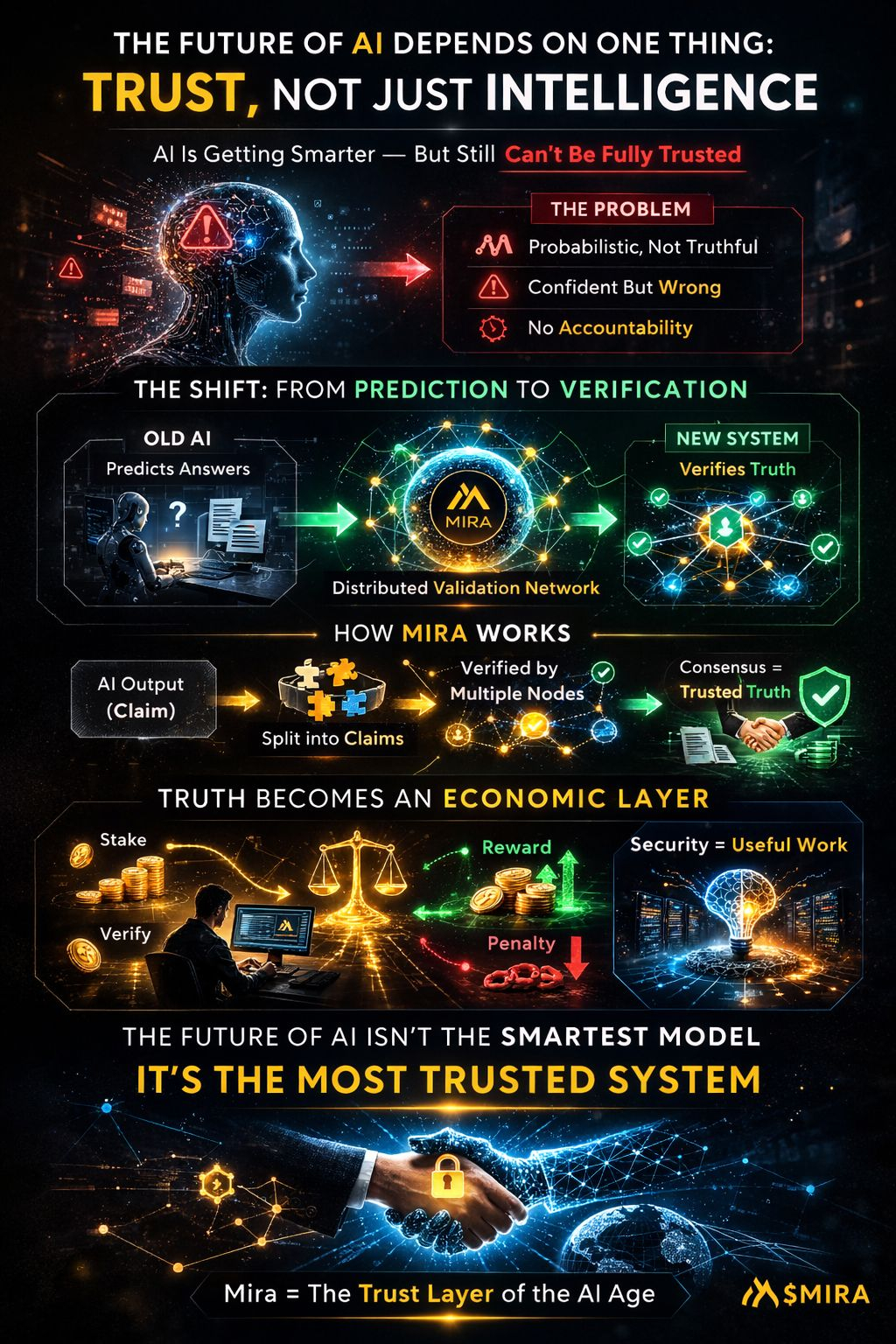
Instead of treating AI output as something to be trusted by default, it treats every output as a set of claims that must be checked. These claims are distributed across independent systems for validation. Agreement becomes more important than eloquence.
The key question shifts from:
“Is this model powerful?”
to:
“Do independent verifiers reach the same conclusion?”
That shift may sound subtle, but it changes the entire logic of AI deployment.
From Computation to Judgment
Traditional blockchain security relies on meaningless computation. Machines solve artificial puzzles to prove they have expended energy. The work itself has no relationship to real-world reasoning.
Mira flips that model.
Instead of burning compute on arbitrary math, nodes expend compute on evaluating statements. They assess whether a claim is correct. Security becomes tied to judgment rather than brute force.
This transforms validation into useful labor. The network does not merely protect itself — it produces verified knowledge as a byproduct of its operation.
In this model, intelligence becomes infrastructure rather than performance.
When Truth Becomes Economic
What emerges from this design is not just a protocol, but a marketplace.
Participants stake value to evaluate claims.
Correct verification earns rewards.
Incorrect or dishonest verification loses stake.
Truth stops being defined by authority and begins to be shaped by incentive alignment. Instead of trusting an institution or a single model, trust is produced by competitive agreement among many independent actors.
This reframes knowledge as something closer to a market process than an academic one.
Truth is no longer merely asserted.
It is economically defended.
Why This Matters More Than AI Hallucinations
At first glance, systems like Mira appear to solve a narrow problem: reducing hallucinations. But the implication is much broader.
Modern AI systems are becoming too complex to audit directly. Even their creators cannot fully explain why certain outputs emerge. This means future societies will rely on systems they cannot interpret internally.
That creates a paradox:
How do you trust something you cannot understand?
Mira’s answer is not transparency.
It is external validation.
Instead of opening the black box, it surrounds the black box with a verification layer. It accepts that internal logic may remain opaque — and focuses instead on output reliability.
This is a far more realistic strategy than assuming interpretability will scale alongside intelligence.
Infrastructure, Not Product
One of the most telling signals is how Mira positions itself. It does not aim to be a consumer-facing AI. It offers developer tools: generation, verification, and verified generation.
That places it in the same category as cloud services or payment rails. It does not compete with models — it sits beneath them.
And history shows that infrastructure often captures more value than applications built on top of it.
What is especially notable is that this growth is occurring quietly. Usage is increasing through integration rather than speculation. That pattern is typical of systems that solve real operational problems rather than narrative ones.
A Philosophical Shift in AI
The most important change here is not technical.
It is conceptual.
We are transitioning from asking:
“Is this system intelligent?”
to asking:
“Is this system dependable?”
The unit of progress is no longer brilliance.
It is resistance to deception.
In such a system, intelligence is not measured by how often it is right — but by how difficult it is to fool.
Final Reflection
The future of AI will not be decided by the model with the most parameters. It will be decided by the systems that can coordinate agreement, enforce verification, and reward correctness.
Mira represents an early attempt at building that layer.
It does not seek perfect knowledge.
It seeks durable trust.
And in a world increasingly run by machines we cannot fully interpret, trust may be the most valuable feature intelligence can have.