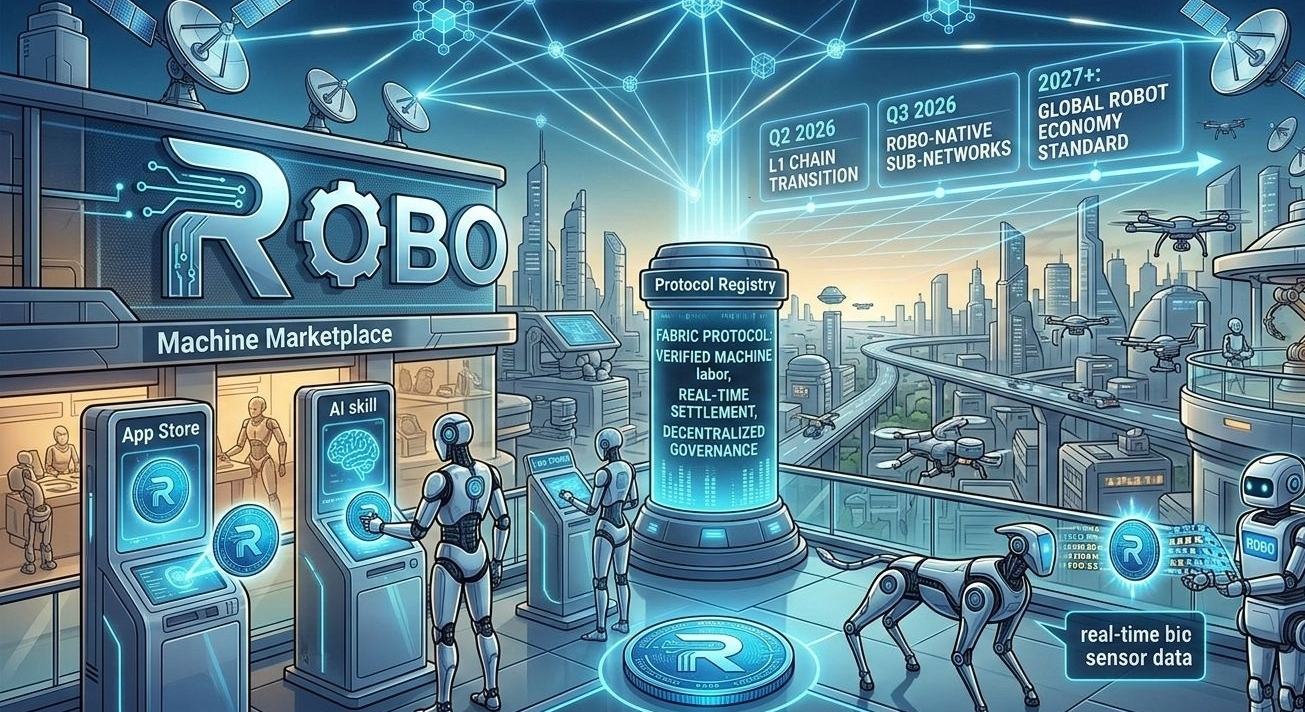
ROBO (of the Fabric Protocol) is one of the most intriguing projects emerging at the intersection of blockchain, Artificial Intelligence (AI), and physical robotics. While many "AI coins" are purely speculative or facilitate niche on-chain data tasks, ROBO aims to be the standard utility and settlement layer for the entire global "Robot Economy"—an ecosystem where autonomous machines can operate, interact, and transact independently. This is a crucial distinction. ROBO isn't just an "AI coin"; it is a foundational infrastructure token for decentralized physical infrastructure networks (DePIN) in the robotics sector.
1. Introduction & The 'Machine Economy' Vision
The fundamental problem ROBO addresses is the siloed nature of traditional robotics. Currently, robots from different manufacturers cannot talk to each other, share data, or verify their identities. Their AI "minds" are often locked in centralized data centers, and their "bodies" (the hardware) cannot perform labor for anyone except their immediate owner.
ROBO's vision, executed through the Fabric Protocol, is to create an open, trustless marketplace for robotic labor, computational power, and data.
Trust and Coordination Layer: The protocol acts as a social network and trust layer for machines. It provides a standardized framework for robots to verify identities, share situational context, and exchange skills.
Decentralized Machine labor: The ultimate goal is to enable "Machine-to-Machine" (M2M) commerce, where a delivery drone, for instance, can pay a recharging station without human intervention. This transitions robots from isolated assets into verifiable, independent economic participants.
2. Key Technological Pillars
The project is built on several key innovations that provide strong fundamental competitive advantages:
The FABRIC Protocol: A trust and coordination layer that functions as a "Social Network for Machines." It uses on-chain registries to let robots verify identities, share situational context, and exchange skills in real-time.
OM1 Operating System: Often called "Android for Robotics," OM1 is a hardware-agnostic OS that lets one software application run across diverse hardware—from humanoids and quadrupeds to robotic arms. This drastically reduces development costs and accelerates deployment.
Robot Crafter & App Store: A decentralized marketplace where developers can publish robotic skills or tasks. A business can deploy a pre-built "delivery skill" to any compatible robot fleet, making automation highly flexible.
Proof of Robotic Work (PoRW): A consensus mechanism that rewards participants for verifiable machine labor, data contributions, or hardware coordination.
3. Tokenomics: ROBO Utility
The ROBO token (with a total supply of 10 billion tokens) is designed to be the economic engine of the entire ecosystem. Its utility is multifaceted and deeply embedded:
Access and Work Bonds: Robot operators must post a refundable ROBO "work bond" to register hardware on the network. This "skin in the game" acts as a security deposit against fraud or prolonged offline periods.
Transaction Settlement: ROBO is the native settlement currency for all network fees. Every data query, compute task, API call, and robot task payment is settled in ROBO, creating constant organic demand.
Delegation and Staking: Token holders can delegate ROBO to specific robot operators to augment their bond, increasing that operator's task capacity and earning a share of rewards. This creates a market-based reputation system, funneling capital to efficient and honest operators.
Governance: ROBO holders can vote on protocol upgrades, change economic incentives, and manage the Fabric Foundation's treasury.
This model—emphasizing "verified work" over passive holding—aligns the token's value directly with real-world activity and value creation.
4. Development & Roadmap Highlights
ROBO has achieved significant milestones, and its roadmap details a transformation towards greater autonomy:
Past Highlights
Successful Airdrop & Community Building: Fabric Foundation has actively distributed tokens to reward early contributors and bootstrap network participation.
Public Sale & Exchange Listings: Strong interest in the public sale validated market demand, and recent listings on major exchanges (Bitget, MEXC, Phemex) have expanded liquidity and exposure.
Integration with Base: The protocol initially operates on Base, the Ethereum Layer-2 incubated by Coinbase, benefiting from its scalability and access to the Ethereum ecosystem.
Roadmap & Future Goals (Highlights)
Q2 2026: Transition to Dedicated Layer-1 (L1) Chain. This is a critical milestone, allowing the protocol to customize consensus parameters (like PoRW) specifically for machine coordination, independent of a general-purpose L2.
Q3 2026: ROBO-Native Sub-Networks. Enabling specialized, high-performance L2s or sidechains tailored for specific industries (e.g., a dedicated sub-network for robotic agriculture or manufacturing).
2027+: Global Robot Economy Standard. Continued expansion of the partnership network with humanoid and quadruped manufacturers to make OM1 the default OS.
5. Fundamental Conclusion: A High-Potential Infrastructure Bet
ROBO is not without risks—the field of AI/Robotics DePIN is incredibly complex, regulatory frameworks for autonomous machine assets are nascent, and competition from centralized tech giants will be fierce.
However, from a fundamental perspective, ROBO has a compelling value proposition. It is a rare "infrastructure play" in the AI space. Its multi-layered approach—combining a specialized OS, a decentralized marketplace, and a tailored consensus mechanism—builds significant competitive moats. By solving the core problems of trust, interoperability, and economic agency for machines, ROBO is positioning itself as essential infrastructure for the next phase of global automation: the transition to a trillion-dollar decentralized robot economy.