
When I first started thinking about robots in the economy, one thought kept sticking with me: being smart isn’t enough. A robot can perform complex tasks, move fast, or calculate precisely, but if no one can prove what it actually did, it can’t really participate in real-world systems. That’s what got me digging into Fabric Foundation. They’re not just focused on making robots smarter, they’re focused on making their actions verifiable. And that changes everything.
Most robotic systems today rely on trust. A warehouse robot moves a box. A delivery bot drops a package. The system logs it, and the operator assumes everything went correctly. It works… until real value is on the line. Fabric flips that model. Their protocol lets robots provide cryptographic evidence of their work. The robot doesn’t just say it completed a task—it proves it. Anyone in the network can verify it, and that proof is tamper-resistant.
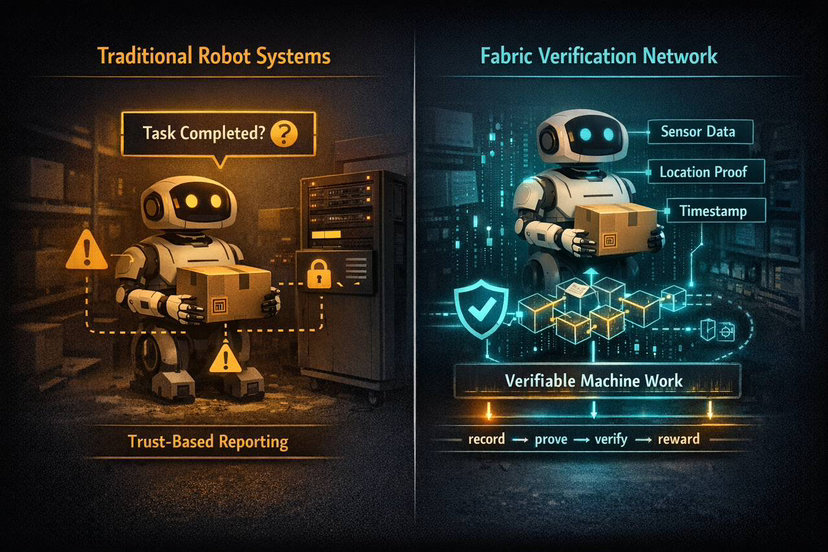
The more I thought about it, the more it became clear how critical this is. Imagine a farm with multiple robots: one monitors crops, another sprays, a third collects yield data. If results drop, how do you know what went wrong? Fabric’s system allows each robot’s work to be independently verified without exposing sensitive data. They even use zero-knowledge methods so proof exists without revealing private information.
They tie verification to real incentives through the $ROBO token. Robots and operators stake value to participate. Misbehavior or false reporting can result in losing their stake. The principle is simple: only verified work earns rewards. Owning hardware alone doesn’t pay, you must perform verifiable tasks.
This changes how machines can collaborate. Delivery bots, monitoring drones, maintenance robots, they can all feed verified data into a shared network. Over time, this builds a history of trusted machine activity. Humans and machines can interact without a central authority.
Of course, challenges remain. Sensors fail. Conditions vary. Machines behave unpredictably. Verification in the real world is far trickier than digital checks. But if Fabric can make this system work reliably, they’re not just building smarter robots, they’re building the foundation for a new machine economy.
After studying it, I can’t look at robotics the same way. It’s no longer just about capability, it’s about trust. If robots are going to earn value, collaborate across industries, and operate in open systems, we need proof that their work is real. That’s what makes Fabric Protocol one of the most exciting projects in the space today.