)
### 1. Introduction
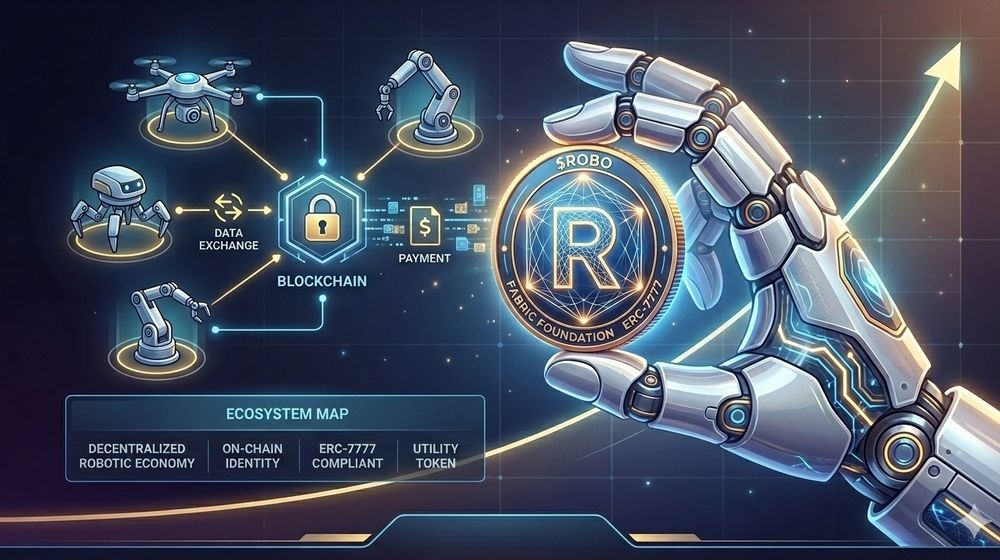
The **@Fabric Foundation ** cryptocurrency, powered by the **$ROBO O token**, is a blockchain-based infrastructure project focused on creating an economic coordination layer for **AI systems, robots, and autonomous machines**. The project aims to merge **blockchain, artificial intelligence, and robotics** into a decentralized ecosystem where machines can interact economically and perform tasks within a global network. ([CoinMarketCap][1])
Unlike traditional cryptocurrencies that mainly focus on payments or decentralized finance, Fabric aims to enable **machine-to-machine economic activity**, allowing robots to operate autonomously using blockchain wallets, identities, and smart contracts. ([CoinMarketCap][1])
---
# 2. Project Vision and Value Proposition
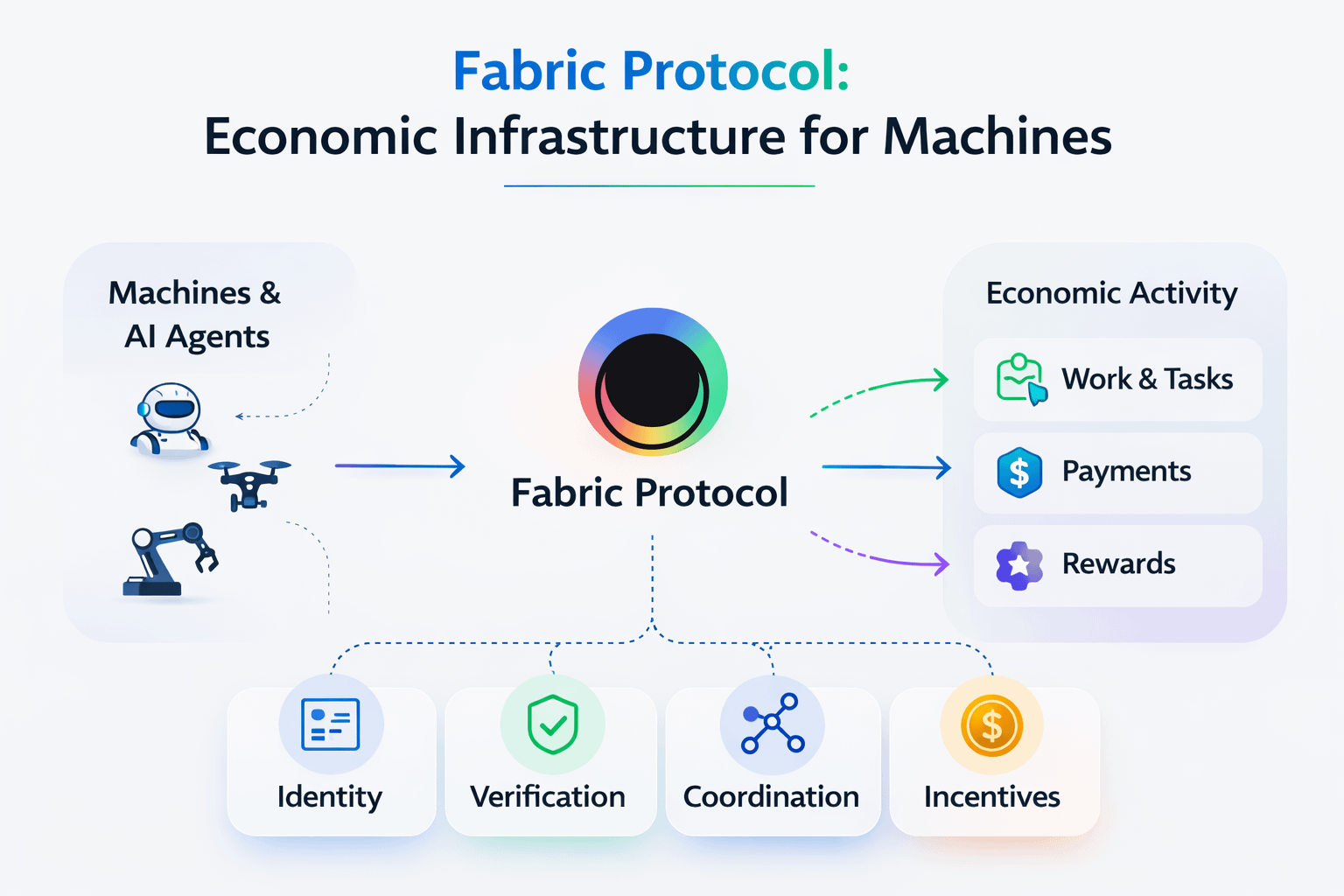
The core vision of the Fabric Foundation is to **“own the robot economy.”** The idea is that in the future, autonomous robots and AI agents will perform large amounts of economic activity, and they will require infrastructure for identity, payments, governance, and coordination. ([fabric.foundation][2])
The Fabric network intends to solve several problems:
* **Robot identity:** Robots need verifiable on-chain identities.
* **Autonomous payments:** Robots require wallets to receive and send funds.
* **Task coordination:** Matching robots with jobs in decentralized marketplaces.
* **Governance:** A decentralized system to manage robotic networks.
By using blockchain technology, Fabric aims to create a **transparent and programmable economic system for intelligent machines.** ([CoinMarketCap][1])
---
# 3. Technology and Architecture
The Fabric Protocol is designed as a blockchain-based infrastructure with multiple components:
### 3.1 Blockchain Layer
Initially, Fabric is deployed on **Base**, an Ethereum Layer-2 network that provides lower transaction costs and higher throughput. Over time, the project plans to transition into its **own dedicated Layer-1 blockchain** optimized for machine-to-machine communication and robotic activity. ([CoinMarketCap][1])
### 3.2 On-Chain Identity System
A major feature is **on-chain identity for robots**. Robots cannot open bank accounts or obtain passports, so Fabric proposes blockchain-based identities that allow robots to interact economically and securely. ([fabric.foundation][2])
### 3.3 Autonomous Wallet Infrastructure
Robots within the Fabric network will operate **crypto wallets** that allow them to pay for services, receive payments for completed tasks, and interact with smart contracts.
### 3.4 Decentralized Task Marketplace
The network envisions a system where robots can perform work such as:
* delivery services
* warehouse automation
* data collection
* industrial maintenance
Task assignments and payments would be coordinated through blockchain smart contracts.
---
# 4. Tokenomics and Utility
The **ROBO token** serves as the core utility asset in the Fabric ecosystem.
### Key token functions
1. **Transaction fees** for payments and identity verification.
2. **Staking** for network participation and security.
3. **Governance voting** for protocol decisions.
4. **Coordination incentives** for robot deployment and operation. ([fabric.foundation][2])
### Supply structure
* **Total supply:** 10 billion ROBO tokens
* **Fixed supply:** No inflation model
* **Token generation event:** February 2026 ([Bitget][3])
### Token allocation (approx.)
* Ecosystem & community: 29.7%
* Investors: 24.3%
* Team & advisors: 20%
* Foundation reserve: 18%
* Airdrops and liquidity: remaining portion. ([fabric.foundation][2])
The project also introduces a unique incentive model called **Proof of Robotic Work**, where tokens are distributed based on real robotic activity rather than purely financial staking. ([CoinMarketCap][1])
---
# 5. Development Progress
Fabric Foundation is currently in an early development phase but has made several initial milestones:
### Exchange Listings
The ROBO token launched in **February 2026** and quickly appeared on several exchanges, increasing liquidity and investor access. ([CoinMarketCap][4])
### Network Deployment
* Phase 1: Deployment on Base Layer-2
* Phase 2: Ecosystem development and robot identity infrastructure
* Phase 3: Migration to Fabric’s native Layer-1 chain. ([CoinMarketCap][1])
These steps are designed to gradually build the decentralized robotics economy.
---
# 6. Roadmap
Although still evolving, the Fabric roadmap generally includes the following stages:
### Phase 1 – Infrastructure Launch
* Token generation event
* Initial deployment on Base L2
* Developer tools and ecosystem bootstrapping
### Phase 2 – Robotics Network Integration
* On-chain robot identity systems
* Machine wallets and payment rails
* Decentralized task allocation
### Phase 3 – Dedicated Blockchain
* Migration to Fabric Layer-1
* Optimized infrastructure for machine economies
* Large-scale robotic coordination networks
### Phase 4 – Global Robot Economy
* Integration with AI systems
* cross-industry robotic services
* decentralized governance for machine ecosystems.
---
# 7. Strengths of the Project
### Innovative Narrative
The project combines three major technology sectors:
* AI
* Robotics
* Blockchain
If successful, this could create a **new category of crypto infrastructure.**
### Real-World Utility
Unlike many speculative tokens, Fabric attempts to link token usage with **real-world robotic activity and services.**
### Unique Incentive Mechanism
The **Proof of Robotic Work** system ties token rewards to real-world machine performance rather than financial speculation.
---
# 8. Risks and Challenges
### Early-Stage Development
Fabric is still in its early stages, and real adoption by robotics companies remains uncertain.
### Execution Complexity
Building infrastructure for autonomous machines interacting economically is extremely complex.
### Market Volatility
New tokens often experience high price volatility due to low circulating supply and speculative trading. ([AInvest][5])
---
# 9. Conclusion
Fabric Foundation represents an ambitious attempt to build **a decentralized economic layer for intelligent machines and robotics networks**. By combining blockchain infrastructure with AI-driven automation, the project aims to create a global marketplace where robots can perform tasks, receive payments, and coordinate autonomously.
While the concept is highly innovative, the success of the project will depend on **real-world robotics integration, developer adoption, and long-term ecosystem growth.**
If the Fabric ecosystem manages to bridge the gap between **crypto incentives and physical machine activity**, it could become a foundational infrastructure layer for the emerging **robot economy.**
---