
The first time I started reading about Midnight Network I assumed it was just another privacy-focused blockchain trying to hide transactions. That’s usually the pattern in crypto. People get really excited about a project that says it will keep them anonymous. Traders think this is great. They talk about it a lot.. Then things start to slow down because regulators and exchanges begin to ask some tough questions.
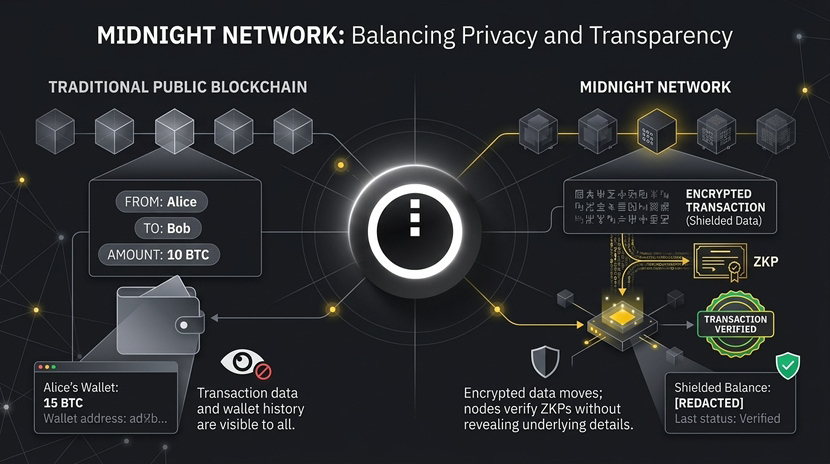
The Midnight project does things differently. You can see this when you look at how it uses something called zero knowledge proofs.
Most of the time blockchains are very open. Every single transaction every balance and every transfer can be seen by anyone who looks at the ledger. This is what most blockchains are, like. That design solved the trust problem that existed before decentralized systems. If anyone can verify the ledger, nobody needs to rely on a central authority. But that same transparency creates a strange situation once blockchain technology moves beyond speculation.
Imagine a company using a decentralized network to process supplier payments. Publishing every payment detail publicly would expose sensitive information to competitors. The same problem appears with identity systems. Nobody wants their personal credentials permanently stored on a fully public ledger.
This tension is exactly where Midnight begins to make sense.
Instead of forcing developers to choose between transparency or privacy, the network tries to balance both. The magic behind that balance is zero knowledge cryptography. It sounds complex. Its actually pretty simple. A zero knowledge proof lets you prove something is true. You do not have to share the information, behind it.Imagine you want to get into a club and they need to make sure you are old enough. You do not want to tell them your birthday. The system just checks if you meet the age requirement and keeps your birthday private.
Midnight works in a way with blockchain transactions.
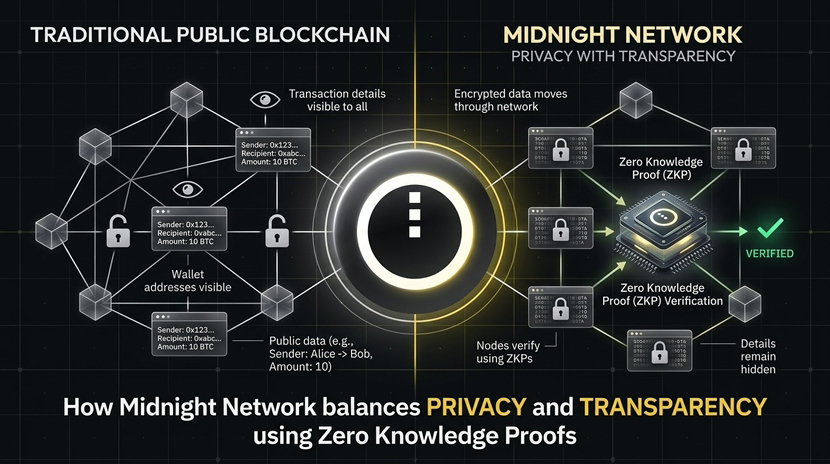
When something happens on the network, a special kind of math proof shows that all the rules were followed. This proof makes sure everything is okay without showing any information. The transaction. The proof is there to confirm it. The details, behind the transaction stay hidden. The system is designed to keep things while still making sure everything is valid. This way you can be sure that the rules are being followed. The network sees that the transaction is legitimate, but the private information remains protected.
When I first wrapped my head around that concept it honestly felt like the missing piece in blockchain design.
Transparency built the foundation of crypto. Privacy might be the layer that allows the technology to expand into real business environments. Midnight’s architecture takes that idea even further by separating different types of data. Some information remains shielded while other elements stay visible so the network can still verify activity. That selective disclosure is what allows Midnight to protect data without breaking the trust model of blockchain. The result is a system where verification still happens publicly while sensitive information stays under the control of the user.
What struck me while reading about this design is how quietly practical it feels.
Crypto conversations often revolve around speed, fees, or price movements. Privacy infrastructure doesn’t generate the same hype, but it might be one of the most necessary upgrades if decentralized systems continue growing.
And honestly, that’s where Midnight feels different.
It’s not trying to make blockchain invisible. It’s trying to make it usable in situations where transparency alone simply isn’t enough. If Web3 keeps expanding into real world applications, the networks that succeed probably won’t be the ones hiding everything.
They’ll be the ones proving the truth while keeping the right things private. 🔐
@MidnightNetwork #night $NIGHT
