
When most people talk about blockchains, they focus on two things: how secure they are and how well they scale. But there’s a third factor becoming impossible to ignore how blockchains actually distribute and price their resources. In modular, privacy-centered networks like Midnight, this “capacity marketplace” isn’t just a footnote. It might end up changing how we even think about decentralized infrastructure. Instead of just fighting for fixed blockspace through blind bidding, Midnight flips the script. Now, computational power turns into a proper market commodity, something you can buy, sell, and plan around.
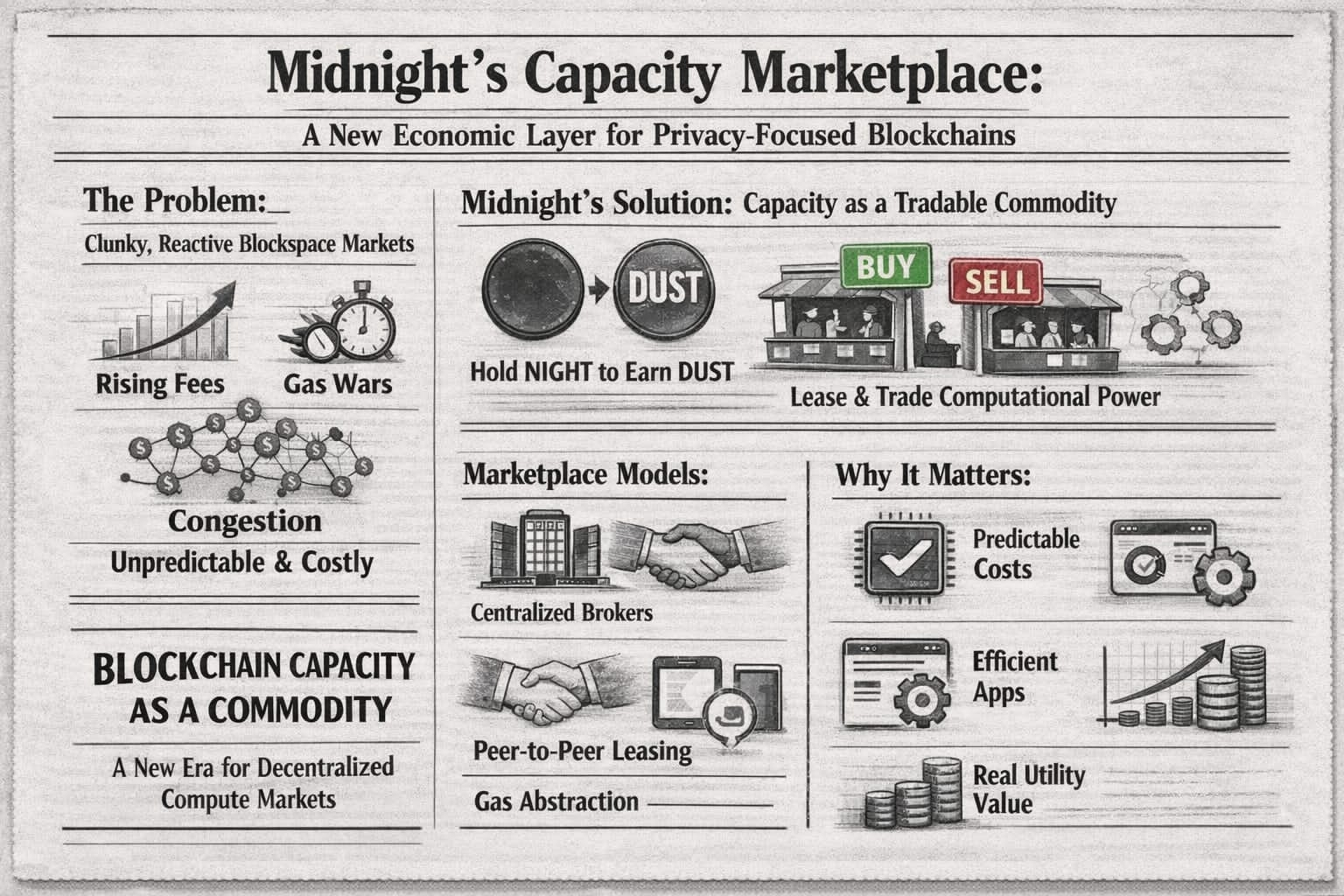
The Problem: Clunky, Reactive Blockspace Markets
In most public blockchains, you get a basic setup: people throw around ever-higher fees to squeeze their transactions into the next block. Ethereum has gas wars, Solana relies on priority fees it works, but barely. When things get busy, costs skyrocket and nobody can predict if their app will keep running smoothly. Developers either cobble together convoluted batch systems or punt work off-chain, just to avoid paying a fortune.
All this chaos comes from one core flaw: these systems only sell blockspace one transaction at a time. There’s no real way to buy blockchain processing power in advance or lock in a price. That’s what Midnight wants to change. They introduce two native assets: NIGHT (the network token) and DUST (a consumable unit that measures how much computation you get per block).
Capacity as a Tradable Commodity
Midnight lays down a new framework: holding NIGHT produces DUST, which you can either spend on your own transactions or lease out to others. Suddenly, blockspace behaves less like a mad dash at a crowded auction and more like a resource market. Instead of scrambling for every single transaction, users (and especially developers) can secure the compute power they need ahead of time.
This isn’t just theoretical. It mirrors what happens in the real world with things like cloud servers. Companies sign up for reserved capacity they’re paying for resources, not surprise bills. Midnight brings that stable, contract-based logic to blockchain computation.
Marketplace Structures
The ways people might trade capacity range from completely centralized brokers to protocol-powered, peer-to-peer deals.
In off-chain brokerage models, specialized players bundle DUST from many NIGHT holders and lease it out to developers. Brokers manage the paperwork, the payments, and carve out a fee they work a lot like commodity brokers who collect supply and connect it with big buyers. The goal? Make it easier and more efficient to match fragmented resources with real demand.
Another option is straight-up direct leasing. NIGHT holders send their DUST directly to another party. The money changes hands off-chain maybe in tokens, maybe in fiat. Sure, you sacrifice some decentralization and need more trust, but you get all sorts of flexibility in how you structure deals.
The most interesting angle might be abstraction layers for end-users. Developers can just cover DUST costs themselves, letting users interact with apps without holding a single token. This approach—gas abstraction is getting a lot of attention in crypto because it makes blockchain apps feel more like normal web apps.
Midnight’s also playing with ideas like Babel-style transaction relaying: users don’t need DUST upfront; they just offer some other asset as payment. Transactions get settled “atomically” across different tokens while privacy stays intact.
Why This Matters for Crypto
Capacity marketplaces signal a much wider shift in blockchain design. As networks become modular and settle into their own specialties, getting resource pricing right is non-negotiable. A system like Midnight’s with its resource-driven pricing could calm down wild fee swings and even serve as the foundation for new financial products based on network bandwidth or computation.
For developers, predictable compute costs mean fewer headaches and more ambitious products. For investors, the value of tokens like NIGHT gets anchored to actual utility how much the network is being used for computation rather than pure speculation.
But this comes with risks. Off-chain brokers mean you’ve got to trust new middlemen, and if the market isn’t active enough, pricing becomes scattered and unreliable.
The Real Point
Midnight’s marketplace pitches blockchain resources as real tradable capacity, not just a per-transaction tax. If this model sticks, it could do for blockchain computation what cloud markets did for internet infrastructure in the past decade.
@MidnightNetwork #night $NIGHT
