
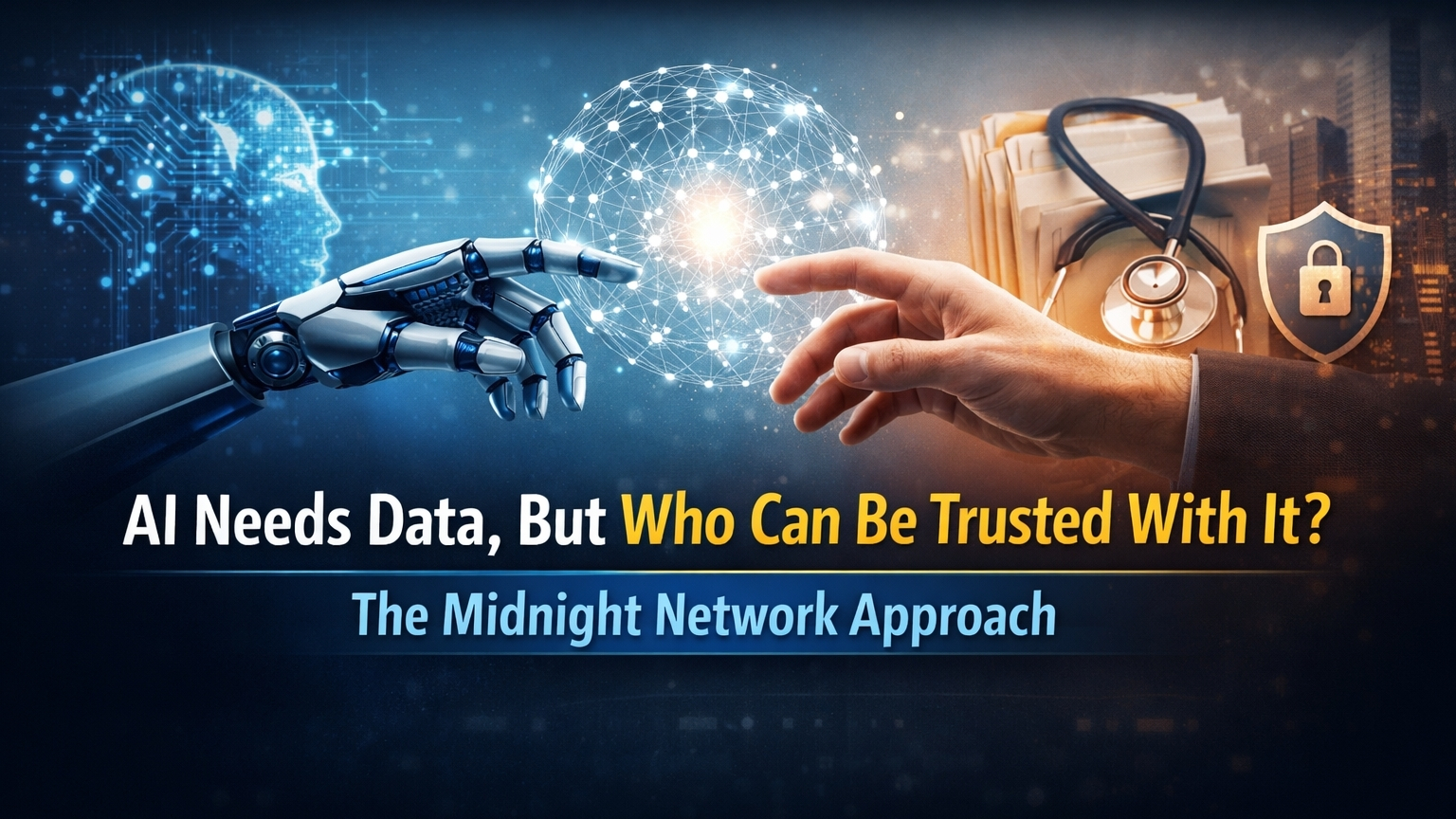
Many blockchain projects talk about privacy, but when you ask them for real-world examples, the answers often become vague. They promise secure data sharing, better protection, and more control for users, yet it is rarely clear how those promises translate into practical solutions. That gap between theory and application is where many privacy-focused projects lose credibility.
What makes @MidnightNetwork interesting is that it tries to focus on problems that already exist today rather than hypothetical future use cases. Instead of only discussing abstract privacy ideals, the project positions its technology around industries that are actively struggling with data management. Areas like artificial intelligence, healthcare data sharing, and regulatory compliance are not just conceptual ideas; they are sectors where companies are already spending billions trying to solve data protection challenges.
Among these, artificial intelligence stands out as one of the most fascinating and controversial examples.
AI systems depend heavily on large amounts of data. The more data they can analyze, the more accurate and capable they become. However, the biggest barrier to accessing valuable datasets is trust. Organizations and individuals are often unwilling to share sensitive information because they cannot guarantee how it will be used or who will ultimately see it.
Midnight’s approach attempts to address this issue through privacy-preserving infrastructure. The network is designed around zero-knowledge architecture, a cryptographic framework that allows computations to occur on data without revealing the underlying information itself. In theory, this means an AI system could train on sensitive datasets medical records, financial transactions, or private user behavior without the operator ever seeing the raw data.
If this concept works as intended, it could remove one of the largest obstacles preventing broader data collaboration in artificial intelligence.
But this is where the discussion becomes more complicated.
The organizations that control the most valuable datasets for AI training are not small startups. They are institutions such as hospitals, financial institutions, insurance companies, and government agencies. Convincing these entities to adopt an entirely new data infrastructure is not just a technical challenge it is also a legal and regulatory one.
Any change to how data is processed or shared must go through internal compliance reviews, legal teams, and regulatory oversight. Even if Midnight’s underlying cryptography is secure, institutions still need to prove that the system satisfies strict legal frameworks.
Healthcare provides a clear example of how difficult this can be.
Medical information is among the most sensitive categories of data in existence. Sharing patient histories between doctors, hospitals, and specialists is often inefficient, yet strict regulations exist to protect privacy. Laws like Health Insurance Portability and Accountability Act in the United States and General Data Protection Regulation in Europe establish detailed rules about how personal information must be handled.
Midnight proposes that programmable privacy could allow medical data to be shared safely without exposing patient identities. In theory, doctors and researchers could access necessary insights while the actual private information remains hidden.
However, regulatory systems do not rely only on technical guarantees. They also require documentation, accountability, and clear explanations of how data is processed. Even if a system proves mathematically that information remains private, institutions must still demonstrate compliance to regulators.
This raises an important question for projects like Midnight:
How does cryptographic privacy translate into legal proof of compliance?
For example, when a hospital or AI company uses Midnight’s infrastructure, regulators may ask for documentation explaining how the system protects user data and whether it aligns with existing legal frameworks. That documentation must be understandable not just to engineers, but also to lawyers, auditors, and government agencies.
Technology alone does not automatically solve those requirements.
This does not mean the project is misguided. In fact, the direction Midnight is exploring makes sense. Artificial intelligence and healthcare are two areas where better privacy technology is urgently needed. If data can be used without exposing personal information, it could unlock enormous innovation while protecting individuals.
The real challenge lies in bridging two different worlds: advanced cryptography and traditional regulatory systems.
$NIGHT appears confident that programmable privacy can help close this gap, but the real test will be adoption. For large institutions to trust and integrate such systems, the network will likely need to provide more than technical infrastructure. It may also need compliance frameworks, audit tools, and standardized documentation that organizations can present to regulators.
Until those pieces are clearly defined, an important question remains open.
If a healthcare provider or an AI company decides to build on Midnight, what exact proof will they be able to present to regulators to show that they are following rules like HIPAA or GDPR?
That question may ultimately determine whether Midnight’s technology stays a promising idea or becomes a practical solution used across real industries.