
@Fabric Foundation is the economic and governance layer for the world’s first open robotics network. Built by OpenMind, the project aims to transform robots from isolated tools into autonomous economic agents capable of interacting, transacting, and collaborating within a decentralized infrastructure.

As artificial intelligence increasingly moves from purely digital environments into physical machines, Fabric provides the identity, coordination, and payment infrastructure necessary for robots to operate safely alongside humans.
By combining the OM1 universal operating system with the FABRIC protocol, robots from different manufacturers such as UBTech, AgiBot, and Fourier can:
Share intelligence
Verify actions on-chain
Execute machine-to-machine transactions
The ROBO token acts as the core asset powering this robotic economy.
In 2026, ROBO has become one of the most anticipated launches in the DePIN (Decentralized Physical Infrastructure Networks) sector following:
A $20M funding round led by Pantera Capital
A highly demanded public sale on Kaito
The project has attracted significant attention from investors interested in the intersection of AI, robotics, and Web3 infrastructure.
What Is Fabric Foundation and How Does It Work?
Fabric acts as the nervous system of the robotics industry.
Today most robots operate in isolated ecosystems, meaning robots from different companies cannot easily communicate or coordinate with one another.
Fabric solves this by providing a standardized infrastructure layer where:
AI intelligence
robotic hardware
blockchain wallets
can operate together.
Using the Base network (with future plans for a native Layer-1 blockchain), Fabric enables robots to:
hold cryptographic keys
sign smart contracts
pay for services such as maintenance or charging
This allows robots to function as independent economic actors.
Key Components of the Fabric Protocol and OpenMind Ecosystem
1. OM1 Operating System
OM1 is often described as “Android for Robotics.”
It is a hardware-agnostic operating system that allows developers to build applications that can run across different robot types, including:
humanoid robots
quadruped robots
robotic arms
This dramatically reduces development costs and speeds up innovation across the robotics industry.
2. FABRIC Protocol
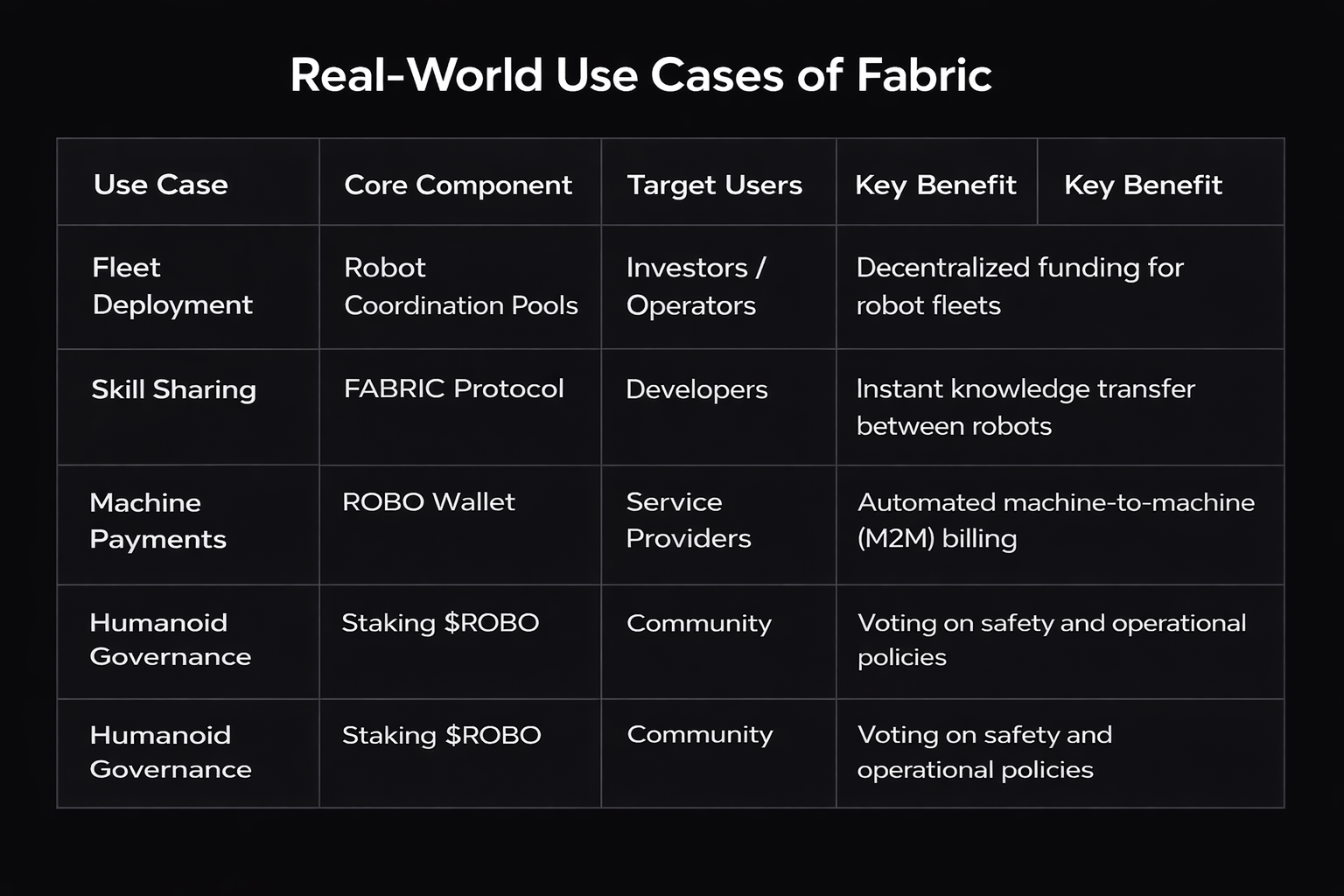
The FABRIC Protocol acts as a coordination and trust layer for machines.
It works like a social network for robots, allowing machines to:
verify identity
share situational data
exchange learned skills
All of these interactions are recorded on-chain through decentralized registries.
3. Robot Crafter & App Store
Fabric includes a marketplace for robotic capabilities.
Developers can publish robot skills or software modules, which can then be deployed to any compatible robot.
Example:
A logistics company could deploy a delivery skill that automatically works across all OM1-compatible robots in a city.
Real-World Use Cases of Fabric
What Is the Utility of the ROBO Token?
The ROBO token is the native utility and governance asset of the Fabric ecosystem.
Total supply:
10,000,000,000 ROBO
It powers several key functions across the network.
1. Network Fees
All on-chain activities require ROBO tokens, including:
identity verification
task settlement
skill execution
robot coordination
2. Coordination Staking
To participate in Robot Genesis, which coordinates the deployment of new robotics hardware, users must stake $ROBO tokens.
This ensures network security and aligns incentives between operators and developers.
3. Governance
ROBO token holders can participate in decentralized governance decisions such as:
robot safety standards
protocol upgrades
operational policies
This allows the community to help shape the future of the robot economy.
Why Fabric Matters for the Future Robot Economy
Fabric represents a shift in how robotics infrastructure is built.
Instead of isolated machines controlled by centralized companies, Fabric proposes a decentralized coordination layer where robots can:
interact autonomously
share intelligence
transact economically
If successful, this model could enable an entirely new machine-to-machine economy powered by blockchain.
Key Narrative for Investors
Fabric sits at the intersection of three major narratives:
AI infrastructure
robotics automation
DePIN networks
These sectors are expected to grow significantly as intelligent machines become integrated into real-world industries.
