
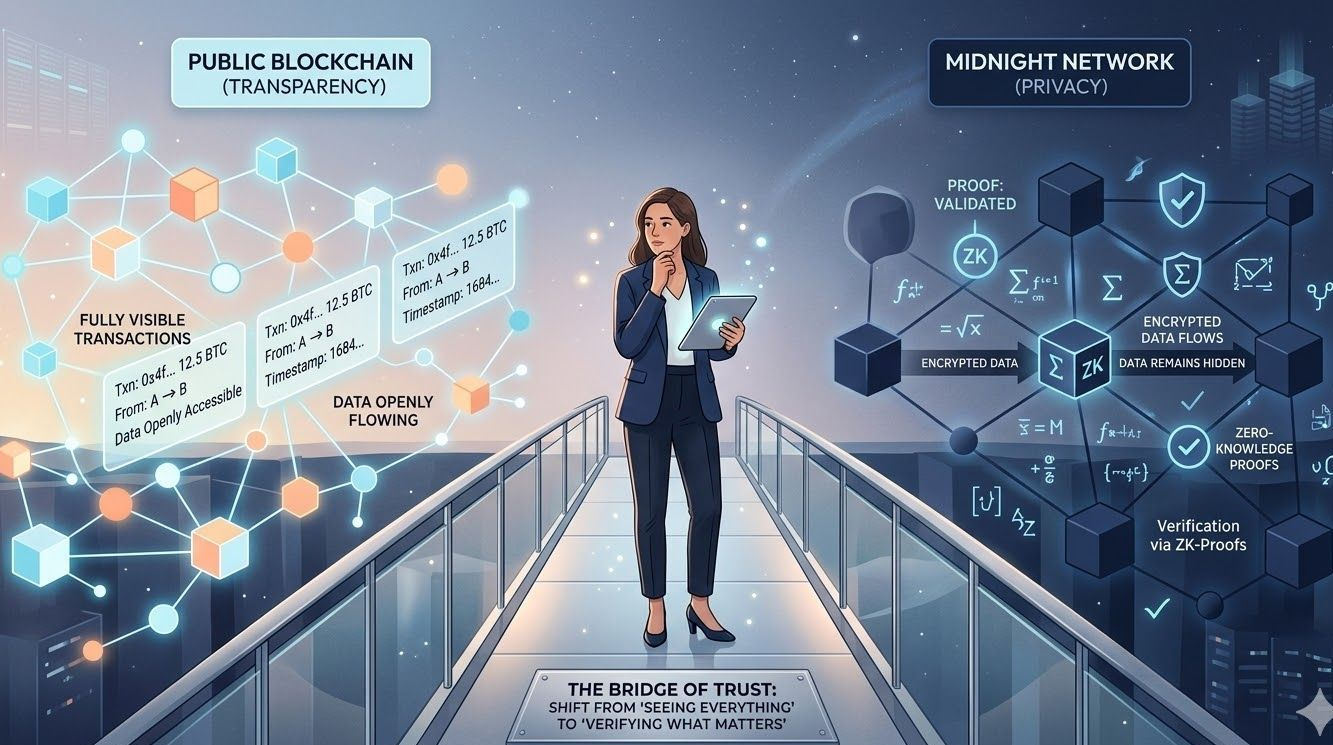
One of the ideas that I felt almost undisputable when I was initially learning about blockchain is that transparency generates trust. It made sense at the time. No one can cheat in case all is seen. All the transactions are transparent, all the rules are verifiable and the system does not require a central authority to operate.
Nevertheless, the longer I think about how this or that system would operate in reality, the less confident I become about such an assumption.
Transparency does generate trust although in specific cases.
It is effective when the information under exchange is not sensitive. It is effective when the users are at peace with having their activity being open. However, when I start considering the practical application instances such as financial system, medical records or even identity, the concept of putting all the information on a publicly-accessible ledger becomes unrealistic.
Majority of systems do not operate like that. They are based on the controlled access rather than complete exposure.
It was there that I began to think of trust in a different way, not initially as something that is automatically present given transparency, but rather, as a designing aspect. And it is such a change in thinking that made me take a closer look at Midnight Network.
It was not hype or bold claims that struck me. The question behind it was the basic one: can a blockchain system not make you reveal everything but prove that something is true?
That thought is initially somewhat bizarre. We are so accustomed to believe that verification must be visible. Without being able to see the data, how can I believe it?
However, I have then encountered the notion of Zero Knowledge Proofs, and it began to make more sense.
This notion is oddly self-evident when you sit on it. You do not present the entire data but demonstrate evidence that the data satisfies some conditions. The system examines the evidence, as opposed to the original information.
Instead of the system saying, Here is everything verify yourself the system says, You do not need to see everything. You only have to understand that it is right.
That is such a little change, yet the more I consider it the more significant it becomes.
Since in case blockchain is to become more than mere transactions and get to actual systems, it will need to work with delicate data. And in such strong-smelling places full transparency is not not only unnecessary, it is also even a liability.
Whenever I consider where such a thing might be relevant, there are a few places that come to mind naturally.
Healthcare is an obvious one. Patient information is highly confidential yet on the other hand, the systems should be able to confirm that such information has not been altered by anyone. It may actually make sense to have a system that is able to prove validity without revealing the data itself.
The financial systems are the same. Compliance always has to be demonstrated, yet the institutions are unable to disclose all the particulars of their work. Verification is again of importance but so also is privacy.
This challenge may be experienced even by the AI systems in the future. Since models are based on big data, there is an increasing demand to prove the usage of data or its origin without revealing everything behind the curtain.
In that sense, Midnight is not another blockchain that tries to win the race based on speed or size. It is more of a bid to reconsider the functioning of trust at a greater level.
Nevertheless, I attempt to be realistic at the same time.
Such ideas are very appealing, however, they are not readily convertible into working systems. Zero-knowledge proofs, such as the ones, are resilient but may be complicated and costly. It is still a challenge to make them efficient enough to be applied in the real world.
Then there is the issue of developers. However good the idea is, it will not help much when it is not embraced by builders. Individuals usually gravitate towards these tools which are straightforward, trustworthy and supported. When the system is too complex to operate with, it can be easily disregarded as the technically superior one.
And there is the question of the question of how trust can actually work within the network. Although there may be hidden data, the system must have validators who would ensure that nothing is amiss. Then the trust model does not vanish it merely changes to another form. The question of whether that model will stand the test of time can not actually be answered.
The token of the network $NIGHT has its role to play in ensuring the running of the system. It assists in organizing the members and motivating those running the network. But that I do not see as the most important piece. Tokens go hand in hand--but they do not stipulate whether those systems are useful.
More important to my mind is whether the problem under consideration is factual.
And I think it is.
In order to become bigger than we currently observe Web3, it must operate under an environment where not all things can be open to the public. It must have to accommodate trust and privacy in the same system.
That is not a balance to come by.
I am not sure whether Midnight Network will be the project that will get it right. Still, the number of unknowns remains too high as technical issues, adoption issues and ecosystem development are all factors.
However, I believe that the direction it is taking is not irrelevant.
Since the better I understand blockchain, the more I understand that trust does not simply involve seeing everything.
It is about having that sense that you know that what is important has been tested even when you cannot see it.
@MidnightNetwork #night $NIGHT
