Midnight isn’t trying to reinvent blockchain in a loud or dramatic way. It’s doing something more subtle—and arguably more important. Instead of asking whether everything should be public or private, it starts from a more practical question: what actually needs to be visible, and what doesn’t?
That might sound simple, but it cuts right into one of the biggest limitations of traditional blockchains. Most networks were built on the idea that transparency equals trust. And while that works for basic transactions, it starts to break down the moment real-world data enters the picture. Financial activity, identity, business logic—these aren’t things people or companies are comfortable exposing entirely. Midnight recognizes that reality and builds around it.
At its core, Midnight uses zero-knowledge proofs to separate proof from data. The network can verify that something is valid without revealing the underlying details. Instead of publishing everything, it publishes enough to prove correctness. That shift—from exposing data to proving truth—is where Midnight becomes interesting.
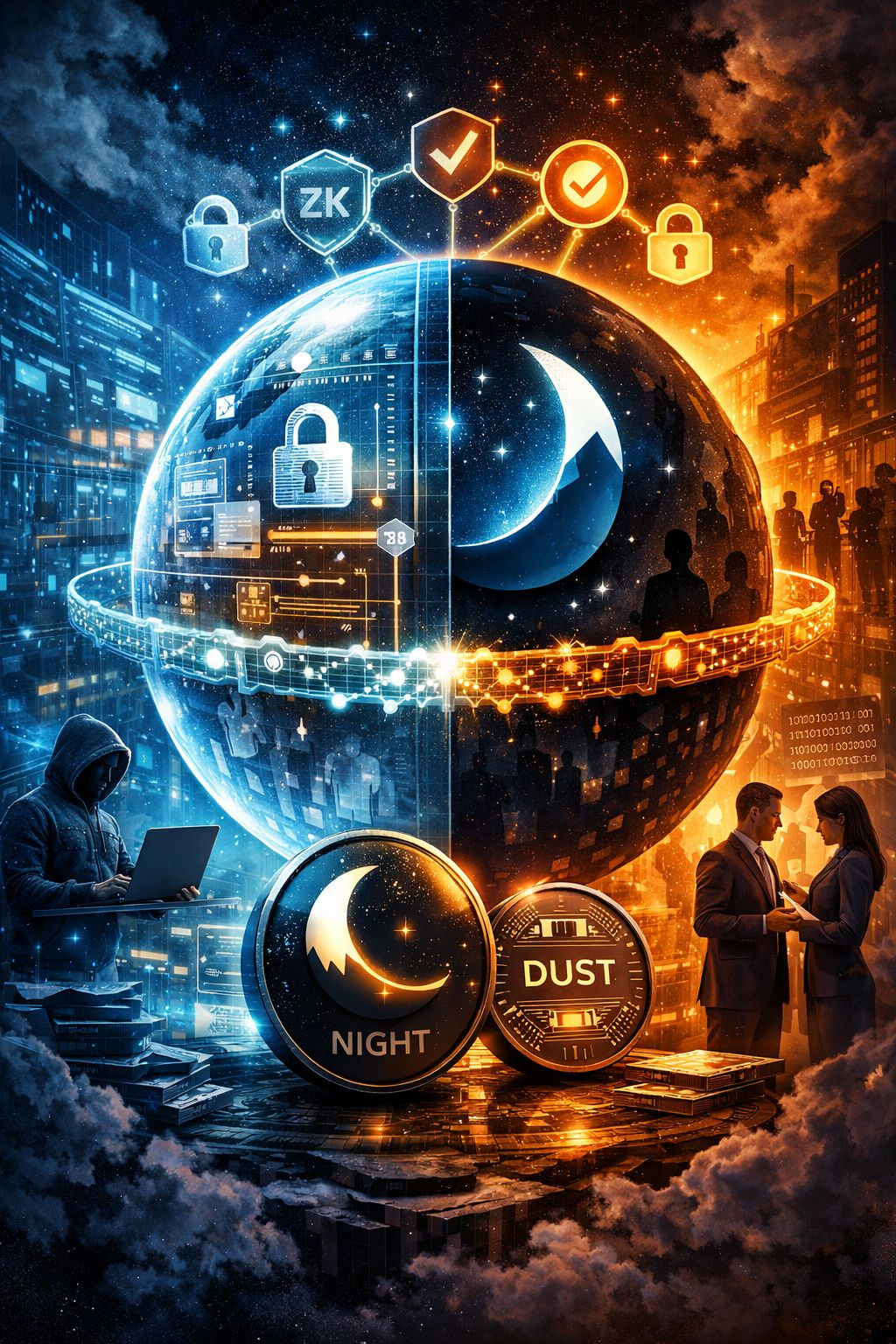
The architecture reflects this thinking. Rather than forcing everything onto a single public ledger, Midnight operates with a dual-state model. There’s a public layer where proofs, settlement, and essential logic live. And then there’s a private layer where sensitive data stays encrypted and controlled by the user. The two interact through zero-knowledge proofs, so the system remains verifiable without becoming invasive.
This design feels less like a privacy add-on and more like a rethinking of how blockchains should behave in real environments. It acknowledges something many projects avoid: full transparency isn’t always useful, and full privacy isn’t always acceptable. The value is in the balance.
That same balance shows up in the token model, which is one of the more thoughtful parts of the project. Midnight doesn’t rely on a single token to do everything. Instead, it splits responsibilities between NIGHT and DUST.
NIGHT is the main token. It represents ownership, governance, and long-term participation in the network. DUST, on the other hand, is what actually gets used. It’s consumed when transactions are executed or smart contracts run—but it isn’t transferable. You can’t trade it, speculate on it, or move it around like a normal asset.
What’s interesting is how DUST is generated. Holding NIGHT produces DUST over time, almost like earning network bandwidth just by being part of the system. So instead of constantly spending your core asset to use the network, you’re generating the resource needed to operate within it.
This small change has bigger implications than it first appears. It separates speculation from utility. It also makes the system more predictable for developers and businesses. If you’re building on Midnight, you’re not forced into a constant cycle of buying and spending tokens just to keep things running—you can hold NIGHT and generate the usage capacity you need.
From a regulatory perspective, it’s also a clever move. Because DUST isn’t transferable, it avoids becoming a hidden payment layer. It behaves more like a consumable resource than money, which helps position the network in a way that doesn’t immediately clash with compliance expectations.
Looking at the numbers, Midnight is still in that early-to-mid stage where things are forming but not fully defined. The total supply of NIGHT is fixed at 24 billion, with roughly 16.6 billion already in circulation—about 69% of the total. The market cap sits in the mid-range, large enough to show traction but still small enough that the long-term valuation story hasn’t played out yet.
Distribution is another area where Midnight is trying to do things differently. Instead of a heavy private-sale structure, a large portion of tokens was spread across multiple ecosystems through mechanisms like the Glacier Drop. The idea is to start with a wider base of participants rather than a tightly controlled early ownership structure. Whether that leads to real decentralization over time is something only the market can answer, but the intent is clear.
Recent activity suggests the network is gaining some real momentum, at least on the development side. There’s been a noticeable increase in smart contract deployments and block producer participation, along with growing user interaction through testnet tools. These aren’t explosive numbers, but they’re steady—and that kind of steady growth often matters more in infrastructure projects.
The transition into the Kūkolu phase, which introduces a federated mainnet, is another sign of how Midnight is approaching growth. Instead of rushing into full decentralization, the network is starting with a more controlled validator set to ensure stability. It’s not the most idealistic approach, but it’s a practical one. Privacy-focused systems are complex, and getting them to work reliably matters more than launching with perfect decentralization on day one.
The choice of early node operators says a lot about where Midnight sees itself. Names like Google Cloud, Blockdaemon, MoneyGram, and Vodafone-linked infrastructure partners point toward a network that isn’t just targeting crypto-native users. It’s positioning itself at the intersection of blockchain and real-world systems—where privacy isn’t optional, and compliance isn’t negotiable.
That direction becomes even clearer when you look at the ecosystem. Midnight isn’t focusing on meme-driven activity or short-term hype cycles. It’s leaning into use cases like decentralized identity, confidential payments, and privacy-preserving stablecoins. These are slower to develop, but they’re also where blockchain either becomes useful—or gets ignored.
The broader idea behind Midnight feels less like “privacy is the future” and more like “privacy needs to work alongside everything else.” That’s a much harder problem to solve. It requires not just strong cryptography, but thoughtful design, realistic economics, and an understanding of how systems are actually used.
If Midnight succeeds, it won’t be because it hid everything. It will be because it made selective privacy feel normal—something developers can build with, institutions can trust, and users don’t have to think about constantly.
And that might end up being the more important shift. Not making blockchain more secretive, but making it more usable in a world where not everything should be public in the first place.
@MidnightNetwork $NIGHT #NIGHT