
You know that feeling when you walk into a massive, bustling city for the first time? You see the bright lights, the towering skyscrapers, and the endless stream of people. It’s exciting, but if you’re anything like me, your second thought isn’t about the view—it’s about finding the quiet side street where you can actually breathe. It’s about finding the space where you can exist without a crowd peering over your shoulder.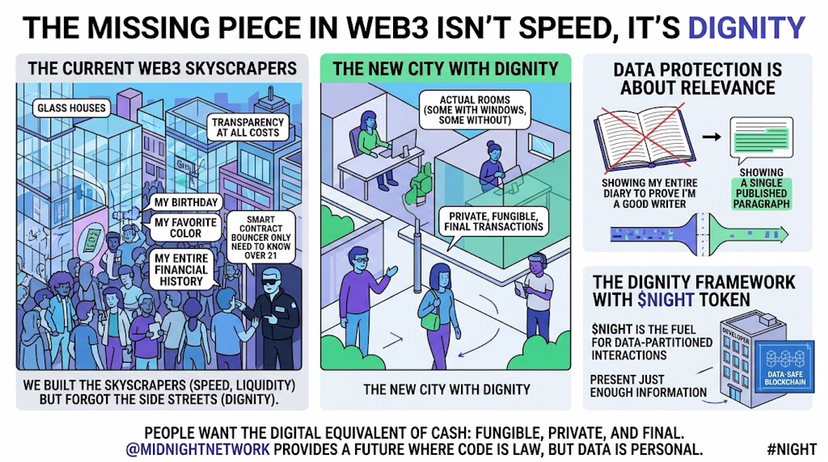
That’s the exact sensation I’ve been chasing in crypto for the last year. We’ve built the skyscrapers. We have the fast transactions and the massive liquidity pools. But we forgot to build the side streets.
Lately, I’ve been digging deep into projects that aren't just about moving money faster, but about building a space where the context of that money—and the data attached to it—remains my own. That rabbit hole led me straight to Midnight Network.
I’ll be honest:
when I first heard the term "data protection" tossed around in the blockchain space, my eyes glazed over. It sounds like a compliance meeting dressed up in crypto clothing. But the more I looked at the day-to-day reality of using dApps, the more I realized that privacy isn’t about hiding; it’s about relevance.
Let’s talk about the digital layers we wear every day. Every time you interact with a smart contract, you’re basically handing over your digital ID card. Sometimes that’s necessary. But most of the time, the bouncer doesn’t need to know my name, my birthday, and my favorite color just to let me into the club. They just need to know I’m over 21.
This is where the architecture of Midnight Network started to click for me. It’s not trying to shove everything into a dark vault. Instead, it’s building a framework where you can present just enough information to get the job done. It’s the difference between showing someone your entire diary to prove you’re a good writer, versus showing them a single published paragraph.
I spent a few evenings reading through the concepts surrounding the $NIGHT token, and it struck me how the utility isn’t forced. In so many projects, the token feels like an afterthought—a way to raise funds that is loosely tied to governance. With NIGHT, the necessity feels embedded. It’s the fuel for this new type of interaction where the data is partitioned. You need it to operate in this environment where the code executes on data that isn’t fully exposed to the world. It’s the key to that quiet side street.
What really hooked me was thinking about the developers. Building a dApp today is like building a glass house. You can see everything inside, and more importantly, so can everyone else. That’s fine for a simple vending machine, but it’s terrible for a law firm, a healthcare provider, or even a social network. Midnight Network offers a blueprint for building a house with actual rooms—some with windows, some without.
We often talk about mass adoption as if the only barrier is transaction speed or gas fees. But I think the real barrier is dignity. People don’t want their entire financial history broadcasted to the world just to pay for a coffee with crypto.
They want the digital equivalent of cash:
fungible, private, and final. @MidnightNetwork seems to understand that the future of Web3 isn't just about what we build, but about who gets to see us building it.
The concept of a "data-safe" blockchain is a hard sell to someone who just wants to speculate, and I get that. It’s abstract. But for those of us who have been around long enough to see data leaks, doxxing attacks, and the general lack of nuance in on-chain analysis, it feels less like a feature and more like a necessity for survival.
I’m not interested in the hype cycles. I’m interested in the infrastructure that allows us to interact in a mature, nuanced way. The work being done around $NIGHT feels like laying the electrical wiring in that new city I mentioned. You don’t see it, but without it, the lights don't work.
For now, I’m watching the development closely. The space needs a counterbalance to the "transparency at all costs" mantra. We need a place where the code is law, but the data is personal. That’s a future I can actually live in.
#night