

In today’s crypto landscape, privacy is no longer just a feature—it has become a core narrative. As governments tighten regulations and users demand greater control over their data, projects are racing to find a middle ground. Midnight ($NIGHT ) steps into this space with an ambitious vision: to deliver both regulatory compliance and genuine privacy. But the critical question remains—can these two opposing ideas truly coexist?
From a technical standpoint, Midnight presents a compelling innovation. Its foundation is built on zero-knowledge (ZK) cryptography, which enables selective disclosure of information. This means users can prove certain facts without revealing underlying data, a breakthrough that aligns well with modern digital privacy needs. The architecture appears robust, and the engineering behind it reflects a serious effort to push blockchain technology forward.
However, the concept of “regulated privacy” introduces a fundamental contradiction. True privacy implies full user control, where individuals decide what to share and with whom. Regulation, on the other hand, introduces oversight, compliance requirements, and in some cases, the ability for external entities to intervene. Midnight attempts to reconcile this conflict by incorporating features such as viewing keys, federated nodes, and compliance layers designed to satisfy institutional standards.
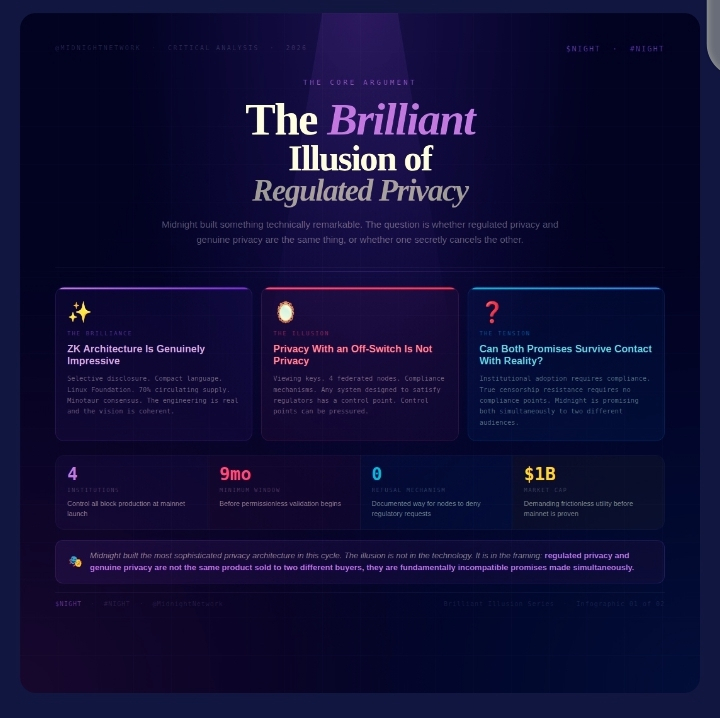
This is where the illusion begins to take shape. Any system that includes mechanisms for regulatory access inherently creates control points. For example, viewing keys may allow certain parties to access transaction data under specific conditions. Federated nodes, while improving efficiency and governance, may reduce decentralization. These design choices raise an important concern: if privacy can be overridden, is it still true privacy?
Another challenge lies in Midnight’s target audience. On one side, institutional investors and regulators demand transparency and compliance. On the other, crypto-native users prioritize decentralization and censorship resistance. These groups often have conflicting expectations. By attempting to serve both, Midnight is walking a very fine line—one that few projects have successfully navigated.
The data presented in the visual further fuels this debate. Limited decentralization at launch, a structured validation timeline, and the absence of a clearly defined refusal mechanism for regulatory intervention suggest that control may be more centralized than expected. Additionally, ambitious projections such as a $1 billion market cap before full mainnet validation indicate strong market confidence—but also significant risk.
Despite these criticisms, it would be unfair to dismiss Midnight’s innovation. The project represents a new category of blockchain solutions—those designed not in opposition to regulation, but in alignment with it. This approach could open doors to mainstream adoption, particularly among enterprises and financial institutions that have previously avoided privacy-focused technologies due to compliance concerns.
Ultimately, Midnight (NIGHT) is more than just a cryptocurrency; it is an experiment in redefining the boundaries of privacy in a regulated world. Its success will depend on whether it can maintain a meaningful level of user autonomy while meeting external requirements. If it succeeds, it could set a new standard for the industry. If it fails, it may prove that regulated privacy is not a solution, but a contradiction.
For investors and observers, the key takeaway is clear: Midnight offers real technological value, but its core narrative deserves careful scrutiny. In crypto, innovation often comes with trade-offs—and understanding those trade-offs is essential before making any decision.#Midnight #Night $NIGHT