@MidnightNetwork #night $NIGHT

There’s a quiet problem in crypto that keeps repeating itself, no matter how many new chains or tokens show up: we still haven’t figured out how to price privacy properly.
On one side, you’ve got transparent systems where everything is visible but cheap and simple. On the other, privacy-focused designs that protect users—but often feel clunky, expensive, or just… disconnected from real usage. And when fees get unpredictable (especially with gas spikes), the whole experience starts breaking down.
I’ve noticed this pattern a lot: privacy becomes a feature, not a default—and users end up paying the complexity cost.
That’s where the idea behind Midnight’s dual-token model caught my attention.
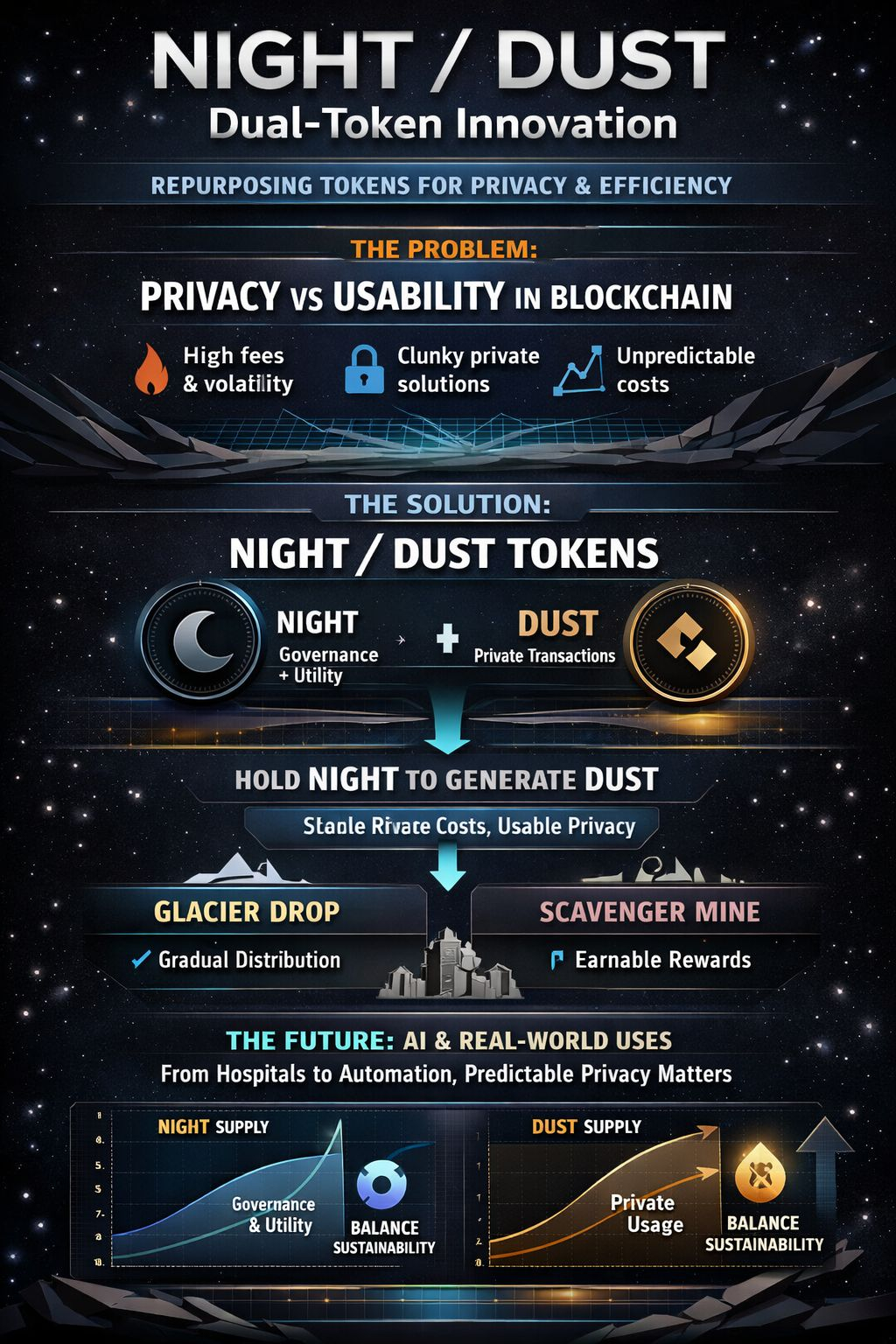
The Core Tension: Privacy vs Usability
Let’s be honest—privacy in blockchain isn’t just a technical challenge, it’s an economic one.
If private transactions are too expensive, people won’t use them.
If they’re too cheap without limits, the system gets abused.
And if fees are tied to volatile tokens, users can’t predict costs.
So the real question becomes:
How do you make privacy usable without making it chaotic or unsustainable?
Enter the NIGHT / DUST Model
Midnight’s answer is surprisingly simple on the surface:
NIGHT → governance + utility token
DUST → resource token used for private transactions
But what stood out to me is the shift in mindset:
instead of “token pays fee,” it’s more like “token generates resource.”
That’s a subtle but powerful difference.
“Token Generates Resource” — Why It Matters
In most blockchains, you spend tokens directly to pay fees. That means:
Fees fluctuate with market price
Users constantly calculate cost
Volatility affects usability
Midnight flips this.
You hold or lock NIGHT, and it gives you access to DUST—
which is what you actually spend for private computation.
Think of it like:
NIGHT = owning a machine
DUST = the electricity it produces
You’re no longer buying electricity every second from the market.
You’re generating it based on what you hold.
I think this is one of the more underrated innovations here—it separates speculation from usage.
DUST: Pricing Privacy More Predictably
DUST is used for private transactions and computations.
What I like about this approach:
It creates a buffer layer between market volatility and user experience
Developers can estimate costs more reliably
Users don’t feel like they’re gambling every time they interact
In real-world terms, imagine trying to run a business where your electricity bill changes wildly every hour. That’s what gas fees feel like today.
DUST smooths that out.
Cross-Chain Mirroring: Quiet but Important
Another piece that doesn’t get enough attention is mirroring across chains.
Instead of isolating value, Midnight allows representations of assets (like BTC or ETH) to exist within its system while maintaining privacy features.
But here’s the key difference:
This isn’t just about bridging assets—it’s about making them usable in a privacy-preserving environment without constant friction.
If this works well in practice, it could reduce one of the biggest headaches in crypto: jumping between ecosystems and losing efficiency every time.
Distribution Mechanics: Glacier Drop & Scavenger Mine
Now let’s talk about how tokens actually get into the system.
Two mechanisms stood out:
Glacier Drop
This feels like a controlled, long-term distribution strategy.
Instead of flooding the market, tokens are released gradually.
The idea is to avoid sudden shocks and encourage sustained participation.
But I’ll be honest—I’m slightly skeptical here.
Slow distribution sounds great in theory, but it can also:
Delay real adoption
Concentrate early advantages
Create uncertainty about future supply
It really depends on execution.
Scavenger Mine
This one is more interesting.
It introduces a way for users to actively earn participation-based rewards, rather than just passively receiving tokens.
What I noticed is that it leans into:
Engagement over speculation
Contribution over pure holding
That’s a healthier direction compared to traditional airdrops, which often attract short-term behavior.
Still, the challenge will be keeping it meaningful—not just another gamified system people exploit.
Supply Curves & Inflation — The Long Game
From a tokenomics perspective, the dual-token system changes how inflation is felt.
Instead of a single token absorbing all pressure:
NIGHT handles governance and value
DUST absorbs usage demand
This separation could:
Reduce direct sell pressure on NIGHT
Stabilize transaction costs via DUST
Create a more balanced ecosystem
But here’s the catch:
If DUST supply isn’t managed carefully, it could either:
Become too abundant → reducing its value as a resource
Or too scarce → making private transactions expensive again
So the system lives or dies on how well these supply curves are tuned over time.
And that’s not easy.
Real-World Example
Imagine a hospital using blockchain for patient data:
They need privacy (obviously)
They need predictable costs
They can’t deal with volatile fees
With this model:
They hold NIGHT
Generate DUST
Use DUST for secure, private operations
No constant fee recalculation. No exposure of sensitive data.
That’s where I start seeing real-world potential—not just DeFi speculation.
Where This Could Go (AI, Automation, Real Systems)
Looking ahead, this model could actually fit well with AI-driven systems.
Autonomous agents need:
Predictable costs
Private execution
Minimal human intervention
If every AI action required volatile gas payments, it wouldn’t scale.
But a resource-generation model like DUST?
That’s much more compatible with automated systems.
Final Thoughts
I think Midnight is trying to solve a deeper issue than most projects:
not just privacy, but the economics of privacy.
The NIGHT / DUST model isn’t perfect, and there are real risks around:
Distribution fairness
Resource balancing
Long-term incentives
But what stood out to me is the shift in thinking.
Instead of forcing users to adapt to blockchain limitations,
it tries to reshape the system around how people actually use it.
And honestly, that’s where most projects fail.
If this model holds up under real usage—not just theory—it could quietly influence how future blockchains handle fees, privacy, and usability.