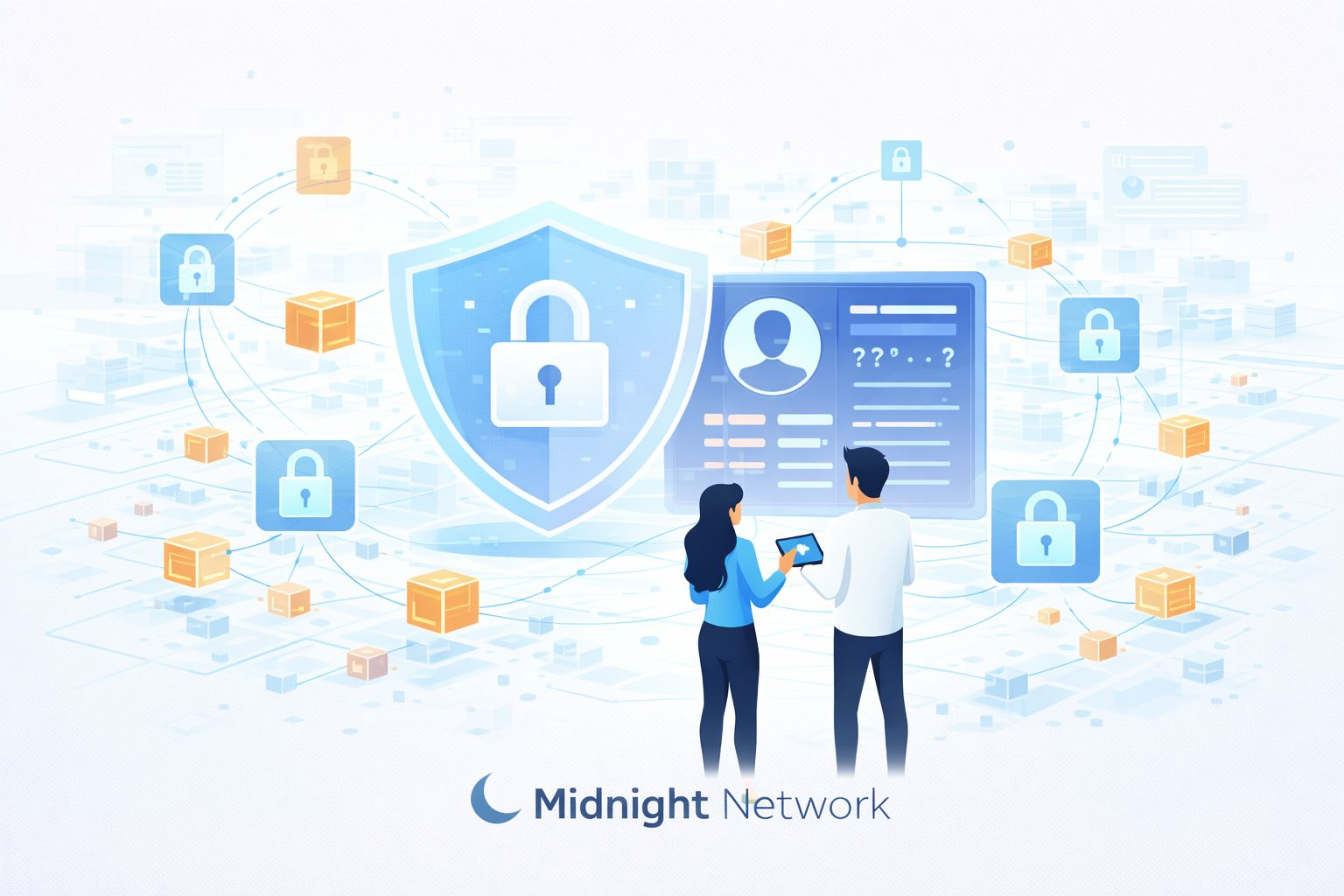
I was not thinking about privacy when I started looking into @MidnightNetwork again.
I was actually thinking about usability.
Because if we are honest, a lot of blockchain systems still feel a bit uncomfortable to use once you move beyond basic transactions. Not in terms of technology, but in terms of exposure. You are always aware that everything you do leaves a visible trail. Maybe not instantly understood, but always there.
And that creates a strange kind of pressure.
Not fear. Just friction.
That is where Midnight starts to feel different to me, but not in the way most people describe it. People usually frame it as a “privacy chain.” I think that framing is too small.
It feels more like an attempt to fix how blockchain handles information at a basic level.
Because the real issue is not just privacy.
It is how much information a system forces you to reveal just to function inside it.
Right now, most blockchains ask for too much.
You make a simple transaction, but the system exposes patterns.
You interact with an application, but your behavior becomes traceable.
You participate in something small, but it connects to a bigger visible history.
Individually, none of this feels like a big problem.
Collectively, it becomes one.
Midnight seems to approach this from a more practical angle.
Instead of asking “how do we hide everything?”
It asks “how do we reduce unnecessary exposure?”
That shift matters more than it sounds.
Because once you start reducing what is unnecessary, you start designing systems differently. You stop assuming that full visibility is required for trust. You start building around controlled information flow instead of forced transparency.
This is where zero-knowledge proofs come in, but again, the technology is not the main story.
The main story is efficiency of trust.
Why should a system require full data when a simple proof is enough?
Why should users reveal details that are irrelevant to the outcome?
Why should every interaction become permanent public data?
Midnight feels like it is trying to remove that inefficiency.
And that is why I see it less as a “privacy solution” and more as a data minimization layer for blockchain.
That perspective changes how you look at its potential.
It is not just about protecting individuals.
It is also about enabling better applications.
Because a lot of real-world use cases struggle on public chains for a simple reason: they cannot operate properly in full exposure.
Business logic, sensitive data, internal rules — these things do not belong fully in public view. Developers know this. That is why many serious applications still hesitate to fully move on-chain.
Midnight is trying to make that transition easier.
Not by hiding everything.
But by making systems flexible enough to reveal only what is needed.
That feels closer to how real environments work.
In normal life, you do not show everything to prove something small.
You show just enough.
Blockchain has been doing the opposite for years.
Another thing that stands out is how Midnight separates roles inside its network. Instead of mixing everything into one token flow, it creates a structure where participation and usage are not treated the same way.
That design choice might look small, but it shows intent.
It suggests the team is thinking beyond short-term activity and more about how the system behaves over time.
And honestly, that is where most projects fail.
They design for launch.
Not for long-term behavior.
Still, none of this guarantees success.
I have seen too many well-designed systems struggle because reality is always more complex than theory. Adoption is slow. Developers are selective. Users follow simplicity, not architecture.
Midnight will have to prove that its model is not just logical, but usable.
Because in the end, people do not adopt ideas.
They adopt experiences.
If this kind of selective privacy becomes easy to use, then Midnight becomes important.
If it stays complex or abstract, then it risks staying in the background.
That is the gap it needs to cross.
But I will say this.
The direction makes sense.
As blockchain moves toward more serious use, the demand for better data handling will only increase. Systems that expose everything by default will start to feel outdated in environments where control matters.
Midnight is already positioned in that direction.
Not as a loud solution.
Not as a hype narrative.
But as a system quietly asking:
What if blockchain didn’t require so much exposure to function properly?
That question alone is enough to keep it on my radar.