
If you really think about it, almost everything in our daily lives runs on claims.
A person claims they’re eligible for a benefit.
A business claims it’s compliant.
An institution claims it approved something.
A system claims a payment went through.
For years, we’ve just accepted these claims because we trust the institutions behind them. But the world has changed. Systems are now digital, interconnected, and often spread across different organizations and even countries. That old model of “just trust us” doesn’t hold up the same way anymore.
That’s exactly where S.I.G.N. comes in.
Instead of relying on assumptions, it focuses on something much stronger: proof.
A New Way to Build National Systems
S.I.G.N. isn’t just another tech product or a single platform. It’s more like a blueprint, a way to design entire national systems so they actually work in today’s digital world.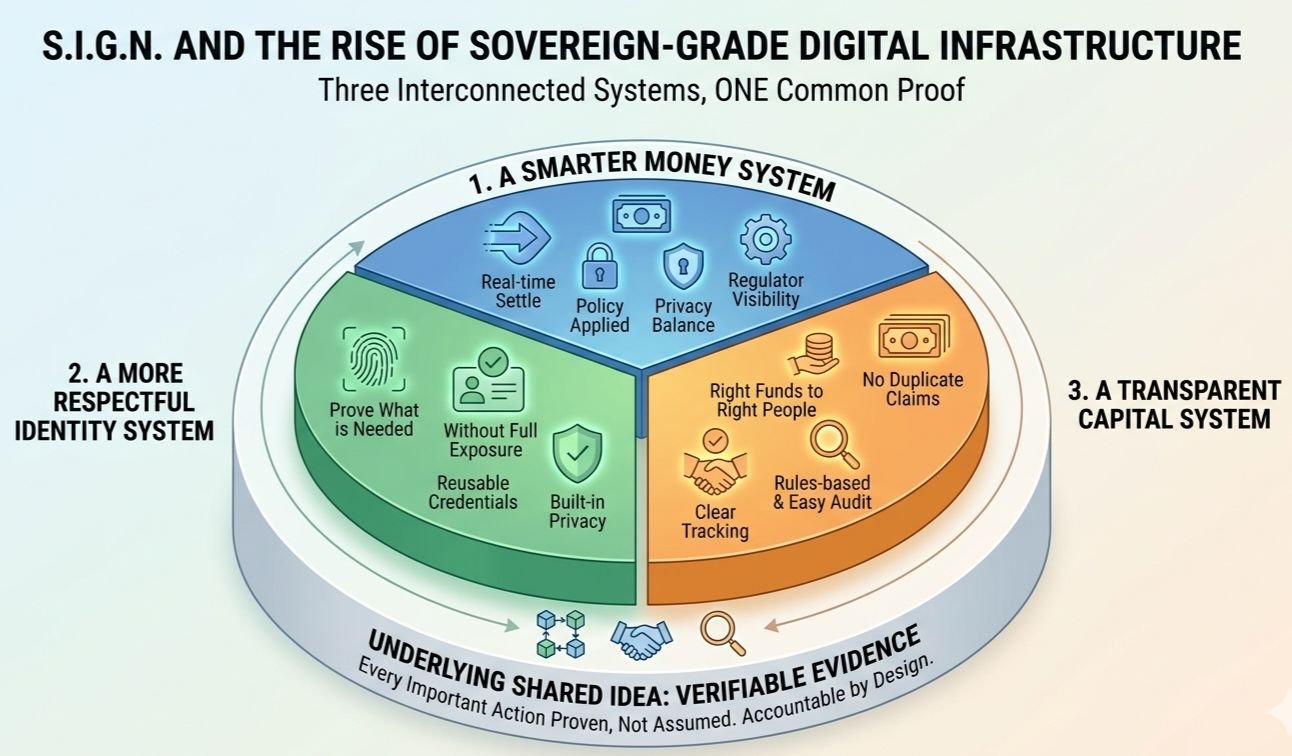
It brings together three big areas that every country depends on:
Money – how value moves
Identity – how people prove who they are
Capital – how funds like benefits or grants are distributed
What’s interesting is that S.I.G.N. doesn’t treat these as separate problems. It connects them in a way that makes everything more reliable and easier to verify.
From my point of view, this is what makes it stand out. Most projects focus on solving one piece of the puzzle. S.I.G.N. is trying to fix the entire system.
The Real Problem: Trust Doesn’t Scale Easily
In smaller or traditional systems, trust works because relationships are clear. But when you scale things to a national or global level, trust becomes fragile.
Think about it:
What happens when multiple agencies, private companies, and digital systems all interact with each other?
Things can get messy fast.
S.I.G.N. tackles this by making sure every important action leaves behind verifiable evidence. Not just logs or records but structured, cryptographic proof that can be checked anytime.
And honestly, I think this is the future. Not faster systems, not just smarter systems but systems that can prove what they’ve done.
The Three Core Systems (Made Simple)
Let’s break it down in a more human way.
1. A Smarter Money System
This isn’t just about digital currency. It’s about creating a system where money moves quickly, safely, and under clear rules.
Payments can settle in real time
Governments can apply policies when needed
Sensitive transactions can stay private
Regulators still get the visibility they need
To me, this balance is everything. You don’t want a system that’s fully exposed but you also can’t have one that’s completely hidden. S.I.G.N. tries to sit right in the middle.
2. A More Respectful Identity System
Right now, proving your identity online often means giving away too much information.
S.I.G.N. flips that idea.
Instead of saying “here’s all my data,” you can say:
“I can prove what you need to know, without exposing everything else.”
You can verify eligibility without sharing full identity
Credentials can be reused across systems
Privacy is built in, not added later
Personally, I think this is one of the most powerful parts. In a world where data leaks and misuse are common, having control over your own information is a big deal.
3. A Transparent Capital System
This is about how money is distributed, things like benefits, grants, or incentives.
The goal is simple:
Make sure the right people get the right funds, at the right time, with clear proof.
No duplicate claims
Clear tracking of where money goes
Rules-based distribution
Easy auditing when needed
From my perspective, this could fix a lot of inefficiencies we see today. Too many systems lose track of funds or rely on outdated processes.
The Heart of It All: Verifiable Evidence
All of these systems rely on one shared idea: evidence that can be trusted.
Every action, whether it’s an approval, a payment, or a verification, can be proven
Who approved it
When it happened
Under what rules
What data supports it
This isn’t just helpful, it’s necessary.
In my opinion, this is the biggest shift S.I.G.N. is bringing. It’s not about doing things differently for the sake of innovation. It’s about making systems accountable by design.
Built for the Real World (Not Just Theory)
One thing I really appreciate about S.I.G.N. is that it doesn’t force a single approach.
It understands that different situations need different setups:
Some systems need full transparency
Others need strict privacy
Many need a mix of both
So it supports public, private, and hybrid models.
That flexibility makes it feel practical, not idealistic.
Because let’s be honest, real-world systems are messy. And any solution that ignores that usually doesn’t last.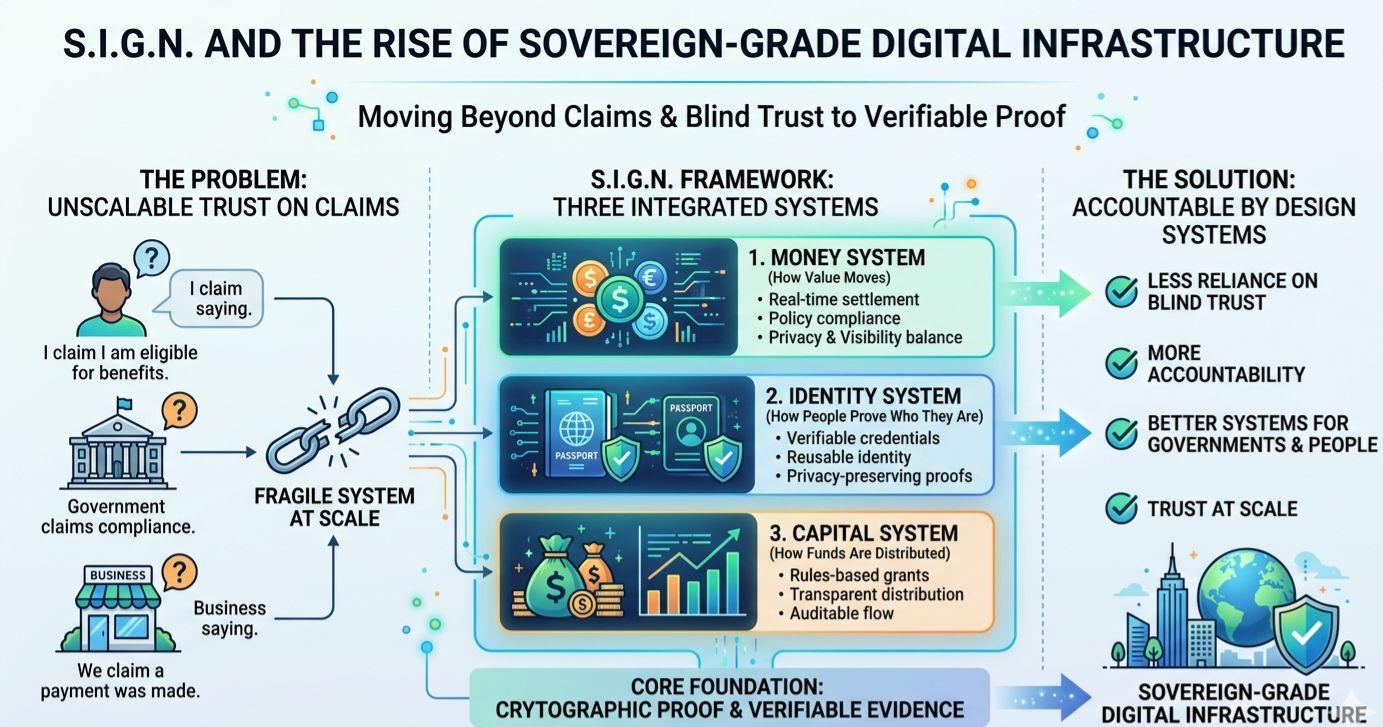
My Take: Why This Actually Matters
A lot of projects talk about the future. Faster transactions, smarter contracts, more automation.
But S.I.G.N. is focused on something deeper: trust at scale.
And not the kind of trust you’re asked to believe in but the kind you can verify yourself.
To me, that’s a big shift.
It means:
Less reliance on blind trust
More accountability
Better systems for both governments and people
If this approach is implemented well, it could change how entire economies operate.
Final Thoughts
At the end of the day, S.I.G.N. is trying to answer a simple but powerful question:
What if every important action in a system could be proven?
Not assumed. Not trusted blindly. But proven, clearly, consistently and securely.
That’s the direction things are heading.
And in my opinion, frameworks like S.I.G.N. aren’t just part of that future, they’re helping define it.
@SignOfficial #SignDigitalSovereignInfra $SIGN
