I didn’t take it seriously at first…
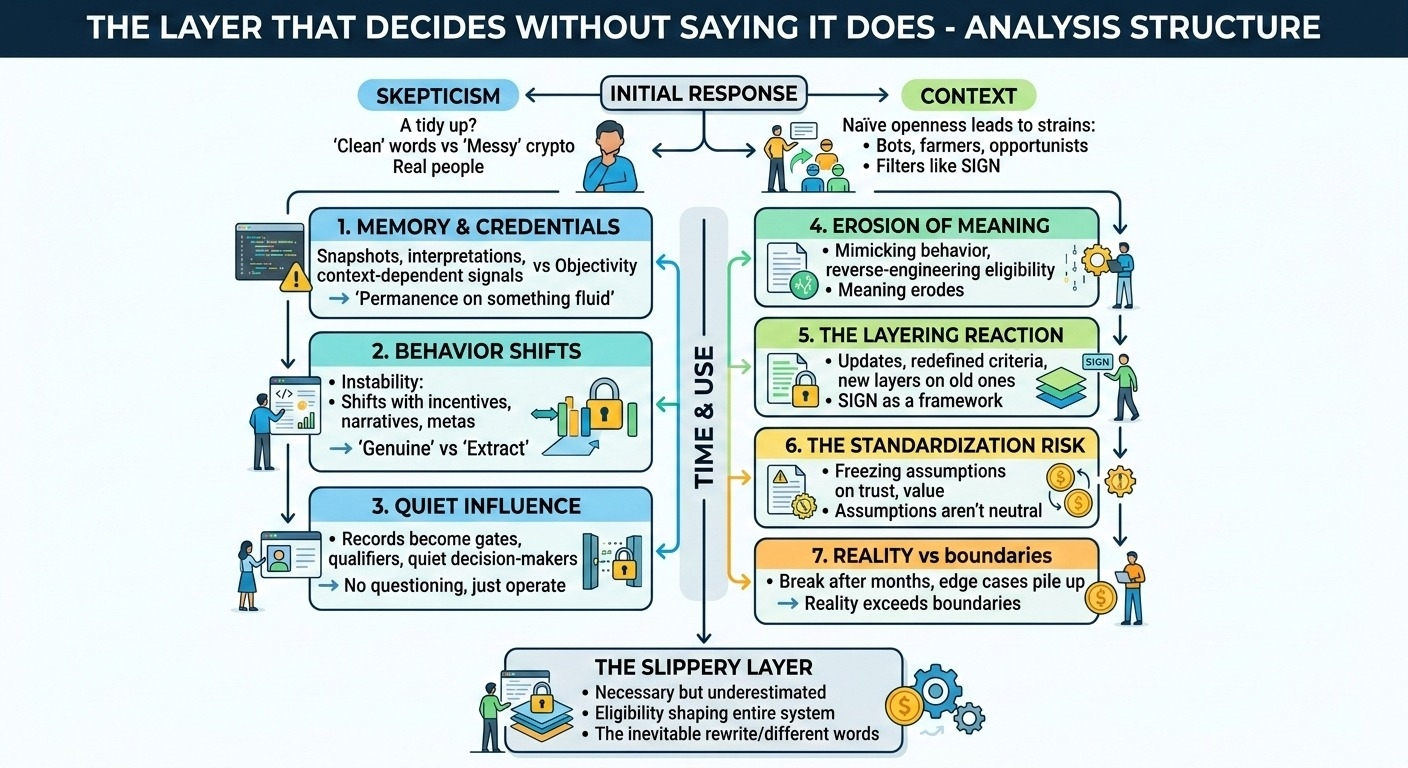
It felt like another attempt to tidy up something that was never meant to be tidy. Verification, credentials, eligibility — words that sound clean until you actually try to apply them to real people, real behavior, real incentives.
And crypto is nothing if not messy.
I’ve seen this pattern before. Systems launch open, almost naïvely so. Anyone can participate, anyone can show up. That’s the promise. But it doesn’t take long before that openness starts to strain. Bots, farmers, opportunists — all indistinguishable at first glance.
So we reach for filters.
SIGN seems like one of those filters, just more formalized. Less ad hoc. A way to encode some memory into the system so it doesn’t have to start from zero every time.
Which, on paper, makes sense.
But I keep getting stuck on what exactly is being remembered.
Because credentials sound solid. Like they represent something objective. But when you look closer, they’re just interpretations of past behavior. Snapshots. Context-dependent signals that we treat as if they carry forward cleanly.
They don’t. Not really.
Maybe that’s too harsh…
But behavior in this space is rarely stable. It shifts with incentives, with narratives, with whatever the current meta happens to be. Something that looks like “genuine participation” in one cycle looks like pure extraction in another.
And yet, we record it. We store it. We build on top of it.
I keep coming back to that — the idea that we’re layering permanence onto something inherently fluid.
That’s where things start to feel uncomfortable…
Because once a credential exists, it starts influencing outcomes. It’s no longer just a record — it becomes a gate. A qualifier. A quiet decision-maker embedded into infrastructure.
And the thing about quiet decision-makers is that no one really questions them once they’re in place.
They just… operate.
Until they don’t.
I wonder what happens when the assumptions behind these credentials start to break. Not in obvious ways, but gradually. When the signals get noisier. When people learn how to mimic whatever behavior the system is rewarding.
Because they will.
They’ll reverse-engineer eligibility. They’ll optimize for it. And over time, the meaning behind those credentials starts to erode. Not all at once — just enough that you begin to question what they’re actually measuring.
And then what?
Do we update the system? Redefine the criteria? Introduce new layers to compensate for the old ones?
That’s usually how it goes. Layer on top of layer. Each one trying to fix the blind spots of the last.
SIGN feels like it’s trying to get ahead of that. To build something more resilient, more adaptable. A framework instead of a patch.
And I respect that, I think.
But frameworks carry their own risks.
Because the moment you standardize something like eligibility, you’re freezing a set of assumptions into place. About what matters. About what should be remembered. About how trust is inferred.
And those assumptions don’t stay neutral for long.
I keep thinking about how these systems behave over time. Not at launch, not in ideal conditions, but after months of use. After people have figured them out. After edge cases start piling up.
That’s where most things break.
Not because the idea was wrong, but because reality doesn’t stay within the boundaries the system was designed for.
And this feels like one of those ideas.
Necessary, maybe. Even inevitable.
But I can’t shake the feeling that we’re still underestimating how slippery this layer really is. How hard it is to define something like “eligibility” without quietly shaping the entire system around it.
And maybe that’s fine.
Or maybe it’s the part we’ll end up rewriting again… just with different words next time.
$SIGN @SignOfficial #signdigitalsovereigninfra