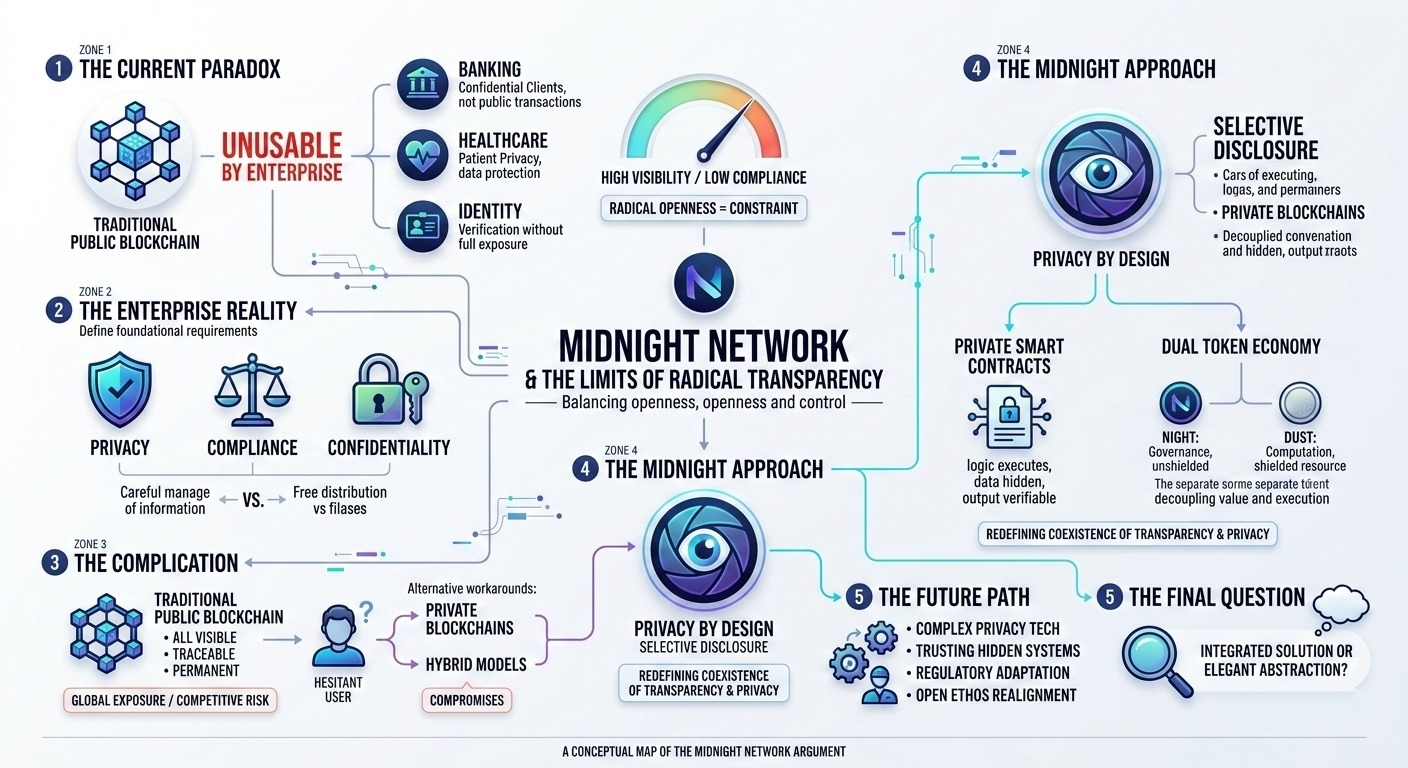
There’s a quiet tension sitting beneath the surface of enterprise blockchain adoption, and it doesn’t get enough attention. Public blockchains promise openness, verifiability, and trust without intermediaries. But for most real-world organizations, that same openness feels less like a feature and more like a constraint.
When you think about it, enterprises are not designed to operate in full view. A bank can’t expose client transactions to the public. A healthcare provider can’t broadcast patient data, no matter how secure the system claims to be. Identity systems, too, rely on proving who you are without revealing everything about you. These industries are built on a principle that’s almost the opposite of blockchain’s default: controlled information sharing.
The reality is that privacy, compliance, and confidentiality aren’t optional layers—they’re foundational requirements. Financial institutions answer to regulators. Healthcare systems are bound by strict data protection laws. Identity frameworks must balance verification with discretion. In all of these cases, information flows are carefully managed, not freely distributed.
That’s where things get complicated. Traditional public blockchains flatten all of this nuance into a single paradigm: everything is visible, everything is traceable, and everything is permanent. It works beautifully for certain use cases, especially in open financial ecosystems. But for enterprises, it introduces friction at every level.
Too much transparency can expose sensitive business operations. It can reveal patterns that competitors might exploit. It can even create new compliance risks, where data that should remain restricted becomes globally accessible. Honestly, it’s not hard to see why many organizations hesitate. The promise of decentralization starts to feel overshadowed by the risk of overexposure.
So the industry has spent years circling around the problem. Private blockchains emerged as a workaround, offering more control but sacrificing interoperability and openness. Hybrid models tried to bridge the gap, but often felt like compromises rather than solutions.
Midnight Network enters this conversation with a different framing. Instead of asking enterprises to adapt to transparency, it tries to redesign the system around privacy from the ground up. Not privacy as an afterthought, but as a core architectural principle.
At the center of this idea is selective disclosure. It’s a simple concept on the surface, but it changes everything. Rather than making all data public or all data private, the system allows specific information to be revealed only when necessary, and only to the appropriate parties. A transaction can be validated without exposing its full details. A user can prove eligibility without revealing identity.
Honestly, that feels much closer to how the real world works. You don’t hand over your entire life story to complete a single transaction. You share just enough.
This approach extends into privacy-preserving smart contracts, which operate on data that isn’t fully visible to the network. These contracts can execute logic and produce outcomes that others can verify, without exposing the underlying inputs. It shifts the trust model away from transparency and toward cryptographic assurance.
Then there’s the NIGHT token, which plays a more nuanced role than just being a medium of exchange. It’s tied to how the network handles computation and incentives, particularly in a design that separates value from execution. That separation is subtle but important. It suggests that financial transfers and computational processes don’t have to be bundled together in a fully transparent layer, which opens up new ways to think about privacy and scalability.
And here’s the part that often gets overlooked: privacy doesn’t necessarily conflict with compliance. In fact, it might enhance it. If systems can prove that rules are being followed without exposing sensitive data, regulators get what they need without introducing unnecessary risk. Compliance becomes about verification, not exposure.
Still, the path forward isn’t straightforward. Privacy technologies are complex, both technically and conceptually. Enterprises will need to trust systems they may not fully understand. Regulators will need to adapt to models that don’t rely on direct visibility. And the broader ecosystem will need to decide whether this approach aligns with the open ethos that defined blockchain in the first place.
Maybe the future isn’t about choosing between transparency and privacy, but about redefining how they coexist. That idea feels promising, but also uncertain.
And that uncertainty lingers. Can a privacy-first infrastructure like Midnight actually integrate into the messy, regulated, and often contradictory systems that define the real world—or will it remain an elegant solution searching for a problem it can fully solve?
$NIGHT @MidnightNetwork #night