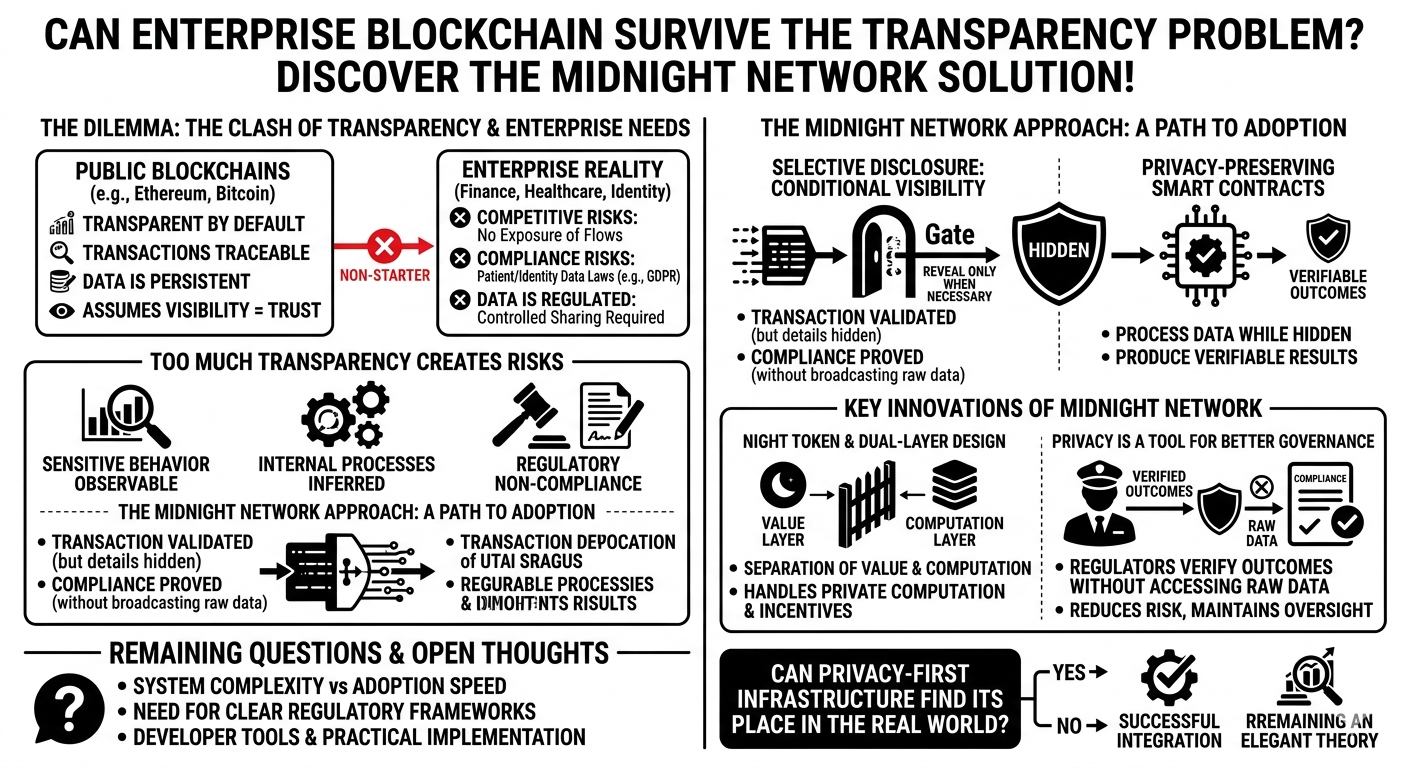
There’s a quiet dilemma sitting at the edge of enterprise blockchain adoption, and it hasn’t really been resolved. Public blockchains promise trust through transparency, but for many organizations, that same transparency feels like a non-starter.
When you think about it, enterprises don’t operate in the open. They can’t. A bank isn’t going to expose its transaction flows to competitors. A hospital won’t publish patient data, even in anonymized form. Identity systems are built on a careful balance—proving something about a person without revealing everything about them. These systems depend on privacy, not as an afterthought, but as a core requirement.
The reality is that industries like finance, healthcare, and identity management are structured around controlled information sharing. Compliance frameworks are strict. Data access is tightly regulated. Every piece of information has a defined audience and purpose. There’s a reason these systems evolved this way—it’s not just about secrecy, it’s about minimizing risk.
That’s where things get complicated. Public blockchains, in their current form, assume that visibility equals trust. Everything is transparent by default. Transactions are traceable. Data is persistent. And while that works beautifully in certain contexts, it clashes with the way enterprises actually function.
Too much transparency can create new problems. Sensitive financial behavior becomes observable. Internal processes can be inferred. Even anonymized data can sometimes be pieced together in ways that weren’t intended. And from a regulatory perspective, exposing too much information can be just as problematic as exposing too little.
So organizations hesitate. Some experiment with private blockchains, but those often feel like closed systems—useful in isolation, but lacking the broader interoperability of public networks. Others simply wait, hoping the technology matures into something that better reflects their needs.
Midnight Network enters this space with a different approach. Instead of trying to force enterprises into a transparency-first model, it rethinks the relationship between visibility and trust. It doesn’t reject transparency, but it makes it conditional.
At the center of this idea is selective disclosure. Rather than making all data public, Midnight allows specific pieces of information to be revealed only when necessary. A transaction can be validated without exposing all of its details. A system can prove compliance without broadcasting sensitive data. Honestly, it’s a subtle shift, but it changes the entire dynamic.
This idea extends into privacy-preserving smart contracts. These contracts don’t operate entirely in the open. They can process data that remains hidden, while still producing outputs that others can verify. It’s less about seeing everything and more about trusting that the system works as intended.
Then there’s the NIGHT token, which plays a more structural role than it might first appear. It’s not just a currency—it’s part of how the network handles private computation and incentives. Midnight also introduces a separation between value and computation, which feels like a quiet but important departure from traditional blockchain design. Financial transactions and computational logic don’t have to exist in the same transparent layer anymore.
And here’s where things get interesting. Privacy, often seen as a barrier to compliance, might actually support it. If regulators can verify outcomes without accessing raw data, it reduces risk while maintaining oversight. In that sense, privacy becomes a tool for better governance, not a way to avoid it.
Still, there are open questions. Privacy-focused systems are inherently complex, and complexity can slow adoption. Enterprises need clarity and reliability. Regulators need frameworks they can trust. And developers need tools that make these ideas practical, not just theoretical.
The concept is compelling, though. Maybe the issue was never transparency itself, but how rigidly it was applied. Maybe trust doesn’t require full visibility—just enough to prove that things are working correctly.
And that leaves us with an unresolved thought. Can a privacy-first infrastructure like Midnight actually integrate into the messy, regulated, and often inconsistent systems that define the real world—or will it remain an elegant idea that makes sense in theory, but struggles to find its place in practice?
$NIGHT @MidnightNetwork #night