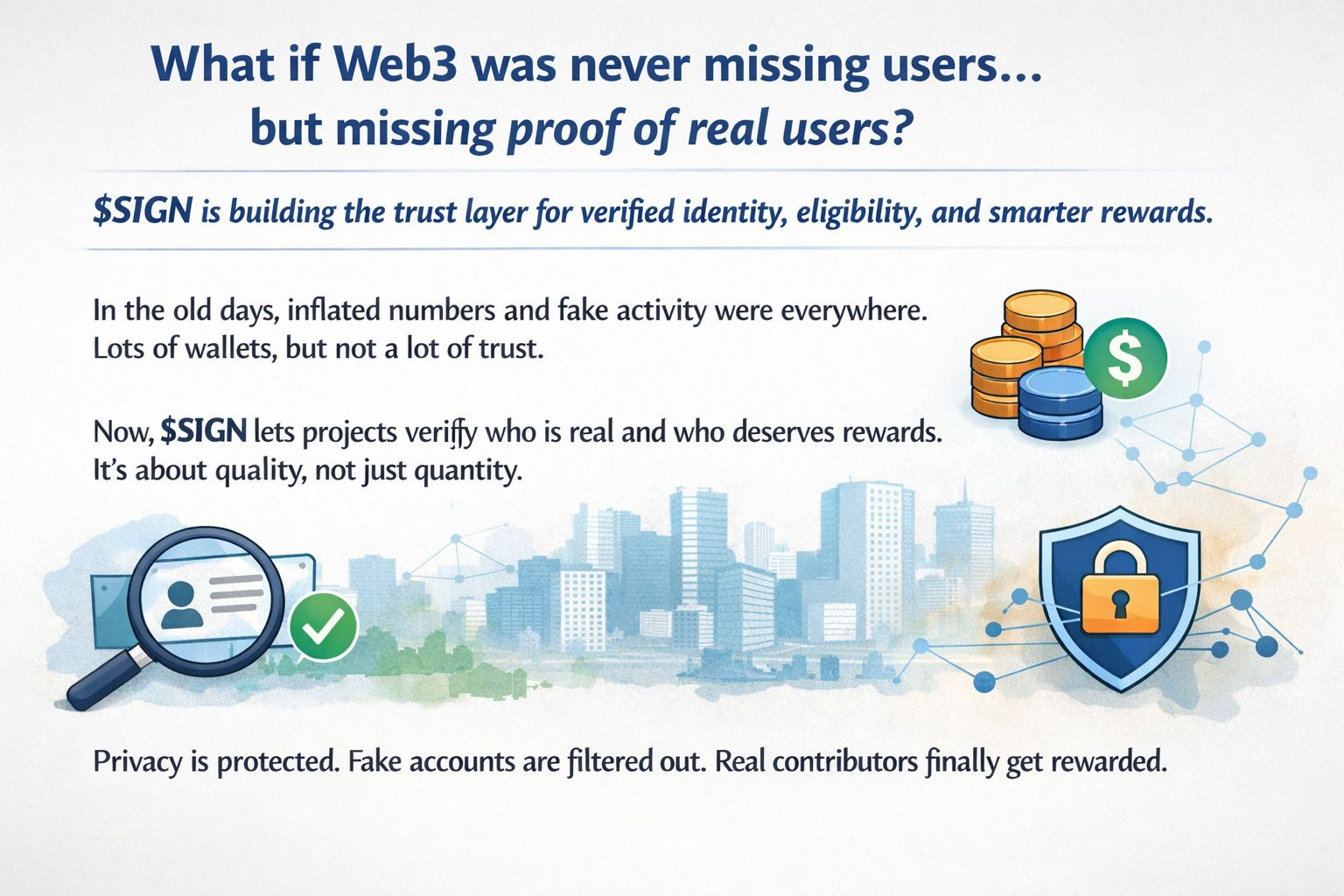
I think one of the biggest changes happening in Web3 is that projects are starting to understand that not every user is equally valuable just because they show up. In the earlier phase, a lot of systems were built around numbers. If a project had more wallets, more clicks, more tasks completed, or more people joining campaigns, it looked successful. But over time, it became clear that these numbers could be misleading. Many users were creating multiple wallets, farming rewards, and repeating the same activity just to collect tokens. This created a system where projects were spending money, but not always building real communities or real usage. That is where SIGN starts to make sense to me.
When I look at $SIGN, I see it as a trust infrastructure for Web3. It is trying to solve a very basic but important problem. In crypto, it is easy to send tokens, create wallets, and interact with apps, but it is much harder to know whether the person on the other side is real, eligible, and contributing in a meaningful way. SIGN helps fix that by creating a system where credentials, actions, and eligibility can be verified in a structured way. That means projects do not have to rely only on guesses or raw wallet activity. They can use actual proof.
What makes SIGN stronger is the way the process works. First, actions or identities are captured as credentials. Then those credentials can be checked and validated to see if they meet the right standards. After that, rewards or access can be distributed more precisely through the $SIGN ecosystem. To me, this is important because it changes token distribution from something broad and wasteful into something more targeted and efficient. Instead of giving rewards to anyone who looks active, projects can focus on people who actually qualify. This improves incentive alignment because value goes to useful participants instead of being lost to fake accounts or low-quality activity.
Another part I find important about SIGN is the privacy side. A lot of people want verification, but they do not want to expose all of their personal data. The $SIGN model is interesting because it supports privacy-preserving proof. In simple words, a person can prove something important about themselves without revealing every private detail behind it. That is a better direction for Web3 because trust should not require complete exposure.
I also think $SIGN matters for the bigger ecosystem. Verified identity by itself is not the final goal. The real value comes when that verified identity connects to actual products, user activity, and token distribution. That is where the synergy becomes more practical. Activity layers like $XAN and $BAN become more useful when $SIGN helps separate real contributors from empty traffic. In that kind of setup, identity is no longer just a label. It becomes a working part of how rewards, access, and participation are managed.
For me, the bigger reason why $SIGN infrastructure matters is simple. The next stage of Web3 growth cannot depend only on more users joining. It has to depend on better users, better proof, and better systems for distributing value. That is why the shift from quantity to quality is so important. In the long run, I do not think $SIGN will be judged by short-term excitement. Its real value will come from developer adoption, real transaction frequency, and whether people actually use $SIGN infrastructure in live ecosystems. That is what makes the thesis around $SIGN more serious and more sustainable than many of the older Web3 models.